Yesterday, I shared our journey from agent builder to agent platform—and why we bet on no-code when everyone said it couldn't be done.
Today I want to share something that matters even more: how we built it.
Because in this market, what you build matters less than how you build it. Products that can't evolve become liabilities. Architectures that require rewrites become graveyards.
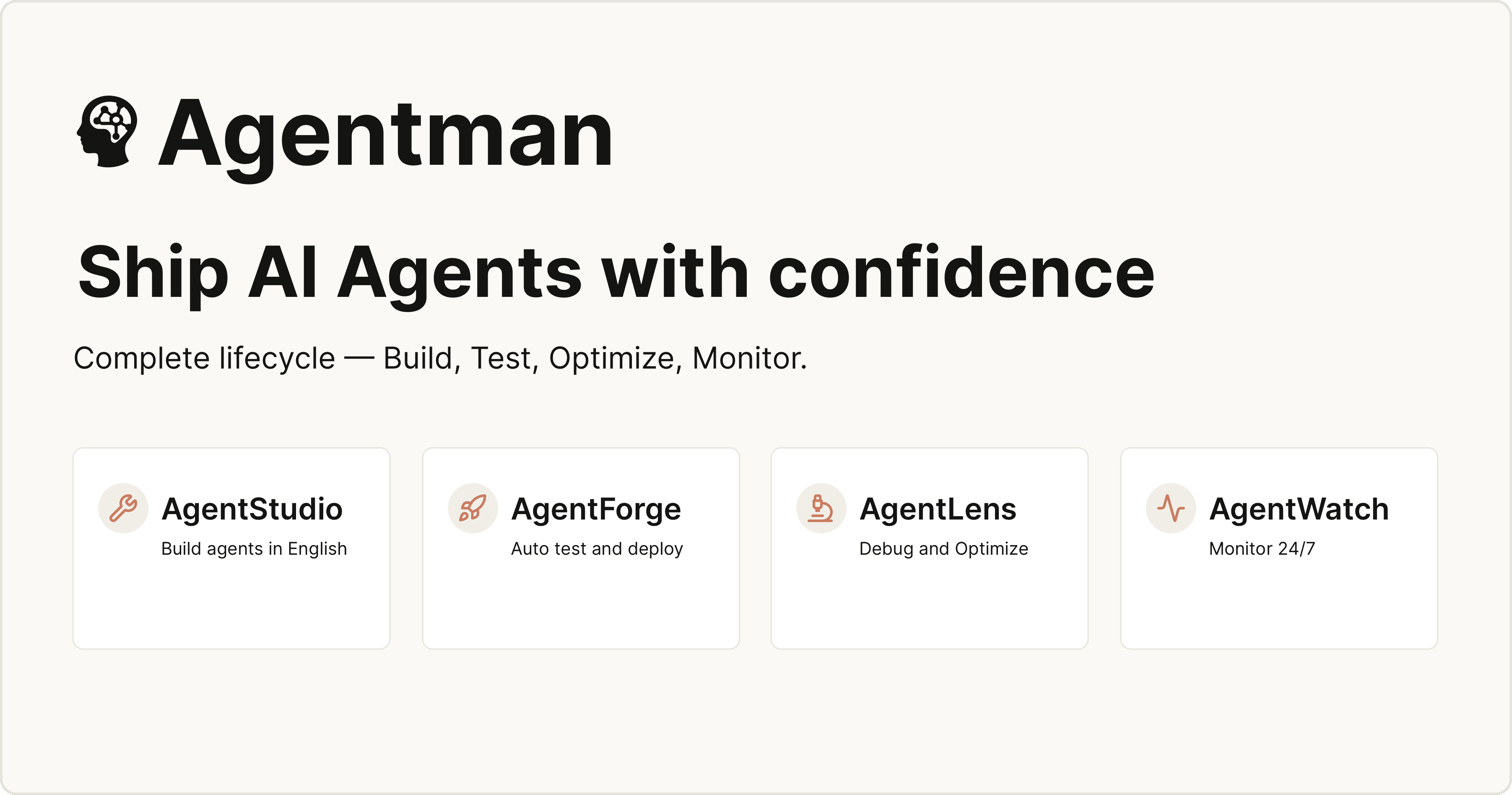
We've shipped three products—AgentStudio (now Agent Builder), AgentForge (now Agent Testing), and AgentLens (now Agent Insights)—on the same underlying architecture. No rewrites. No rearchitects. Just continuous evolution.
The Last 12 Months Were Chaos
Let's be honest about what just happened in agentic AI:
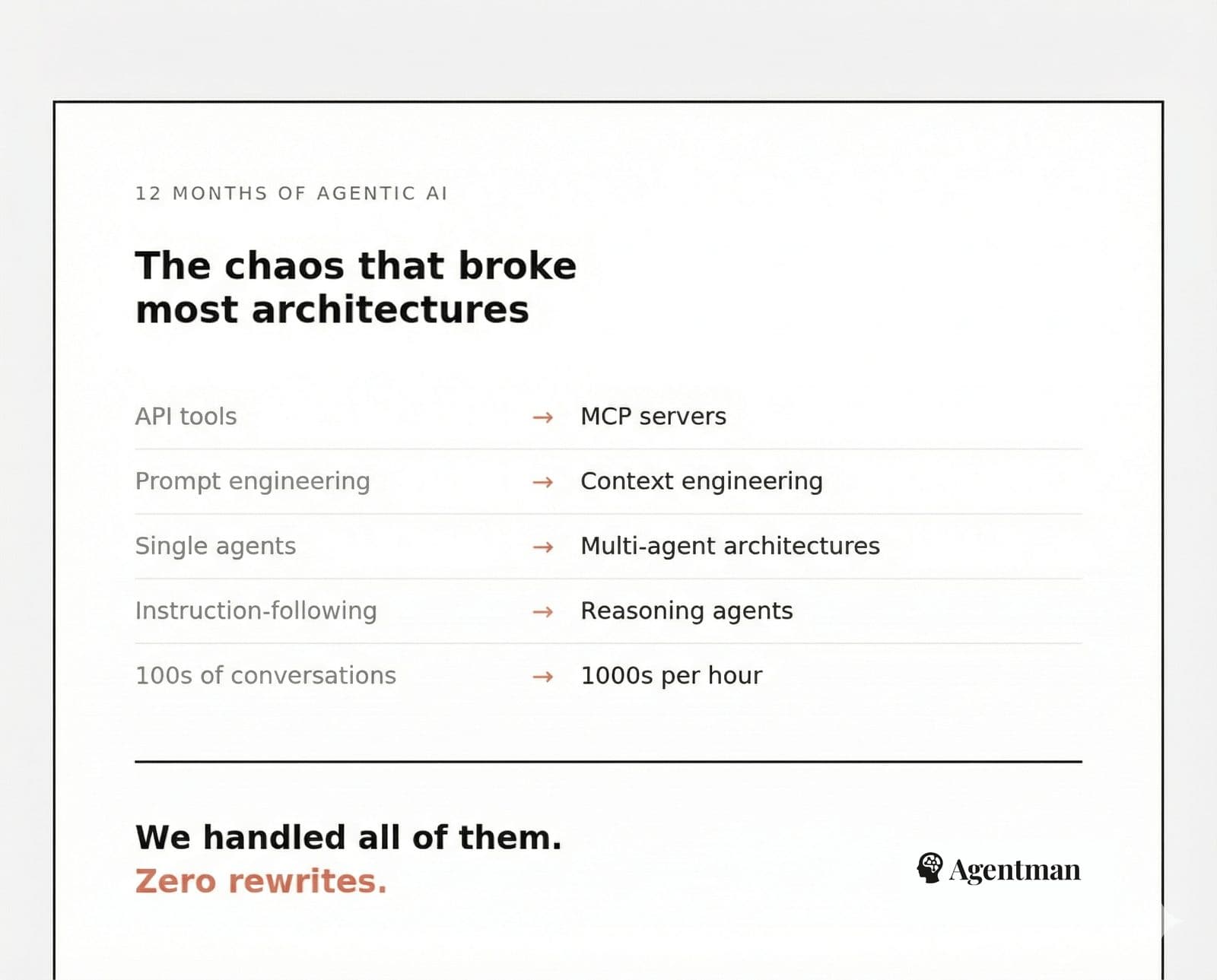
The underlying technology transformed completely:
→
API tools → MCP servers
Simple function calls became full workflow orchestration
→
Prompt engineering → Context engineering
Writing good prompts became managing context windows, caching, and retrieval
→
Single agents → Multi-agent architectures
One agent doing everything became specialized agents coordinating at scale
→
Instruction-following → Reasoning agents
"Do exactly this" became "figure out how to achieve this goal"
→
100s of conversations → 100s of 1000s per hour
Demo scale became production scale—with observability requirements to match
Any one of these shifts would break most architectures.
We handled all of them. Without rewrites.
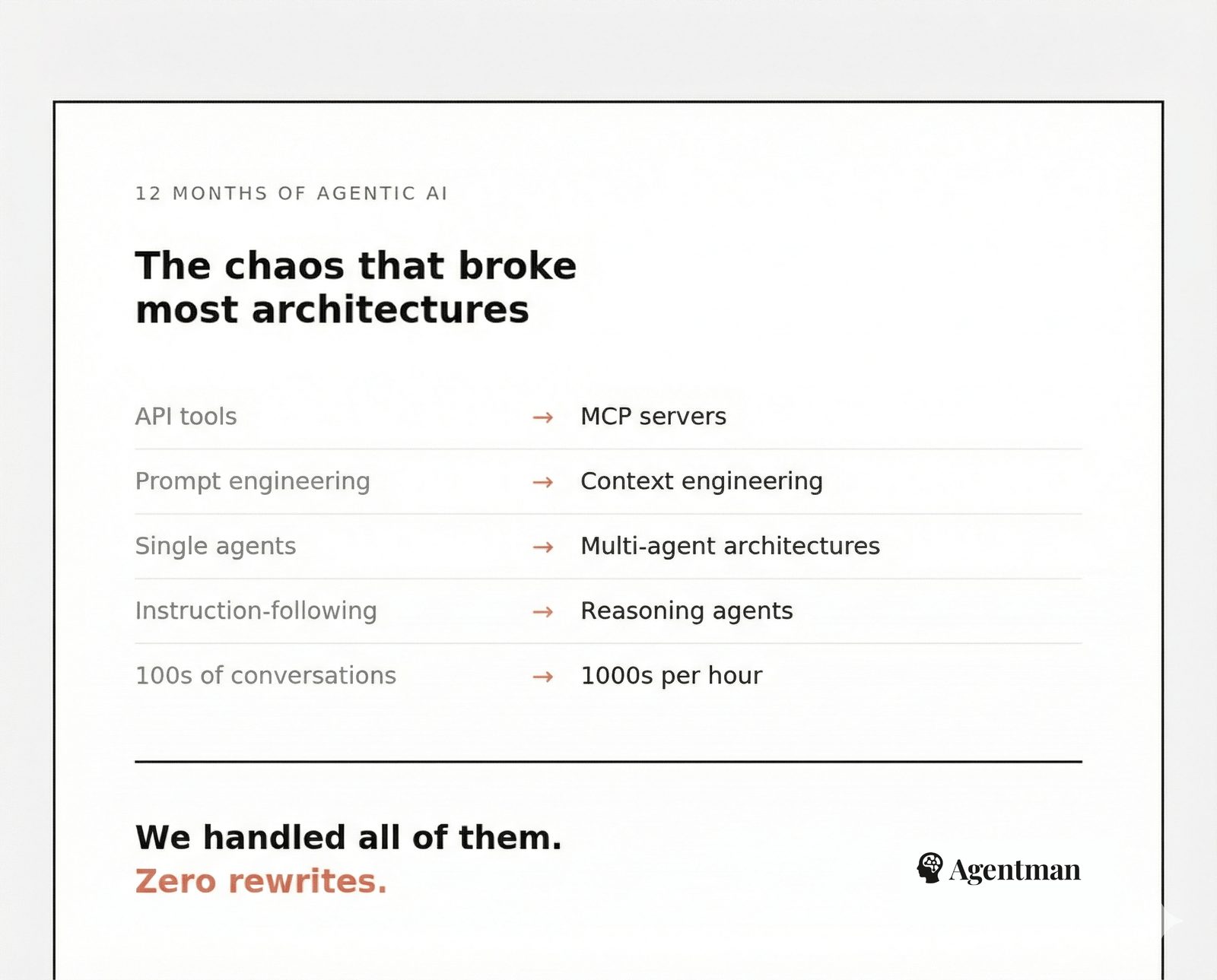 The chaos that broke most architectures. We handled all of it. Zero rewrites.
The Lesson From 40 Years of Building
Our team of three engineers have collectively spent 40 years building products at the bleeding edge of technology. We've seen cycles come and go. We've watched companies win and lose.
The pattern is always the same: Companies that architect for today's requirements hit walls when the market evolves. Then they face a choice: painful rewrite or slow death.
So when we started Agentman, we made a deliberate choice: architect for where the market is going, not where it is today.
Two years ago, we anticipated:
- Agent builders would become agent platforms
- Single-model would become multi-model
- Proprietary integrations would become open standards (MCP)
- Simple agents would become multi-agent systems
- Solo building would become team collaboration
- Embedded logic would become extracted, reusable intelligence
Three Shifts We Saw Coming
Shift 1: From Solo to Collaborative
Agent building used to be an individual sport. One person, one agent, one prompt file. Not anymore.
Production agents require product managers, developers, subject matter experts, QA, and stakeholders all working together.
Agent building became a team sport. We built multi-user workspaces from day one. Most platforms are still single-user. They'll need to rebuild.
Shift 2: From Embedded to Extracted Intelligence
Teams would encode business intelligence directly into agent prompts. Policies. Procedures. Domain expertise. All mixed together.
It worked—until it didn't. Updating one policy meant touching the whole agent. Reusing knowledge was copy-paste. Version control was a nightmare.
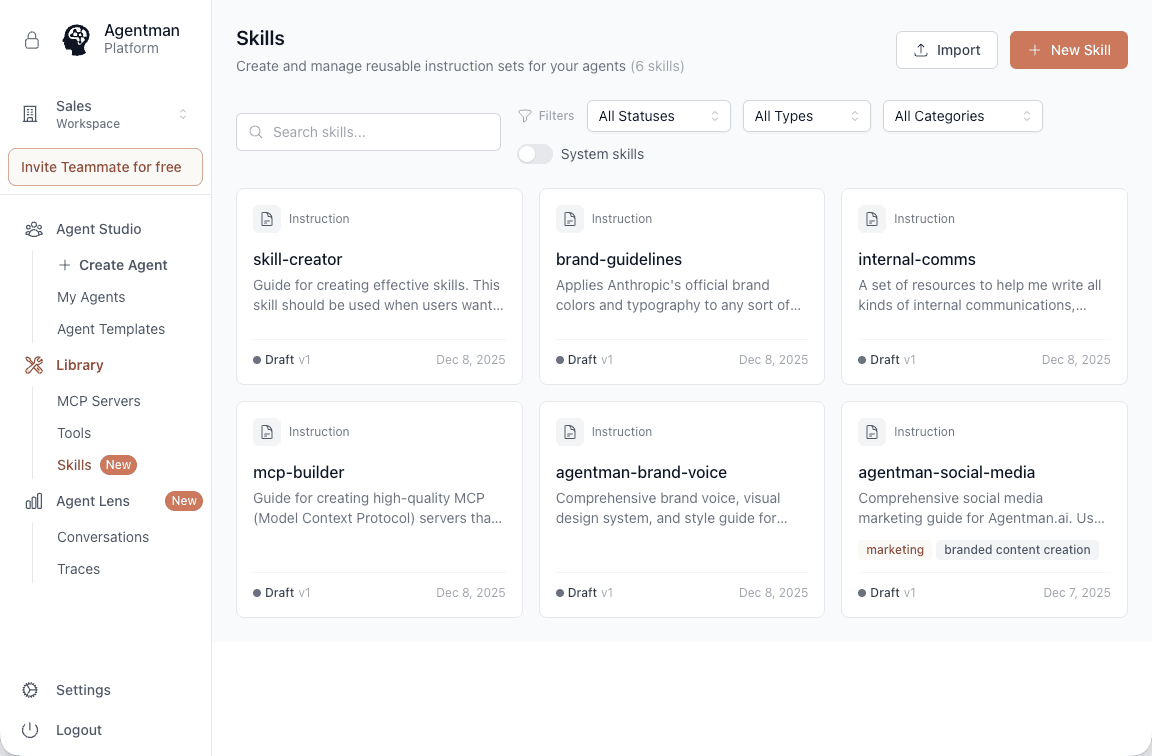
The solution: Agent Skills—reusable packages of business intelligence that agents can access. SOPs become structured assets. Domain expertise gets captured once, used everywhere.
This is where the industry is headed. We're already there.
Shift 3: From Build-Only to Full Lifecycle
Scaling from demos to production—from 100s to 1000s of conversations per hour—requires Testing at scale (AgentForge), Observability (AgentLens), and Monitoring (AgentWatch, coming 2026). Our architecture supports the full lifecycle because we designed it that way.
Agents All the Way Down
Here's something we don't talk about enough:
Agentman runs on Agentman.
This isn't just dogfooding. It's proof that the platform works at production scale—because we bet our own product on it.
Doogent (our agent building assistant)
When you ask for help generating agents, revising prompts, or creating tools—you're talking to an Agentman agent.
AgentForge's testing engine
Test generation, execution, and evaluation—all Agentman agents.
AgentLens auto-evaluations (coming soon)
Sentiment analysis, completeness scoring, brand consistency—powered by Agentman agents.
Every platform claims to be production-ready. We prove it by running our core product capabilities on it.
Agents making agent-building easier. That's the future we're building.
One Architecture, Three Products
AgentStudio
AgentForge
AgentLens
All three products share the same Agent OS underneath. When we improve the core, all products benefit. When we add capabilities—MCP support, Skills, multi-agent orchestration—they're available everywhere.
What We Built Into the Foundation
Model Neutrality From Day One
We're the Switzerland of agent platforms. While Google wants you on Gemini, Microsoft wants you on Azure OpenAI, Amazon wants you on Bedrock—we want you to use whatever works best.
- OpenAI: From GPT-4 to GPT-5.1
- Anthropic: Claude Haiku, Sonnet and Opus 3.5 to 4.5
- Google: Gemini Pro, Flash, and Flash Lite 1.5 to 3.0
Switch models with a dropdown. No code changes. No vendor lock-in.
Standards-Based Integration
When Anthropic launched MCP, we were ready in days—not months. When observability became essential, we shipped AgentLens in 2 weeks. Standards adoption is how you survive rapid evolution.
Multi-Tenant, Multi-User From the Start
Most startups build single-user MVPs, then rewrite for teams at Series B. We built for collaboration from day one: complete data isolation, workspace management, multi-user access, role-based permissions. Agent building is now a team sport.
The Numbers
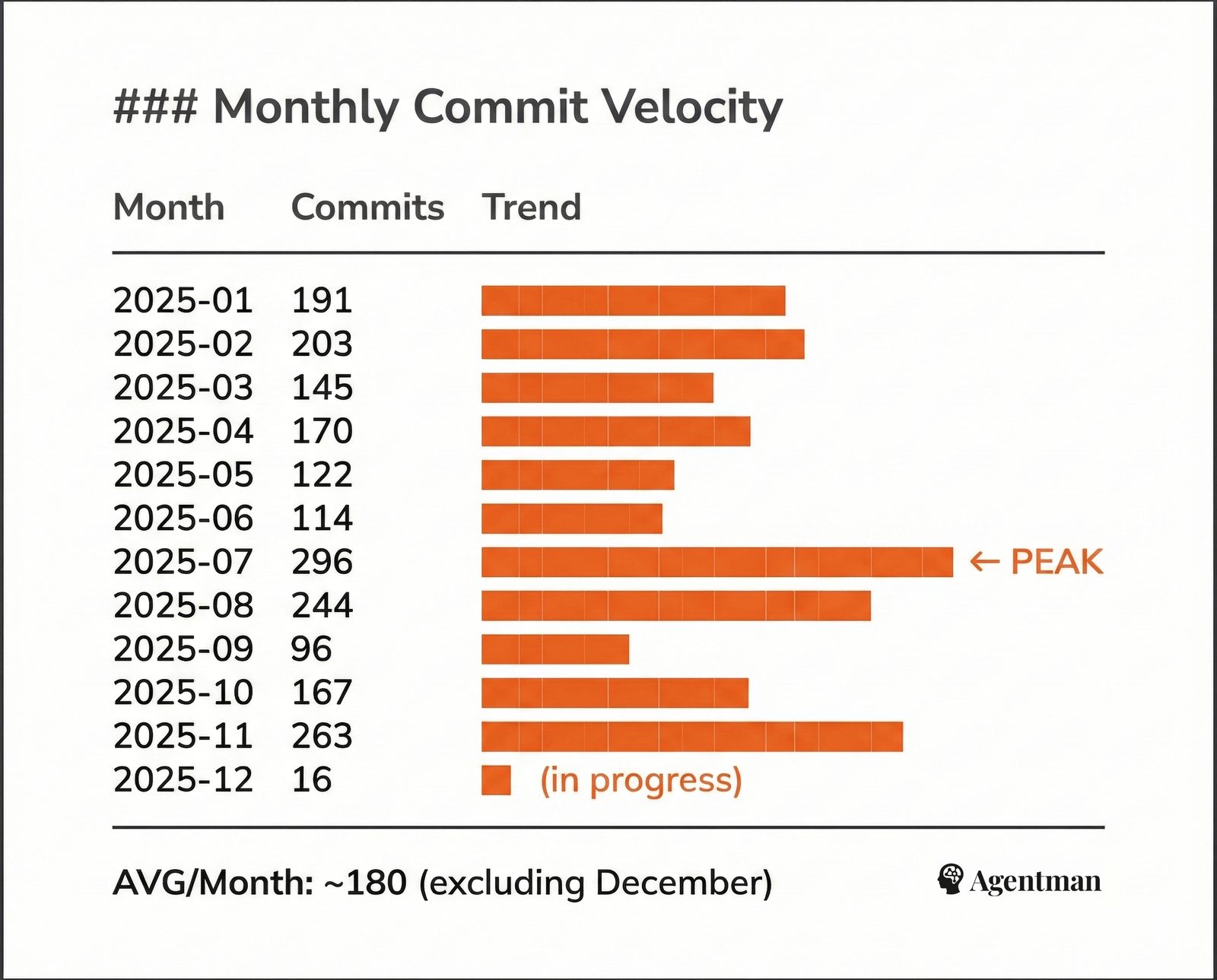 600,000+ lines of code. 4000+ commits. Averaging 180 commits per month.
But here's the number that matters more: feature velocity increased as the codebase grew. That only happens when architecture is right.
Coming Tomorrow: The Independence Advantage
Tomorrow, I'll share why being independent matters—and why the "Switzerland of agent platforms" positioning is a strategic advantage, not just a tagline. When Google, Microsoft, Amazon, and Salesforce all want to own the agent layer, there's value in being the neutral choice.
Try It Yourself
The best way to understand the architecture is to use it. Build an agent in AgentStudio, test it in AgentForge, observe it in AgentLens. See how it all connects.