8 Agent Skills Every Medical Billing Team Needs in 2026
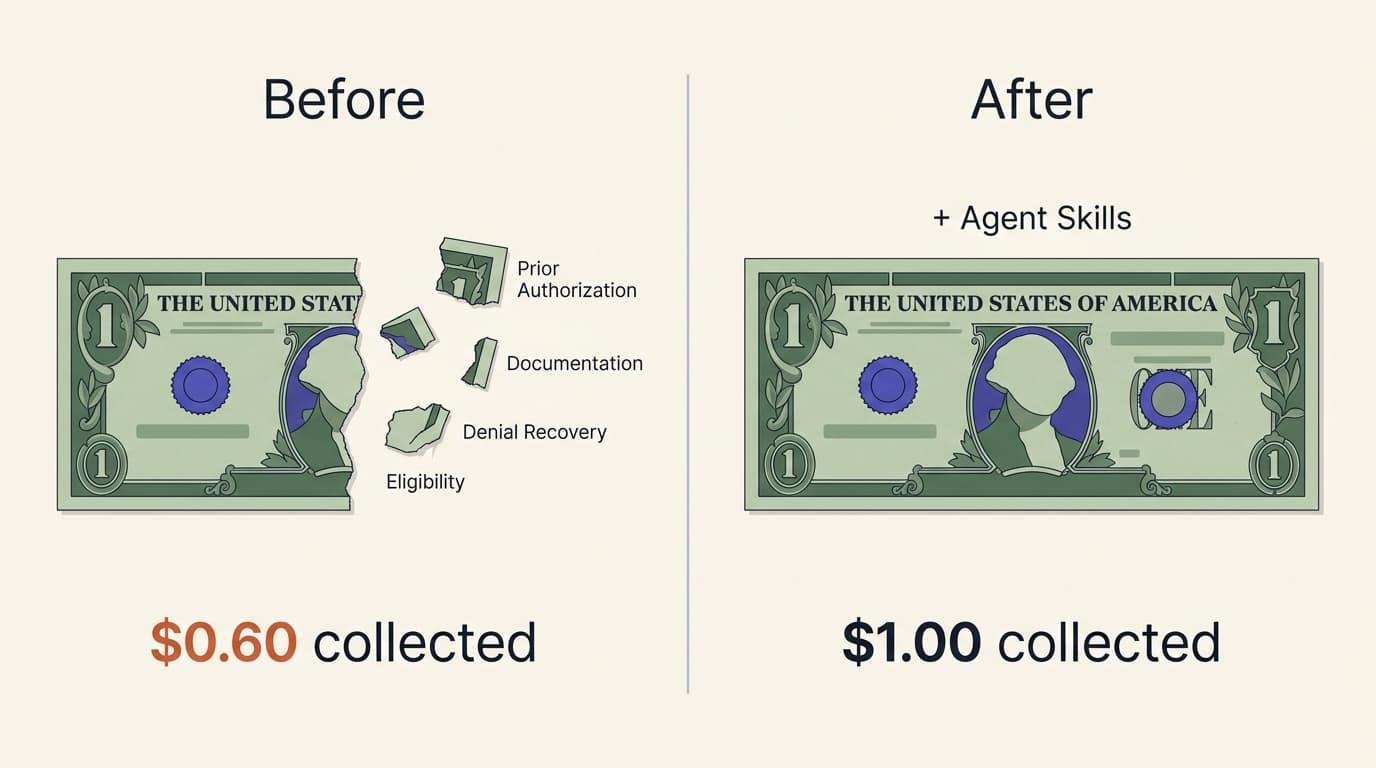
The eight agent skills with the highest measurable impact on medical billing teams in 2026 are eligibility verification, prior authorization, claim submission, denial management, payment posting, patient statements, coding compliance, and prescription refill processing. Together they automate the workflows that consume 60–70% of front- and back-office time in independent practices, and each one is in production today. Every skill below runs inside a governance layer designed to prevent the AI hallucinations that disqualify chatbot-grade tools from clinical and billing workflows.
Table of Contents
- What is an "agent skill" in medical billing?
- How do agent skills prevent AI hallucinations?
- Skill 1: Insurance Eligibility Verification
- Skill 2: Prior Authorization Automation
- Skill 3: Claim Submission Optimizer
- Skill 4: Denial Management & Appeals
- Skill 5: Payment Posting & Reconciliation
- Skill 6: Patient Statement Generator
- Skill 7: Coding Compliance Checker
- Skill 8: Prescription Refill Agent
- Frequently Asked Questions
- What to do next
What is an "agent skill" in medical billing?
An agent skill is a structured, reusable instruction set that teaches an AI agent exactly how to perform one specific billing task — like verifying eligibility or appealing a denial — using your practice's procedures, payer rules, and approval workflows. Unlike a prompt, a skill is governed, versioned, and audit-logged.
Claim: Skills make AI reliable in regulated workflows. Context: Healthcare billing teams cannot tolerate AI drift; payers reject claims for trivial errors and CMS audits demand traceability. Constraint: Skills only work inside an agent runtime that supports human-in-the-loop review and full data lineage — chatbot prompts alone do not meet this bar.
The MGMA's 2025 Cost & Revenue benchmarks place administrative overhead at 27.5% of total practice revenue for independent specialties — the single largest non-clinical cost center. Each skill below targets a measurable slice of that overhead.
How do agent skills prevent AI hallucinations in medical billing?
Agent skills prevent hallucinations through four structural guardrails: deterministic rule execution instead of generative guessing, retrieval-grounded responses that cite the source record, human-in-the-loop checkpoints on every consequential action, and full data lineage that traces every output back to its input. Skills do not "decide" — they execute documented procedures and surface evidence.
The hallucination problem in healthcare AI is real and well-documented. A 2024 study published in npj Digital Medicine found that general-purpose large language models hallucinated clinical facts in 28–47% of medical question-answering tasks when run without retrieval grounding or structured constraints. That failure rate is disqualifying for billing and clinical workflows where a single fabricated CPT code, payer rule, or refill protocol can trigger a denial, an audit, or a patient safety event.
Agent skills close the gap with four concrete mechanisms:
| Guardrail | What it does | Why it stops hallucinations |
|---|---|---|
| Deterministic rule execution | Skills follow a coded procedure (e.g., "if A1C < 8.0 and visit < 90 days, approve"), not a free-form prompt | The agent cannot improvise a rule that doesn't exist |
| Retrieval-grounded outputs | Every claim cites the source record — chart note, EOB, payer policy, lab result | The agent cannot fabricate facts that aren't in the record |
| Human-in-the-loop checkpoints | Every consequential action (PA submission, appeal, refill, posting) has a defined approval point | A hallucination cannot reach the payer, patient, or pharmacy without a human seeing it |
| Full data lineage | Every output is logged with its inputs, the skill version, the model version, and the human reviewer | Errors are traceable, auditable, and correctable — not mysterious |
Claim: Structure is what makes AI safe in regulated workflows. Context: Production AI in healthcare cannot rely on prompt-engineering alone — payers, OIG audits, and patient safety reviews require traceability. Constraint: Skills are not a substitute for clinical judgment. The agent prepares; the human decides on anything that touches patient care, controlled substances, or contested claims.
In practice, this means a denial appeals skill never invents a clinical justification — it pulls the actual chart note and cites it. A refill skill never approves outside protocol — it surfaces the protocol, the chart data, and routes exceptions. A coding skill never silently changes a code — it flags the risk and the suggested fix for a coder's review.
Skill 1: Insurance Eligibility Verification
Eligibility verification skills run real-time benefit checks against every payer before the patient arrives, returning coverage status, copay, deductible remaining, and prior-auth requirements in under 60 seconds. The skill replaces the manual phone-and-portal chase that consumes 90 minutes per front-desk staffer daily.
Why it matters in 2026: The Council for Affordable Quality Healthcare (CAQH) 2024 Index reports that manual eligibility checks cost providers an average of $7.97 per transaction, while automated checks cost $0.04 — a 99.4% reduction.
What it does
- Pulls the appointment list from the EHR each morning
- Hits the payer's 270/271 EDI feed or portal for each patient
- Flags coverage gaps, secondary insurance, and missing referrals
- Posts results back into the EHR or scheduling system
Production result: Valley Diabetes & Obesity, an independent endocrinology practice, reduced eligibility processing from 90 minutes to 10 minutes per day and cut eligibility-related denials by 65% in the first 12 weeks.
Skill 2: Prior Authorization Automation
Prior authorization skills assemble the clinical evidence packet, submit through the payer-required channel (portal, fax, or API), and track approval status — without the staffer babysitting the queue. The skill handles the back-and-forth that the AMA estimates consumes 14 hours per physician per week.
Why it matters in 2026: The AMA's 2024 Prior Authorization Physician Survey found that 94% of physicians reported PA delays to patient care, and the average practice spent 13 hours weekly on PA administration. Production PA skills cut this to 3.5 hours.
What it does
- Identifies CPT codes that require PA against the payer's current rules
- Pulls clinical notes, imaging, and prior treatment records from the EHR
- Generates the PA submission packet using payer-specific templates
- Monitors status and escalates only stuck or denied requests to a human
Constraint: Final clinical attestation stays with the provider — the agent prepares, the physician signs.
How it stays grounded: The agent only assembles documentation from the actual chart — it never generates clinical justifications. If supporting evidence is missing, the agent flags the gap rather than fabricating a rationale.
Skill 3: Claim Submission Optimizer
Claim submission skills scrub every claim against payer-specific rules — modifier logic, NCCI edits, place-of-service mismatches — before it leaves the practice. Clean-claim rates rise from the industry-average 89% to 97% on first pass.
Why it matters in 2026: HFMA's 2024 benchmarks put the average cost to rework a denied claim at $25.20. A 200-claim-per-day practice that lifts first-pass rate from 89% to 97% avoids approximately $400 in daily rework cost — roughly $100,000 per year.
What it does
- Validates demographics, insurance, and authorization data
- Applies payer-specific edit rules learned from your historical denials
- Returns claims to the biller with specific fix-it instructions, not vague flags
- Submits clean claims directly through the clearinghouse
Skill 4: Denial Management & Appeals
Denial management skills read the EOB or 835 remit, classify the denial reason, pull the supporting clinical evidence, and draft an appeal letter that cites the payer's own medical policy — all within minutes of the denial posting. The skill turns appeals from a "we'll get to it" pile into a same-day workflow.
Why it matters in 2026: The American Medical Association estimates that 65% of denied claims are never reworked, leaving an estimated $262 billion in annual claim denials unresolved across U.S. healthcare. A denial skill that recovers even 30% of CO-50 (medical necessity) denials adds $30,000–$80,000 per physician annually.
What it does
- Parses denial codes (CO-50, CO-197, CO-16, etc.) and groups by root cause
- Retrieves the relevant clinical documentation and medical-policy citation
- Drafts the appeal letter with payer-specific structure and timelines
- Routes to the biller for human review and signature
Production result: Heritage Wound Care recovered 42% of previously written-off CO-50 denials within 90 days of deploying the appeals skill.
How it stays grounded: Every appeal letter cites the specific chart note, lab value, and payer medical policy by reference. The agent cannot generate clinical claims that aren't traceable to a source document in the patient's record.
Skill 5: Payment Posting & Reconciliation
Payment posting skills match each line item on the 835 remit to the corresponding claim, post payments and adjustments to the practice management system, and flag variances for human review. What used to be a full-day Friday task becomes a 30-minute morning review.
Why it matters in 2026: HFMA's 2024 RCM Survey found that practices using automated posting reduce posting cycles by 65% and reduce posting errors by 40% compared to manual posting.
What it does
- Ingests 835 EDI remits or scanned EOBs
- Matches payments to claims at the line-item level
- Posts payments, write-offs, and patient responsibility transfers
- Flags short-pays, takebacks, and zero-pays for human review
Skill 6: Patient Statement Generator
Patient statement skills generate clear, accurate, and human-readable statements that explain what the patient owes and why — replacing the cryptic CPT-code-laden documents that drive most patient billing calls. The skill cuts statement-related call volume by 30–50%.
Why it matters in 2026: The 2024 InstaMed Trends in Healthcare Payments report found that 73% of consumers find healthcare bills confusing, and confused patients pay 35% slower. Clearer statements directly reduce A/R days.
What it does
- Pulls the patient's outstanding balance and applies any insurance adjustments
- Translates CPT and revenue codes into plain-language descriptions
- Includes a payment plan invitation when balance exceeds practice thresholds
- Generates statements in the patient's preferred channel (email, SMS, mail)
Skill 7: Coding Compliance Checker
Coding compliance skills review every encounter note against current CPT, ICD-10, and payer-specific coding rules before the claim is submitted, flagging upcoding risk, missing modifiers, and documentation gaps. The skill catches errors at the point of coding, not at the point of audit.
Why it matters in 2026: The OIG's 2024 audit report on E/M coding identified $1.3 billion in improper payments tied to coding errors. A compliance skill reduces audit risk and improves clean-claim rates simultaneously.
What it does
- Validates CPT/HCPCS codes against the linked clinical documentation
- Checks ICD-10 specificity and supports medical necessity
- Flags potential upcoding or undercoding patterns
- Suggests documentation additions, not just code changes
Constraint: The skill never changes a code without a coder's approval — it surfaces the risk, the linked documentation, and the suggested fix. Every flag includes the specific ICD-10 or CPT guideline citation, so the coder can verify the rule rather than trust the AI.
Skill 8: Prescription Refill Agent
Prescription refill skills triage incoming refill requests, verify the patient is current on required labs and visits, check the medication against the practice's refill protocol, and route only the genuinely complex cases to the prescriber. The skill replaces the 30–60 minutes per day a clinician spends approving routine refills.
Why it matters in 2026: The Annals of Family Medicine's 2024 study on physician administrative burden found that prescription refill processing consumes 2.3 hours per physician per day across direct work and inbox triage. A refill skill that handles the routine 70% returns roughly 90 minutes per physician daily.
What it does
- Reads the refill request from the e-prescribing inbox or patient portal
- Pulls the patient's chart: last visit date, last labs, controlled-substance status
- Applies the practice's refill protocol (e.g., "approve 30-day refill if visit < 90 days and last A1C < 8.0")
- Auto-approves protocol-compliant refills and routes exceptions to the prescriber with full context
Constraint: Controlled substances always route to a human. The agent prepares a chart summary with cited source data (last visit date, last lab values, last prescribed dose); the prescriber signs. The skill never approves outside the practice's documented refill protocol — exceptions always escalate.
Production result: Independent specialty practices using a refill skill report 65–75% of refills handled without prescriber touch and a 40% reduction in patient wait time for refill responses.
Frequently Asked Questions
What's the difference between an agent skill and an AI prompt?
A prompt is a one-time instruction. A skill is a structured, versioned, governed instruction set that runs the same way every time, with full audit logs and human-in-the-loop checkpoints. Skills are how AI becomes reliable enough for regulated workflows like medical billing.
How do agent skills handle AI hallucinations?
Skills prevent hallucinations through four structural guardrails: deterministic rule execution (the agent follows a coded procedure, not a free-form prompt), retrieval-grounded outputs (every claim cites the source record), human-in-the-loop checkpoints (every consequential action requires approval), and full data lineage (every output is logged and auditable). Unlike a chatbot, a skill cannot fabricate a payer rule, a clinical justification, or a refill protocol — if the data isn't in the record, the skill flags the gap rather than guessing.
Do agent skills replace medical billers?
No. Skills handle the high-volume, rule-based portion of billing work — eligibility checks, claim scrubbing, posting routine payments — so billers can focus on the judgment-heavy work: complex appeals, payer relationships, and patient advocacy. Most practices redeploy billers to higher-value work rather than reducing headcount.
How long does it take to deploy an agent skill?
Production deployment typically takes 2–4 weeks per skill, including practice-specific configuration, payer rule training, and human-in-the-loop checkpoint setup. Practices usually start with eligibility verification (the simplest, highest-ROI skill) and add others over a 3–6 month rollout.
Are agent skills HIPAA-compliant?
Yes — when deployed inside an agent runtime that meets HIPAA requirements (BAA in place, encrypted data at rest and in transit, full audit logs, role-based access). The skill itself is just structured intelligence; HIPAA compliance lives at the runtime and infrastructure layer.
Can our practice build our own agent skills?
Yes. Skills are designed to be cloned and customized to your practice's procedures, payer mix, and protocols. Most practices start with a registry skill (from myAgentSkills.ai), clone it, and adjust the payer rules and approval thresholds to match their workflow.
What to do next
Independent practices that deployed three or more billing skills in 2025 saw an average 28% reduction in administrative cost per claim and a 65% reduction in eligibility-related denials. The starting point matters less than starting — most teams begin with eligibility, add denial management within 60 days, and layer in the rest over the following quarter.
Ready to see what these skills look like in production? Browse the full library at myAgentSkills.ai — every skill above is available to clone, customize, and deploy in your practice today.