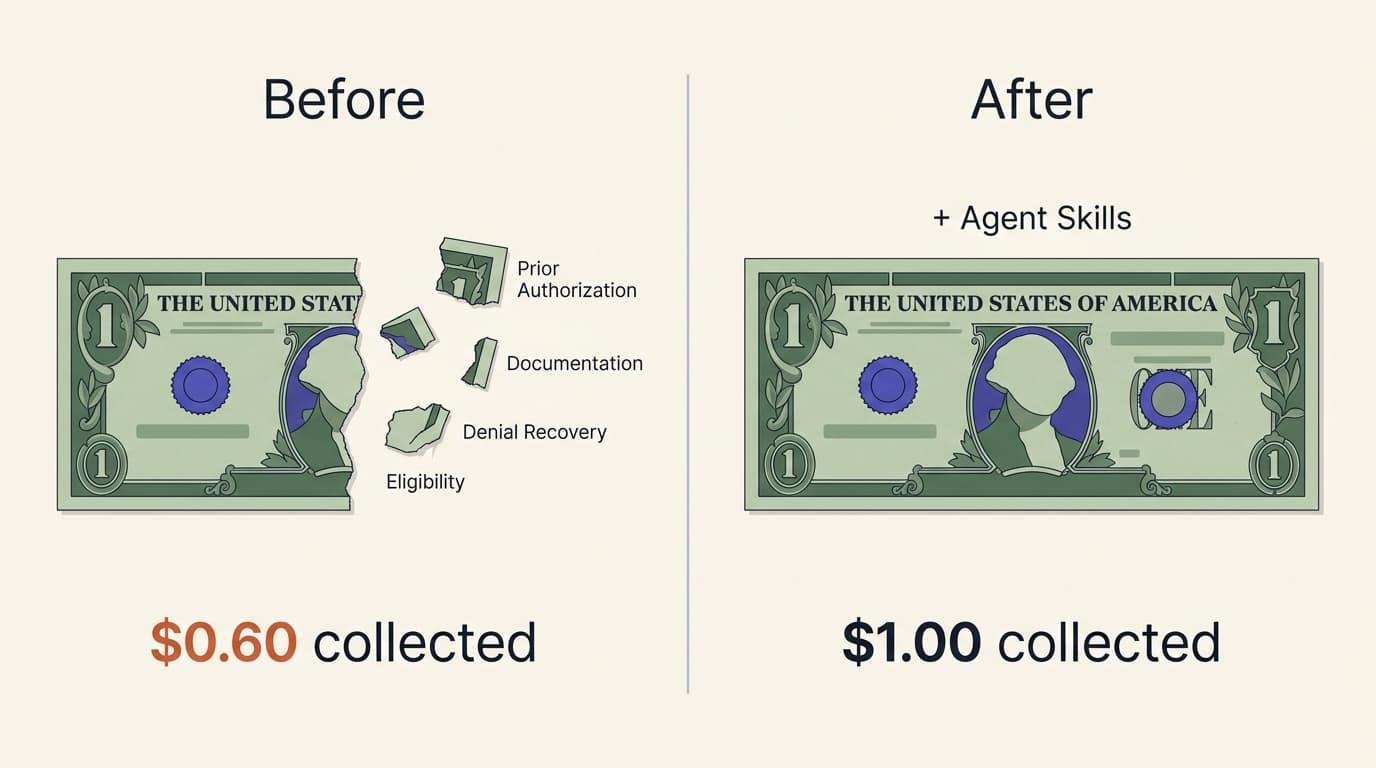
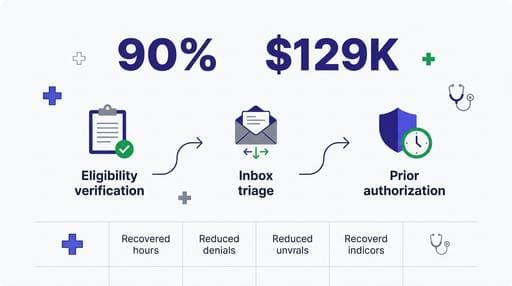
Valley Diabetes & Obesity (VDO), a specialty practice in Central California, deployed Agentman's healthcare agent skills and achieved 90% automation of eligibility and inbox workflows, reduced denials by 65%, and projected $107K–$149K in annual savings per physician — all within 12 weeks of going live.
Quick Results
| Metric | Before Agentman | After Agentman | Improvement |
|---|---|---|---|
| Eligibility verification automation | Manual, 12+ portal logins daily | Agent handles end-to-end | 90% fully automated |
| Staff time on routine tasks | 8+ hours per person per week | Redirected to patient care | 8+ hours recovered weekly |
| Eligibility and prior auth denials | Baseline denial rate | 65% fewer denials | 65% reduction |
| Annual financial impact per physician | N/A | $107K–$149K in savings | Denial prevention + capacity gains |
| Inbox processing time | ~2 hours each morning | ~20 minutes of review | 83% time reduction |
What Back-Office Challenge Did Valley Diabetes Face?
VDO's front-desk and billing teams spent hours each week on eligibility verification alone — logging into 10–15 payer portals across Medicare, Medicaid, commercial, and IPA contracts before a single patient was seen. MGMA's 2024 survey found that small medical practices spend an average of 12–15 hours per week on manual eligibility verification, and VDO was no exception.
The time cost was only the visible problem. The downstream financial impact was worse. When eligibility checks were incomplete — or when a plan change was missed during Q1 enrollment season — the practice discovered the issue only after a denial arrived weeks later. Each denial required manual investigation, rework, and resubmission, pulling staff away from patients and revenue-generating tasks.
The American Medical Association's 2024 Prior Authorization Survey found that 94% of physicians report care delays associated with prior authorization requirements. For a small specialty practice without dedicated IT staff, every manual bottleneck compounds. VDO was not failing — but it was spending enormous energy just to stay level.
What Deployment Approach Did VDO Take?
VDO began working with Agentman in July 2025 and deployed the first agent skill in November 2025. The approach was deliberately phased — one workflow at a time, each skill earning trust before the next was introduced. This mirrors the pattern recommended by KLAS Research (2024), which found that phased AI implementations achieve 2.3× higher staff adoption rates than big-bang rollouts.
Phase 1: Eligibility Verification (November 2025)
The eligibility agent runs automated checks across all active payers each morning, surfacing coverage issues before the patient walks in. No portal logins. No manual queues. Staff review exceptions only — the agent handles the routine.
Phase 2: Inbox Triage (January 2026)
The inbox triage agent classifies, routes, prioritizes, and prepares responses for incoming clinical and administrative messages. What previously consumed two hours of staff time each morning now takes twenty minutes of review. The inbox is processed automatically and prioritized per practice-defined rules.
Phase 3: Prior Authorization (In Progress)
VDO is deploying a prior authorization agent targeting the highest-friction single task in primary care and diabetes specialty billing. Given that the AMA reports physicians and their staff spend an average of 14 hours per week on prior authorization tasks, this phase is expected to deliver substantial additional capacity gains.
What Results Did VDO Achieve in 12 Weeks?
VDO's deployment produced measurable results across four dimensions in its first 12 weeks. These are production numbers from a live practice — not a pilot, not a simulation.
Automation rate: 90% of eligibility verifications and inbox tasks are now handled end-to-end by agent skills, with human review for exceptions only.
Staff time recovered: 8+ hours per staff member per week — time reinvested in patient engagement and higher-complexity billing tasks. The Council for Affordable Quality Healthcare (CAQH) estimates that the U.S. healthcare industry could save $42 billion annually by fully automating eligibility verification and claims-related transactions (2024 CAQH Index).
Denial reduction: 65% fewer eligibility and prior-authorization-related denials. The direct result: complete, timely checks before appointments rather than reactive discovery on the Explanation of Benefits.
Financial impact: $107,000–$149,000 in projected annual savings per physician, driven by denial prevention, increased appointment capacity, reduced write-offs, and recaptured staff time.
"We used to start every morning logging into twelve different payer portals across Medicare, Medicaid, Commercial and IPA portals. Now the agent has already run the checks before we arrive. We're catching issues before the patient walks in instead of finding out about them on the EOB."
What Made the Deployment Succeed?
Three design principles drove VDO's successful deployment. These are transferable to any small practice evaluating AI for revenue cycle management.
Why did starting narrow matter?
The decision to begin with eligibility — one workflow, one agent — meant the team saw real results within days. That early proof built organizational confidence to expand. Practices that attempt to automate the entire revenue cycle at once face change management resistance; practices that prove value on one workflow first build momentum.
How does human-in-the-loop design affect adoption?
Agentman's agent skills are built around review, not replacement. Staff are not watching over AI — they are working alongside it. The agent handles volume; the human handles judgment. This distinction drives staff buy-in. McKinsey's 2024 healthcare AI adoption report found that human-in-the-loop implementations achieve 78% frontline adoption compared to 34% for fully autonomous systems.
What is the compound effect of sequential agent deployment?
The jump from one agent skill to two did not just double the impact — it multiplied it. Capacity freed from eligibility went into inbox management. Capacity freed from inbox went into higher-value work. Each phase creates space for the next.
"The staff aren't doing less work. They're doing different work. The agent handles the volume; they handle the judgment calls. That's how you scale a small practice without burning out your people."
What Can Other Small Practices Learn from VDO?
VDO's experience offers a replicable blueprint for independent and small specialty practices evaluating AI-driven revenue cycle management. The key conditions for success are specific and actionable.
Start with the highest-friction workflow. For most practices, that is eligibility verification or prior authorization. Pick the task that consumes the most staff hours and generates the most downstream rework. Automate that first.
Measure before and after. VDO tracked portal logins, staff hours, denial rates, and processing times from day one. Without baseline metrics, ROI is speculation. With them, expansion decisions are data-driven.
Plan for compound gains. A single agent skill delivers linear savings. Two or more create compounding capacity — each freed hour opens space for the next automation. The phased approach is not just a deployment methodology; it is a trust-building model.
VDO is not a large health system with a dedicated IT team and a seven-figure technology budget. It is a small specialty practice that needed the back office to work better without adding complexity or headcount. Twelve weeks in, that is exactly what happened.
This is what agentic healthcare looks like in production. A real practice, with real patients, running real agent skills — and measurably better for it.
Frequently Asked Questions
How long does it take to deploy the first Agentman agent skill?
That depends on what "deployed" means. A practice can sign up, connect its practice management system, and run its first live eligibility check in about five minutes — no sales call, no implementation project. That first check is real, not a demo.
Full production coverage across a practice's entire payer mix is a longer process. VDO began its engagement in July 2025, deployed its first agent skill — eligibility verification — in November 2025, and was handling production workflows within the first week of go-live. Most practices can expect the first skill to reach full operational coverage across their complete payer mix within 30–60 days of kickoff, depending on payer mix complexity. The 30–60 day window is about breadth (every payer, every edge case, fully trusted by staff), not about time-to-first-result.
Does Agentman replace billing staff?
No. Agentman's agent skills are designed as human-in-the-loop systems. Staff review exceptions and exercise judgment on complex cases; the agent handles high-volume routine tasks. VDO's staff now spend their time on patient engagement and higher-complexity billing — not repetitive portal logins.
What size practice benefits most from healthcare AI agent skills?
Small to mid-size specialty practices with 1–10 physicians see the fastest ROI because manual back-office burden is highest relative to staffing capacity. VDO, a specialty practice in Central California, achieved $107K–$149K in projected annual savings per physician within 12 weeks.
How does the phased deployment model work?
Each agent skill is deployed independently, starting with the highest-friction workflow. The skill must prove measurable results before the next one is introduced. VDO followed this sequence: eligibility verification first, then inbox triage, with prior authorization next. Each phase builds on the trust and capacity gains established by the previous one.
What payer systems does the eligibility agent support?
The eligibility agent runs automated checks across all active payer contracts — including Medicare, Medicaid, commercial insurers, and IPA portals. VDO's environment included 10–15 payer contracts across 12+ portal systems, all handled by a single agent skill.
Key Takeaways
- 90% automation of eligibility and inbox workflows within 12 weeks of deployment.
- 65% reduction in eligibility and prior-authorization-related denials through proactive, pre-appointment verification.
- $107K–$149K projected annual savings per physician from denial prevention, capacity recovery, and reduced write-offs.
- 8+ hours per staff member per week recovered and reinvested in patient care and complex billing.
- Phased deployment — one skill at a time — builds trust, proves ROI, and creates compound capacity gains.
Ready to see what agent skills can do for your practice? Request a demo at agentman.ai →