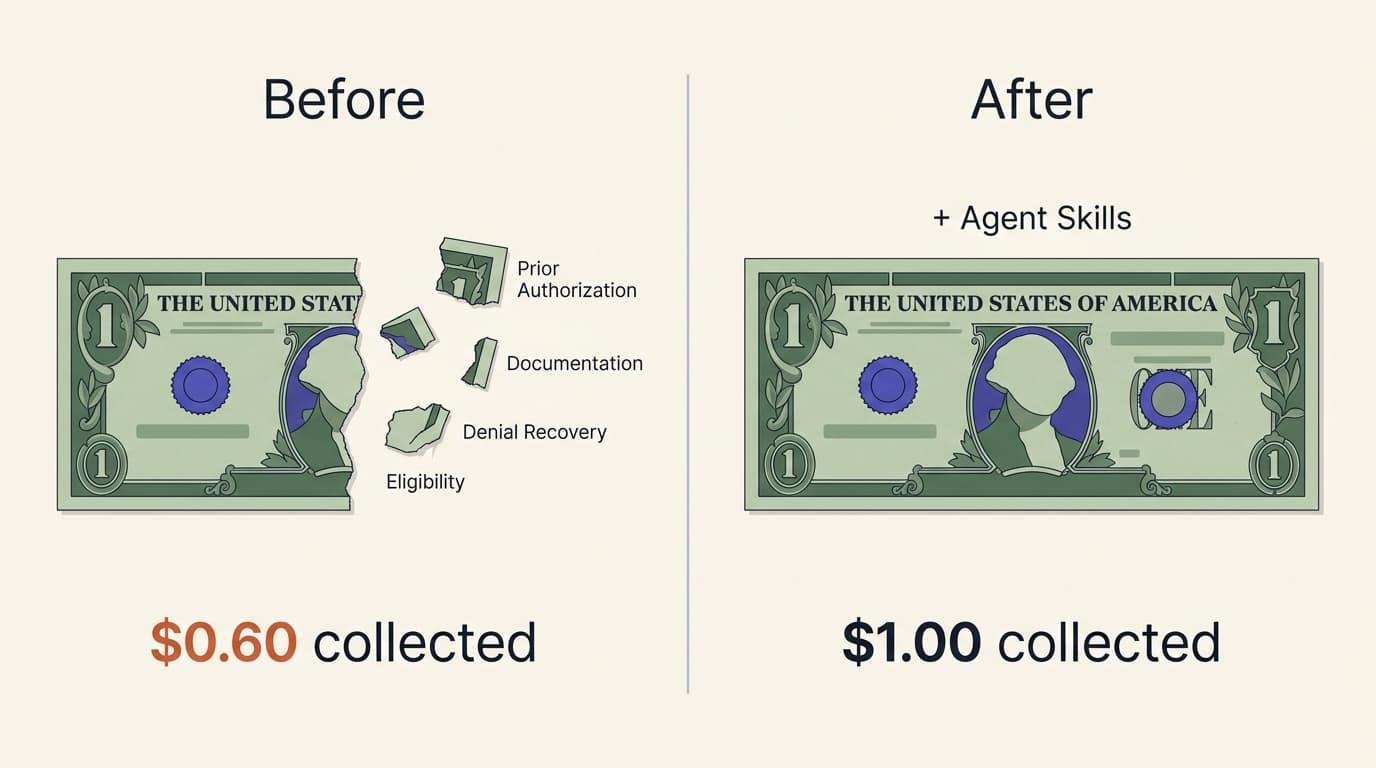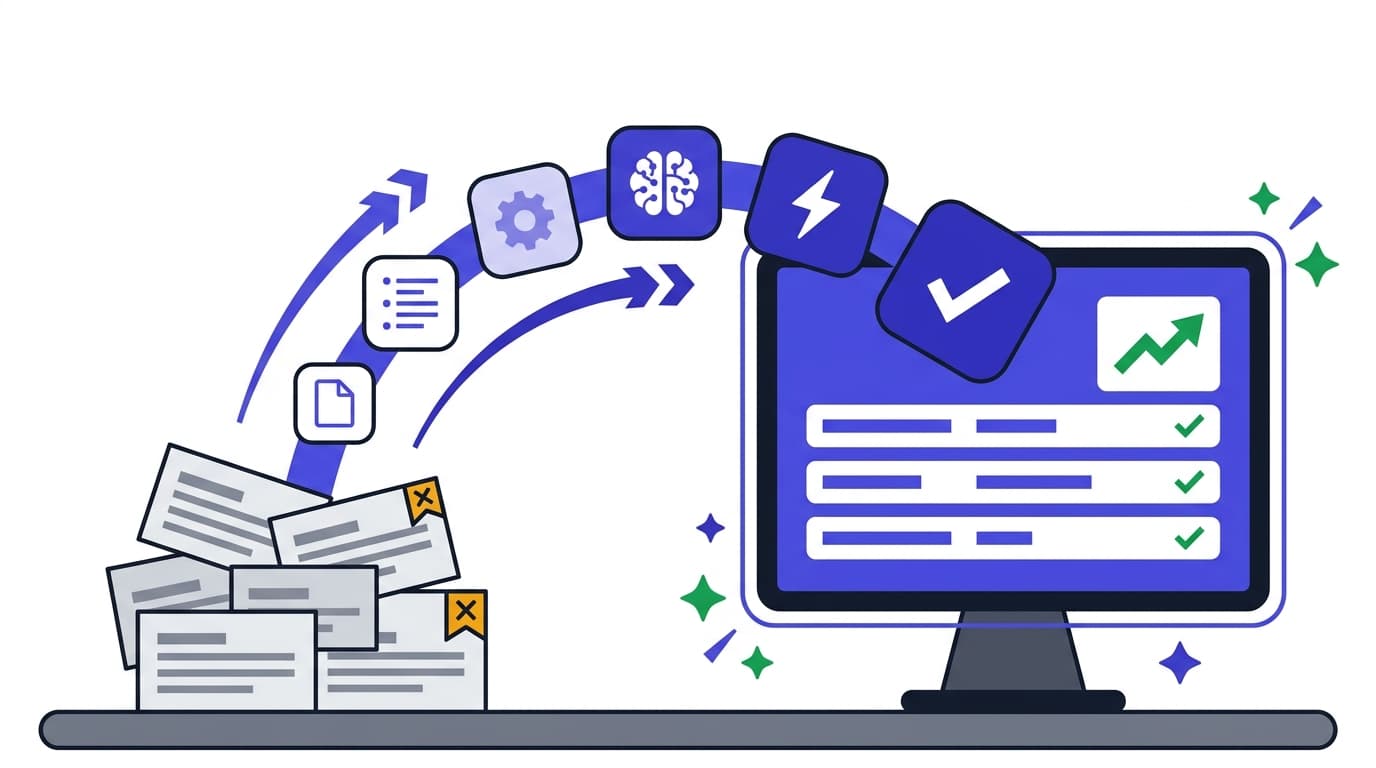
The U.S. healthcare AI market is booming — projected to surpass $37 billion in 2025 alone. Revenue cycle management software is growing at double-digit rates, with the U.S. RCM market reaching $63 billion in 2025. Yet nearly all of that investment targets large health systems and hospitals. Approximately 190,000 independent practices with 1–10 physicians — the practices that deliver the majority of outpatient care in America — remain largely unserved. The RCM opportunity for these small practices represents roughly $5 billion, expanding to $12 billion when you include full back-office operations. Nobody is building for them. We are.
In this article:
- Why Is Healthcare AI Ignoring Small Practices?
- How Big Is the Small Practice Market?
- What Makes Administrative Burden Worse for Small Practices?
- Why Don't Enterprise AI Solutions Work for Small Practices?
- What Does a Small Practice Actually Need from AI?
- How Does the Agent Skills Approach Solve This?
- Frequently Asked Questions
- Key Takeaways
Why Is Healthcare AI Ignoring Small Practices?
Healthcare AI companies overwhelmingly target large health systems because enterprise contracts are bigger, implementation teams can absorb complexity, and a single deal can generate millions in annual recurring revenue. The result is a market where the most sophisticated automation goes to organizations that already have 40-person billing departments — while the two-physician family practice down the street fights payer portals with a staff of eight.
This isn't a technology problem. The AI capabilities exist. The models are powerful enough. The issue is that every major healthcare AI company has built its go-to-market, pricing, and implementation model for the enterprise buyer — and small practices are structurally excluded.
Consider the landscape. AKASA, Waystar, Availity, and Infinx all sell AI-powered RCM solutions. Their sales cycles run 6–12 months. Their implementations require dedicated IT resources. Their contracts start in the six figures. A practice generating $2 million in annual revenue — which is typical for a two-physician office — cannot absorb that cost or that complexity. According to the AMA, 94% of physicians say it has become more financially and administratively difficult to operate a solo or small practice. These practices aren't looking for more complexity. They're drowning in it.
Meanwhile, the vendors that do serve small practices — traditional billing companies, offshore BPOs, and legacy PM systems — offer manual labor wrapped in a service agreement, not AI. The small practice market sits in a gap: too small for enterprise AI, too complex for generic tools, and too busy to evaluate anything that doesn't work on day one.
How Big Is the Small Practice Market?
The addressable market for small practice RCM automation is approximately $5 billion for core revenue cycle functions — eligibility verification, prior authorization, claims submission, denial management, and appeals. When you expand to the full back-office — including patient communications, inbox management, referral coordination, and scheduling operations — the opportunity grows to roughly $12 billion.
The market isn't small. The practices are.
| Metric | Value |
|---|---|
| Independent practices in the U.S. (1–10 physicians) | ~190,000 |
| Core RCM TAM (small practices) | ~$5B |
| Full back-office TAM (small practices) | ~$12B |
| U.S. RCM market overall (2025) | $63B+ |
| Share of RCM spending going to small practices | Less than 8% |
These 190,000 practices represent the first phase of addressable demand. They share common characteristics: independent ownership (not hospital-owned, not PE-owned), small administrative teams relative to patient volume, and high sensitivity to both cost and implementation complexity. They also share a structural problem — the same payer complexity as large health systems, but without the resources to manage it.
The U.S. RCM market overall is projected to exceed $137 billion by 2033, growing at an 11.4% CAGR. Yet the small practice segment of that market is growing faster in terms of unmet need — because every year that enterprise AI improves for hospitals, the capability gap between large and small providers widens.
What Makes Administrative Burden Worse for Small Practices?
Small practices face the same administrative complexity as large health systems but absorb it with a fraction of the staff. The average small practice employs roughly two administrative staff members per physician. Those staff members handle eligibility verification, prior authorizations, claim submissions, denial appeals, patient billing, inbox management, phone calls, and fax processing — often simultaneously.
Physicians across specialties spend an average of 15 hours per week on paperwork and administration. The average doctor spends nearly 45% of their work time interacting with the EHR rather than with patients. According to the AMA, physicians spend roughly two hours on administrative tasks for every one hour of direct patient care. Over half of physicians report burnout symptoms, with administrative burden consistently cited as the primary driver.
For a large health system, these burdens distribute across specialized teams — a coding department, a prior auth team, a denial management unit, each with dedicated staff and technology. For a two-physician family practice, it's the same office manager wearing six hats.
The math is brutal. A small practice handling 25 patients per day per physician runs approximately 250 eligibility verifications per week. At 10–15 minutes per manual verification, that's 40–60 hours of staff time — per week — on a single administrative function. Add prior authorizations, claim follow-ups, denial appeals, and inbox triage, and you begin to understand why these practices are operationally underwater despite healthy patient demand.
The athenahealth 2026 Physician Sentiment Survey found that only 43% of physicians in small group practices feel comfortable with AI, compared with 65% at enterprise organizations. The gap isn't about willingness — it's about access. Enterprise physicians have AI tools integrated into their workflows. Small practice physicians don't, because no one has built AI that fits their operational reality.
Why Don't Enterprise AI Solutions Work for Small Practices?
Enterprise healthcare AI fails small practices on three dimensions: cost, complexity, and assumptions about organizational structure.
Cost. Enterprise RCM platforms like Salesforce's Agentforce, large-scale Optum integrations, and custom AI implementations from consultancies typically require $50,000–$200,000 in professional services fees plus 3–6 months of implementation time. That's before ongoing licensing costs. For a practice generating $2M in annual revenue and operating on margins that tighten every year as Medicare reimbursement declines — down 33% in inflation-adjusted terms from 2001 to 2025 — this is a non-starter.
Complexity. Enterprise solutions assume dedicated IT staff, data engineering resources, and project managers who can oversee multi-month implementations. A small practice has none of these. The office manager who would evaluate, implement, and manage an AI tool is the same person handling prior authorizations between lunch breaks.
Assumptions about structure. Enterprise AI assumes organizational layers that small practices don't have — a dedicated billing department that processes denial appeals, a compliance team that audits coding decisions, a revenue cycle director who monitors KPIs. In a small practice, all of these functions collapse into one or two people. AI designed for a 40-person billing department doesn't shrink gracefully into a team of two.
The result is a market where 75% of physicians worry at least once a year about the financial feasibility of running their practice, where 60% of denied claims are never resubmitted because staff don't have time, and where practices lose $60,000–$80,000 annually to preventable denials alone. These aren't practices that lack sophistication. They lack tools designed for how they actually operate.
What Does a Small Practice Actually Need from AI?
Small practices need AI that works on day one, requires no IT department, costs less than the problem it solves, and handles the specific payer-by-payer complexity of their specialty and geography. That's a different product requirement than what enterprise AI delivers.
Specifically, small practices need:
- Production-ready workflows, not platforms. A small practice doesn't need an AI platform they configure over months. They need an eligibility verification agent that works with their payer mix this afternoon.
- Specialty-specific intelligence. The prior authorization rules for endocrinology GLP-1 medications are different from orthopedic imaging approvals, which are different from behavioral health session limits. Generic AI doesn't handle this. Specialty-specific agent skills do.
- No-integration deployment. Many small practices can't or won't connect their PM/EHR system to a new vendor immediately. They need AI that works with manual upload on day one and deepens integration over time.
- Transparent pricing below their pain threshold. At $0.50 per eligibility check versus the industry average of $7.97 for manual verification, the ROI has to be obvious before the practice commits.
- Full auditability. Even a two-physician practice faces HIPAA obligations, payer audits, and coding reviews. AI that can't explain its decisions doesn't belong in healthcare — regardless of practice size.
How Does the Agent Skills Approach Solve This?
The agent skills approach — which Agentman pioneered and independent research has now validated — solves the small practice problem by encoding domain expertise into modular, production-ready packages that work out of the box.
SkillsBench, a peer-reviewed benchmark from researchers at Stanford, CMU, Berkeley, and Oxford, tested 7,308 AI runs across 29 domains and found that curated agent skills improve AI performance by 16.2 percentage points on average. Healthcare showed the largest gains of any domain tested — a 51.9 percentage point improvement, jumping from 34.2% to 86.1% pass rates. The research also confirmed that AI cannot reliably generate its own procedural knowledge — when models wrote their own skills, performance dropped.
What this means for small practices: the intelligence layer has to come pre-built, by people who understand the workflows. That's what Agentman ships.
Agentman delivers the Healthcare Intelligence Layer on day one — production-ready agent skills built from real clinical operations at Valley Diabetes & Obesity, a mixed-panel practice running Medicare Advantage, Medi-Cal, and commercial payers. Every skill is validated in a live clinical environment before it ships. If it doesn't work in a real practice, it doesn't ship.
Five Packaged Solutions by Specialty
Rather than offering a blank platform that practices must configure, Agentman ships specialty-specific packages that include the agent skills, payer rules, and workflow intelligence each practice type needs:
| Specialty | Key RCM Challenges | What Ships on Day One |
|---|---|---|
| Family Medicine | High patient volume, broad payer mix, preventive care coding complexity | Eligibility verification, multi-payer inbox triage, wellness visit coding rules |
| Internal Medicine | Chronic care management billing, Medicare compliance, complex visit coding | Chronic care management agents, E&M coding skills, Medicare-specific denial patterns |
| Endocrinology | GLP-1 prior authorizations, specialty drug approvals, step therapy tracking | Prior auth agents for GLP-1 and insulin pumps, step therapy documentation skills |
| OB-GYN | Global billing packages, ultrasound authorizations, split billing complexity | Global OB billing skills, imaging prior auth, postpartum care coding agents |
| Behavioral Health | Session-limit tracking, varied payer authorization rules, telehealth billing | Session authorization tracking, telehealth coding rules, payer-specific session limit skills |
Each package arrives with the domain knowledge already encoded. The practice doesn't need to teach the AI how their specialty works — that expertise ships as skills built from real-world clinical operations.
The Network Effect
Every practice that deploys Agentman contributes to a growing library of payer-specific, specialty-specific agent skills. Eligibility rules for Cigna. Denial patterns for Blue Cross. Prior auth workflows for Medicare Advantage. Each skill makes the platform faster and smarter for every practice on the network.
This creates a structural advantage that compounds over time. The first platform to reach 50 healthcare RCM skills — built from real clinical operations, not synthetic data — creates a moat that competitors cannot replicate without operating inside real practices. Agentman is building that moat today.
Frequently Asked Questions
How much does it cost a small practice to use AI for RCM?
Agentman's pricing starts at $0.50 per eligibility check on a pay-as-you-go basis, with no contract required. Subscription plans begin at $150 per physician per month for unlimited checks. A typical two-physician practice saves $5,000–$6,000 per month compared to manual verification costs, making the ROI clear within the first week of use.
Do small practices need an IT department to deploy AI agents?
No. Agentman's agents work without EHR integration through manual upload on day one. Practices on AdvancedMD or DrChrono can connect with one click. No IT staff, no multi-month implementation, no professional services fees required.
How is this different from outsourcing billing to an offshore company?
Outsourced billing companies provide manual labor at lower cost — human staff processing claims and following up on denials. AI agents execute the same workflows in seconds with full auditability, 24/7 availability, and zero variance. Every decision is logged, traceable, and improvable. Offshore teams can't provide data lineage for every claim action.
Are AI agents safe for handling patient health information?
Agentman owns the full technology stack — no third-party AI wrappers. Every agent action is logged, access is scoped per user and role, and data is encrypted in transit and at rest. The platform is designed for HIPAA compliance from the architecture level, with audit trails that support payer and regulatory reviews.
Which specialties benefit most from healthcare AI agents?
Specialties with high prior authorization volume — orthopedics, cardiology, endocrinology, pain management, and vascular — see the fastest ROI because the administrative burden per patient is highest. Primary care and family medicine practices benefit from sheer volume — 25+ patients per day per physician generates hundreds of eligibility checks weekly that agents can automate.
Key Takeaways
- The healthcare AI market is a $63B+ industry that overwhelmingly serves large health systems, leaving ~190,000 small practices without viable AI solutions.
- Small practices face the same administrative complexity as hospitals — prior authorizations, claim denials, payer variability — but absorb it with roughly two admin staff per physician.
- Enterprise AI solutions are too expensive ($50K–$200K implementation), too complex (3–6 month deployments), and structurally mismatched for practices without IT departments.
- The agent skills approach, validated by independent research showing 51.9 percentage point improvements in healthcare AI performance, delivers production-ready intelligence that works on day one.
- Agentman ships the Healthcare Intelligence Layer with specialty-specific packages for Family Medicine, Internal Medicine, Endocrinology, OB-GYN, and Behavioral Health — no configuration, no IT department, no waiting.
Small practices deserve AI that was built for how they actually operate — not enterprise software scaled down and relabeled. See how Agentman serves small practices →