Payer Behavior Is Now the Biggest Threat to Practice Revenue — Here's What Small Practices Can Do About It
Payer denials and underpayments have overtaken internal operational challenges as the #1 revenue risk for small medical practices. A 2026 Adonis survey of 120+ healthcare leaders found 62% now cite payer behavior — not staffing or systems — as their largest barrier to revenue growth. Independent practices losing $60,000–$80,000 annually to preventable denials need proactive payer monitoring, automated denial workflows, and AI agents that track rule changes across dozens of payers in real time.
In this article:
- Why Are Payer Denials the #1 Revenue Threat for Small Practices in 2026?
- How Much Are Payer Denials Costing Small Medical Practices?
- Why Do 38% of Practices Lack Real-Time Payer Data?
- How Can AI Agents Help Small Practices Fight Payer Denials?
- What Should Practice Owners Do Right Now to Protect Revenue?
- Frequently Asked Questions
Key Facts at a Glance
| Metric | Finding | Source |
|---|---|---|
| Leaders citing denials as #1 barrier | 62% | Adonis RCM Survey (2026) |
| Revenue lost to denials and underpayments | 3–4% of net patient revenue | Adonis RCM Survey (2026) |
| Weekly hours spent on denial management | 50–75 hours | Adonis RCM Survey (2026) |
| Organizations lacking real-time payer data | 38% | Adonis RCM Survey (2026) |
| Leaders wanting automated denial follow-up | 66% | Adonis RCM Survey (2026) |
| Leaders wanting AI-driven payer transparency | 29% | Adonis RCM Survey (2026) |
Why Are Payer Denials the #1 Revenue Threat for Small Practices in 2026?
Sixty-two percent of RCM leaders now cite denials and underpayments as their single largest barrier to revenue growth, according to a 2026 Adonis survey of more than 120 healthcare leaders across 18 specialties. This marks a decisive shift from prior years when internal operational challenges — staffing shortages, outdated systems, training gaps — held that position.
For years, when revenue cycle teams discussed what was holding them back, the conversation centered on internal problems. Fix what's happening inside your four walls, the logic went, and the revenue would follow. That era is over.
Nearly half of those surveyed said frequent changes to payer adjudication rules directly impact their ability to collect revenue. Forty-five percent pointed to the sheer volume and complexity of denials. Revenue cycle teams are no longer fighting internal inefficiencies — they're navigating external volatility.
For a five-physician practice without a dedicated RCM department, that volatility hits differently than it does for a health system with hundreds of billing specialists. When payers change adjudication rules mid-quarter, a large organization can absorb the shock. A small practice watches the revenue gap widen while the same three staff members try to figure out what changed and how to respond.
How Much Are Payer Denials Costing Small Medical Practices?
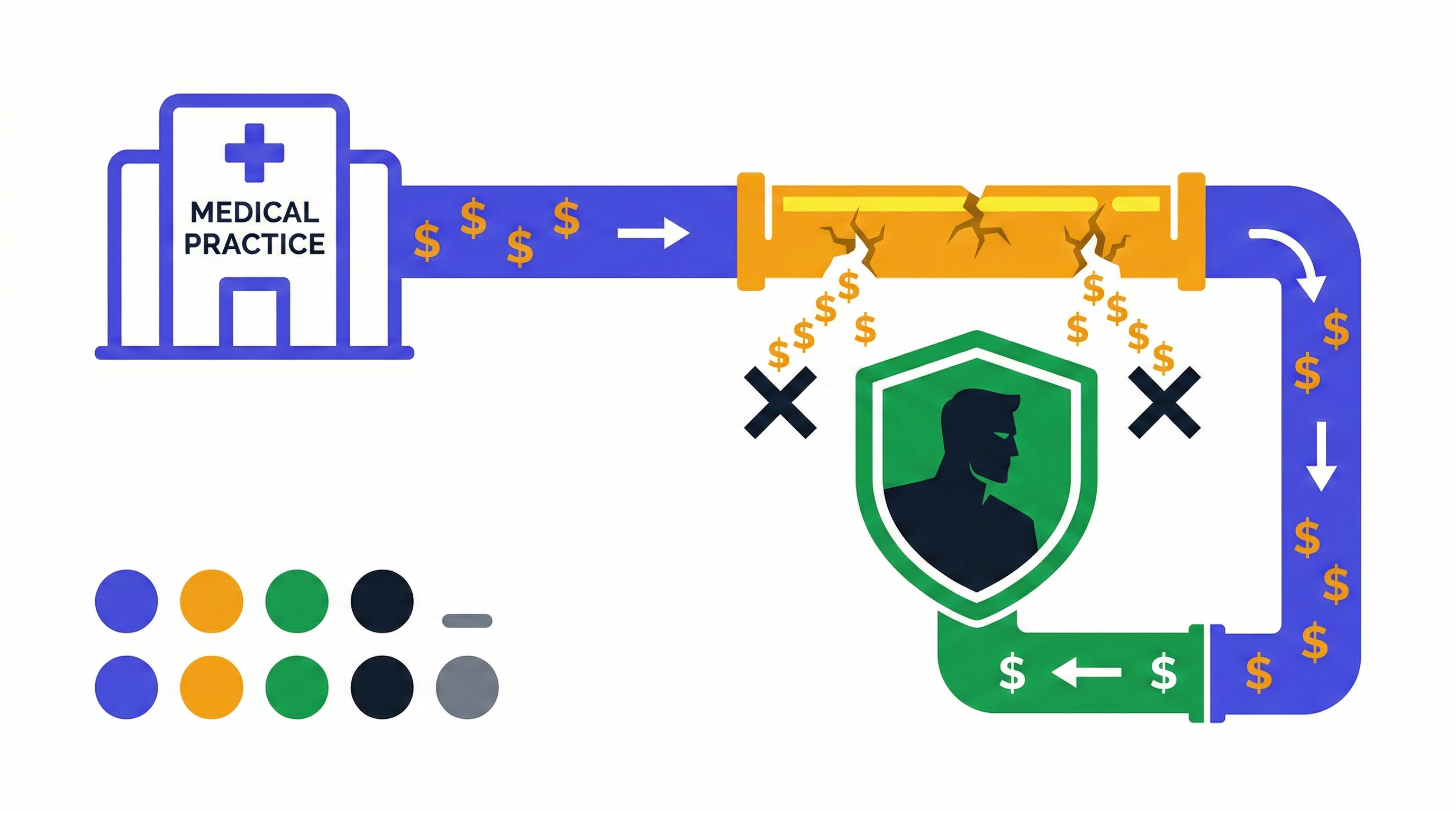
Small medical practices lose between 3% and 4% of net patient revenue to denied claims, underpayments, and timely filing limits — translating to $60,000–$80,000 annually for a practice generating $2 million in revenue. Most organizations spend 50–75 hours per week on denial-related work, representing multiple full-time equivalents devoted to chasing money the practice has already earned (Adonis, 2026).
The financial toll compounds in human terms. That lost revenue represents the medical assistant you couldn't hire, the EHR upgrade you deferred, the extra half-day of patient appointments you could have opened. Every dollar lost to preventable denials is a dollar that should have gone back into caring for patients.
The cruelest dimension is the operational drain. Denial management consumes an extraordinary amount of capacity — not because staff are inefficient, but because the task itself has grown unmanageable. The claims weren't coded incorrectly. The rules changed and nobody caught it in time, or the denial arrived on a Friday and nobody got to it before the appeal window closed.
Why Do 38% of Practices Lack Real-Time Payer Data?
Thirty-eight percent of healthcare organizations lack real-time access to data on payer performance, according to the Adonis survey (2026). Without payer intelligence, practices cannot identify which payers are changing rules, how denial patterns are shifting, or where their greatest financial exposure lies — until the damage is already done.
When asked what AI could most improve about their revenue cycle, 29% of leaders said greater insight and transparency into payer activity. Not faster claims processing. Not better coding assistance. Visibility — the ability to see what's happening before it becomes a write-off.
This resonates with what we hear from the independent practices we work with at Agentman. The problem isn't that billing staff are incompetent. The problem is that human beings are trying to monitor the shifting behavior of dozens of payers — each with their own rules, timelines, and definitions of "medical necessity" — using spreadsheets, phone calls, and whatever the practice management system surfaces. That's not a workflow. That's a guessing game with six-figure stakes.
How Can AI Agents Help Small Practices Fight Payer Denials?
AI agents reduce denial-related revenue loss by automating payer monitoring, eligibility verification, and appeal deadline tracking — the high-volume, rules-based tasks that consume 50–75 hours per week in manual effort. Sixty-six percent of healthcare leaders identified automated denial follow-up and resolution as a "very important" AI capability for their 2026 strategy (Adonis, 2026).
When most people hear "AI in healthcare," they picture something replacing clinical judgment — an algorithm deciding whether a patient needs surgery. That's not what this is. An AI agent for revenue cycle management handles the surveillance, pattern recognition, and deadline tracking that no human team can sustain across 30 payers with constantly shifting rules.
Specifically, an AI agent in the revenue cycle can:
- Monitor eligibility verification queues and catch coverage gaps before the patient arrives
- Track payer denial patterns and flag when a specific CPT code starts getting rejected at a higher rate
- Watch appeal deadlines across every open denial and queue responses before filing windows close
- Assemble supporting documentation from the EHR for billing team review
- Prioritize daily work so billing staff walk in to a ranked list of claims needing attention, with documentation already pulled
Your staff stays in control. Every decision that touches a patient or a payer goes through human review. The agent handles the work that runs 24/7 and never misses a deadline.
We built Agentman for exactly this moment — not because AI is trendy, but because the economics of running a small medical practice have become unsustainable without it. When payers change the rules faster than your team can read the updates, you need something that never stops watching.
What Should Practice Owners Do Right Now to Protect Revenue?
Practices that shift from reactive, manual denial management to proactive, AI-assisted payer monitoring will retain the most revenue through the current payer volatility cycle. The 2026 Adonis survey confirms the direction: 66% of leaders prioritize automated denial workflows and 29% prioritize real-time payer transparency as their top AI investments.
Three immediate actions protect revenue:
-
Audit your payer data. Identify which payers are denying the most claims, which CPT codes are getting flagged, and your average time from denial to appeal submission. If you can't answer these questions, you're flying blind — and that's the vulnerability payers exploit.
-
Redirect staff time from status-checking to decision-making. If your most experienced billing person spends three hours a day on hold with payers checking claim status, that's not a staffing problem — it's an automation opportunity. The tasks that are high-volume, rules-based, and time-sensitive — eligibility verification, denial tracking, appeal deadline management — are precisely where AI agents deliver the most immediate relief.
-
Require transparency in any AI you adopt. Any AI agent in your revenue cycle must be transparent, auditable, and under your team's control. You should see exactly what the agent did, why it did it, and what data it used. If a vendor can't explain that clearly, keep looking.
The shift the Adonis report describes — from internal challenges to external payer volatility — isn't temporary. Payers aren't going to simplify their adjudication rules or reduce their denial rates out of goodwill. This is the new operating environment, and it rewards the practices that build systems to navigate it.
Frequently Asked Questions
How many hours per week do practices spend on denial management?
Most healthcare organizations spend between 50 and 75 hours per week on denial-related work, according to the 2026 Adonis survey of 120+ healthcare leaders. For small practices, this represents a disproportionate share of total staff capacity, often consuming the equivalent of 1–2 full-time employees who could otherwise support patient care or revenue-generating activities.
What percentage of revenue do small practices lose to payer denials?
Nearly half (47%) of organizations surveyed lose between 3% and 4% of net patient revenue to denied claims, underpayments, and timely filing limits. For a practice generating $2 million in annual revenue, that translates to $60,000–$80,000 per year — not from coding errors or poor care delivery, but from payer rule changes and missed appeal windows.
Can AI replace billing staff in a medical practice?
No. AI agents for revenue cycle management handle surveillance, pattern recognition, and deadline tracking — not clinical or billing decisions. Every action that touches a patient or a payer goes through human review. The agent automates the high-volume, rules-based monitoring work that no human team can sustain across dozens of payers with constantly shifting rules, freeing billing staff to focus on complex cases and strategic decisions.
What is the most important AI capability for healthcare RCM in 2026?
Automated denial follow-up and resolution ranks as the top priority, with 66% of healthcare leaders identifying it as "very important" for their 2026 strategy. The second priority is greater insight and transparency into payer activity, cited by 29% of leaders — reflecting a need for proactive intelligence rather than reactive claim processing (Adonis, 2026).
How do payer adjudication rule changes affect small practices differently than large health systems?
Large health systems absorb payer rule changes across hundreds of billing specialists and dedicated compliance teams. Small practices — typically operating with 2–3 billing staff — lack the capacity to monitor rule changes across dozens of payers simultaneously. When adjudication rules shift mid-quarter, small practices often discover the impact only after revenue has already been lost, because they don't have real-time payer performance data.
Key Takeaways
- 62% of RCM leaders now cite payer denials and underpayments as their #1 revenue barrier — overtaking internal operational challenges for the first time (Adonis, 2026)
- Small practices lose $60,000–$80,000 annually (3–4% of net patient revenue) to preventable denials and missed appeal windows
- 50–75 hours per week are consumed by denial management — the equivalent of 1–2 full-time employees
- 38% of organizations lack real-time payer data, leaving them unable to detect rule changes until revenue is already lost
- AI agents deliver the most immediate relief on high-volume, rules-based tasks: eligibility verification, denial tracking, appeal deadline management, and payer behavior monitoring
Doctors didn't go to medical school to fight insurance companies. Neither did the staff who keep their practices running. It's time to stop asking them to.
At Agentman, we build AI agents that handle the back-office work small healthcare practices shouldn't have to do manually — from eligibility verification to denial management to payer behavior monitoring. If the challenges in this report sound familiar, we'd love to talk.