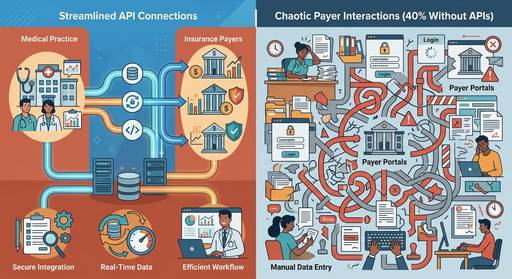
Every healthcare AI startup building prior authorization automation is making the same implicit assumption: that payers have APIs. Agentman's internal analysis — corroborated by partners in the healthcare data infrastructure space — estimates that 30–40% of payer portal interactions lack clean API access. The actual number may be higher. For small practices managing 10–15 payer contracts, this means the majority of daily eligibility and prior authorization work happens through browser-based portals that no API can reach. The result: any platform that only automates the API-connected portion of the revenue cycle is leaving 40% of the problem unsolved.
In this article:
- Why Do 30–40% of Payer Interactions Lack API Access?
- Why Can't Traditional Automation Handle Portal-Only Payers?
- What Is a Screen Agent and How Does It Close the Gap?
- How Does Medman's Desktop Architecture Differ from Cloud-Only Competitors?
- What Does 100% Payer Coverage Actually Look Like?
- Frequently Asked Questions
- Key Takeaways
Why Do 30–40% of Payer Interactions Lack API Access?
The major national payers — UnitedHealthcare, Aetna, Cigna, and the Blue Cross Blue Shield affiliates — offer varying degrees of API coverage for eligibility verification and prior authorization. But the U.S. payer landscape extends far beyond the national carriers. Regional payers, state Medicaid programs, IPA portals, and specialty payer networks make up a significant share of any practice's daily volume — and most of them have little to no API infrastructure.
Agentman's internal analysis, corroborated by conversations with healthcare data infrastructure partners including Stedi, estimates that 30–40% of payer portal interactions don't have clean APIs. The actual percentage is likely higher when accounting for payers whose APIs cover only a subset of required transactions — eligibility but not prior authorization, or claims status but not appeals.
For a small practice like Valley Diabetes & Obesity — a two-physician endocrinology practice managing Medicare Advantage, Medi-Cal, and commercial payers across 10–15 contracts — this means a substantial share of daily administrative work happens through browser-based payer portals. Staff log in, navigate multi-step workflows, enter data manually, check authorization status, and repeat — for every patient, every day.
This is the gap that every cloud-only, API-first healthcare AI platform ignores. The 60–70% they can reach through APIs is valuable. The 30–40% they can't reach is where practices are still drowning.
Why Can't Traditional Automation Handle Portal-Only Payers?
Traditional approaches to automating browser-based workflows — robotic process automation (RPA) and web scraping — fail in healthcare for predictable reasons.
RPA tools record and replay sequences of clicks and keystrokes. They break the moment a payer portal changes a button label, moves a form field, or updates its layout. Payers change their portal interfaces frequently — in some cases deliberately, to frustrate automated access. An RPA script that works on Monday may fail on Wednesday, requiring manual intervention and script maintenance that small practices don't have the technical staff to handle.
Web scraping faces a different set of barriers. Modern payer portals use authentication flows (multi-factor login, session tokens), CAPTCHA challenges, and dynamic JavaScript rendering that scraping tools cannot reliably navigate. These aren't edge cases — they're standard features of virtually every payer portal in production today.
The fundamental problem is architectural. Both RPA and web scraping operate within the browser — they can only interact with what's inside the browser window, and they're constrained by the browser's security model, rendering pipeline, and session management. When a payer portal throws a CAPTCHA, changes its DOM structure, or rotates its session handling, browser-confined tools have no fallback.
Small practices experience this as intermittent, unpredictable automation failures — the worst kind, because staff never know which checks will require manual intervention until they do.
What Is a Screen Agent and How Does It Close the Gap?
A screen agent operates at the desktop level, not the browser level. It controls the entire screen — mouse, keyboard, visual recognition — the same way a human staff member would navigate any application, portal, or workflow. The critical difference: it does so without fatigue, without error, and with full auditability.
Agentman built Medman as a desktop application specifically because desktop applications can control the whole screen. A browser is restricted to what's inside the browser. A screen agent can handle any portal, any login, any navigation — including payer portals that have no API, portals that use CAPTCHA, portals that change their UI quarterly, and portals that require multi-factor authentication flows.
This is not a workaround. It is a deliberate architectural choice with three implications:
Coverage. Medman's screen agent can automate any payer portal a human can navigate. If a staff member can log in and check authorization status, the screen agent can do it — faster, without errors, and with a complete audit trail.
Resilience. Because the screen agent operates on visual recognition and desktop-level control rather than DOM manipulation, it is inherently resilient to the UI changes, session management shifts, and anti-automation measures that break RPA and scraping tools.
Auditability. Every action the screen agent takes is logged with the same data lineage that Agentman applies to API-based transactions. The compliance story is identical regardless of channel.
How Does Medman's Desktop Architecture Differ from Cloud-Only Competitors?
The distinction between desktop and cloud-only architecture is not a feature difference — it is a structural moat.
Cloud-only healthcare AI platforms (the majority of competitors in the space) are architecturally limited to what they can reach through APIs and server-side integrations. They work well for the 60–70% of payer interactions that have clean API access. For the remaining 30–40%, they have no answer — and no path to one without a fundamental architecture rebuild.
| Dimension | Cloud-Only Platforms | Medman (Desktop + Cloud) |
|---|---|---|
| API-connected payers | ✅ Covered via direct API integration (Stedi, clearinghouses) | ✅ Covered via direct API integration |
| Portal-only payers | ❌ No access — outside architectural reach | ✅ Screen agent navigates any portal |
| Total payer coverage | ~60–70% of volume | ~100% of volume |
| Resilience to portal UI changes | N/A — no portal access | High — visual recognition adapts |
| Deployment model | Cloud SaaS | Desktop application + cloud backend |
| Switching cost | Low — API integrations are portable | High — Medman becomes the command center |
No other small-practice automation platform covers both channels. This is not a marginal advantage — it is the difference between automating most of the revenue cycle and automating all of it.
The switching cost dimension matters for investors: once Medman is the daily command center for a practice's back-office operations — the single screen where eligibility, prior auth, inbox triage, and denial management all happen — replacing it requires rebuilding the entire workflow. Cloud-only competitors cannot replicate this without building a desktop client from scratch, which represents a fundamental architectural rebuild, not a feature addition.
What Does 100% Payer Coverage Actually Look Like?
For a practice like Valley Diabetes & Obesity — two physicians, a mixed payer panel, 10–15 active payer contracts — 100% coverage means that every eligibility check, every prior authorization, and every denial follow-up is automated regardless of whether the payer offers an API.
| Channel | Estimated Coverage | Agentman Approach |
|---|---|---|
| Payers with clean APIs | ~60–70% of volume | Direct API integration (Stedi, clearinghouses) |
| Payers with portal-only access | ~30–40% of volume | Screen agent via Medman desktop |
| Total coverage | ~100% | Both channels combined |
In practice, this eliminates the triage step that consumes staff time at every small practice: sorting which checks can be done automatically and which require manual portal navigation. With Medman, the answer is always automated — the system routes each transaction through the appropriate channel (API or screen agent) transparently.
The staff experience changes from "check which payers are automated and manually handle the rest" to "everything is handled." That is not an incremental improvement. For a practice running 250+ eligibility verifications per week, it eliminates 40–60 hours of manual portal work that no cloud-only competitor can touch.
Frequently Asked Questions
Does Agentman work with payers that don't have APIs?
Yes. Medman's screen agent navigates payer portals directly — any portal a human staff member can access, Agentman can automate. This covers the estimated 30–40% of payer interactions where clean APIs don't exist, including regional payers, state Medicaid systems, IPA portals, and specialty payer networks.
What is Medman?
Medman is Agentman's desktop application — the command center for small practice back-office operations. It combines API-based automation for payers with clean integrations and screen agent technology for portal-only payers, providing 100% payer coverage from a single interface.
How is a screen agent different from RPA?
Traditional RPA records and replays click sequences, which break when portal interfaces change. Screen agents operate at the desktop level using visual recognition and intelligent navigation — they adapt to UI changes, handle CAPTCHA challenges, and manage authentication flows that RPA tools cannot.
Can cloud-only competitors add this capability?
Not without a fundamental architecture rebuild. Screen agent technology requires a desktop application that controls the full screen — this is an architectural choice, not a feature that can be added to a cloud-only platform through an API update or plugin.
Is the screen agent HIPAA-compliant?
Every action the screen agent takes is logged with the same data lineage and audit trail that Agentman applies to all transactions. Access is scoped per user and role, data is encrypted in transit and at rest, and the platform is designed for HIPAA compliance from the architecture level.
Key Takeaways
- An estimated 30–40% of payer portal interactions lack clean API access — covering regional payers, state Medicaid systems, IPA portals, and specialty networks that national carriers don't represent.
- Every cloud-only healthcare AI platform is architecturally limited to the 60–70% of payer interactions reachable through APIs. The remaining 30–40% is where small practices are still manually navigating portals.
- Agentman's Medman desktop application uses screen agent technology to automate any payer portal a human can navigate — closing the coverage gap that cloud-only competitors cannot reach.
- The desktop architecture is a structural moat: cloud-only competitors cannot replicate it without a fundamental rebuild, and once Medman is a practice's daily command center, switching costs are high.
- No other small-practice automation platform covers both API-connected and portal-only payers. This is the difference between automating most of the revenue cycle and automating all of it.
The payer API gap is the largest unaddressed problem in healthcare revenue cycle automation. See how Medman closes it →