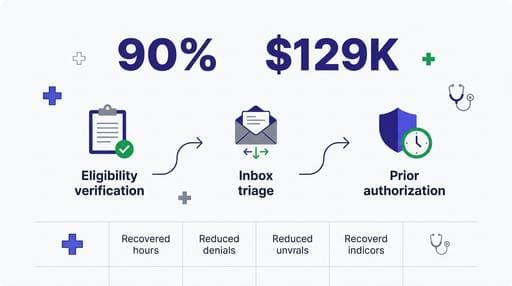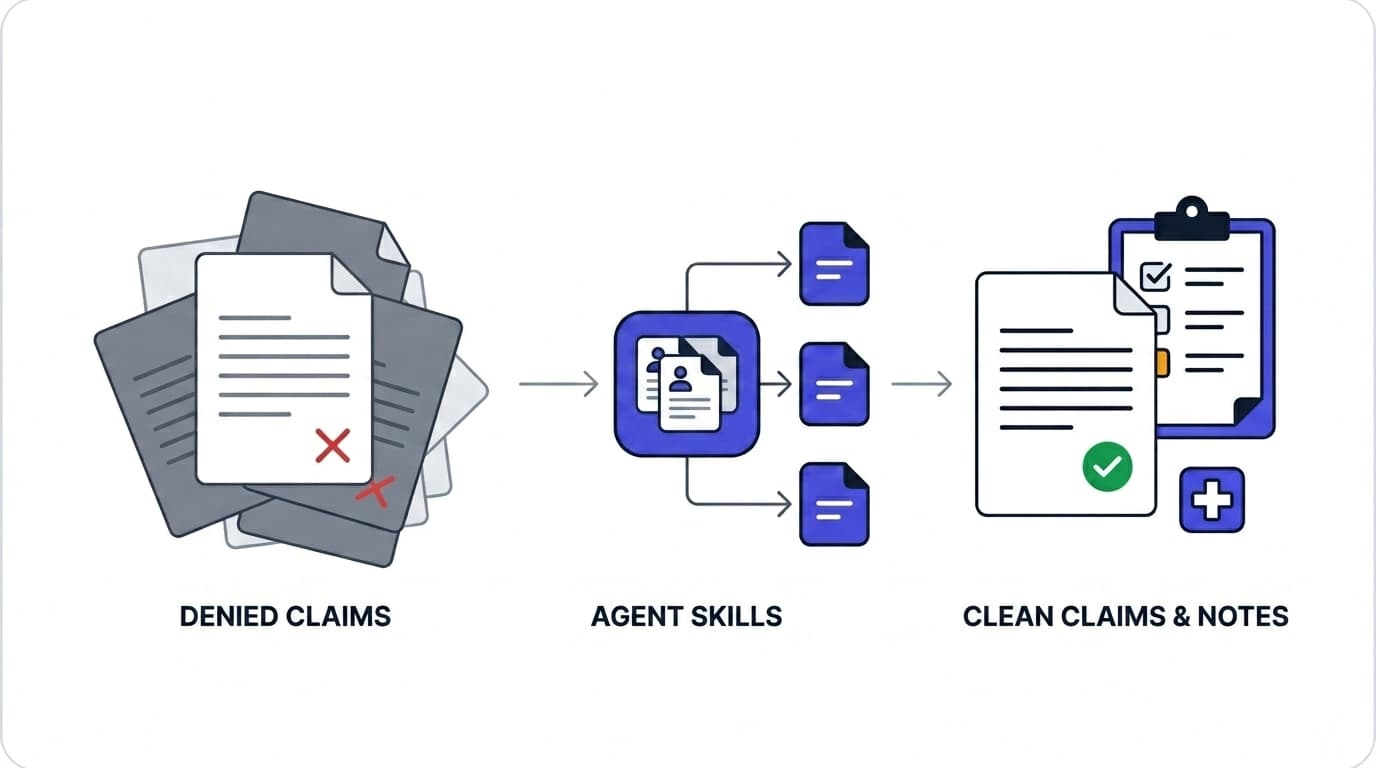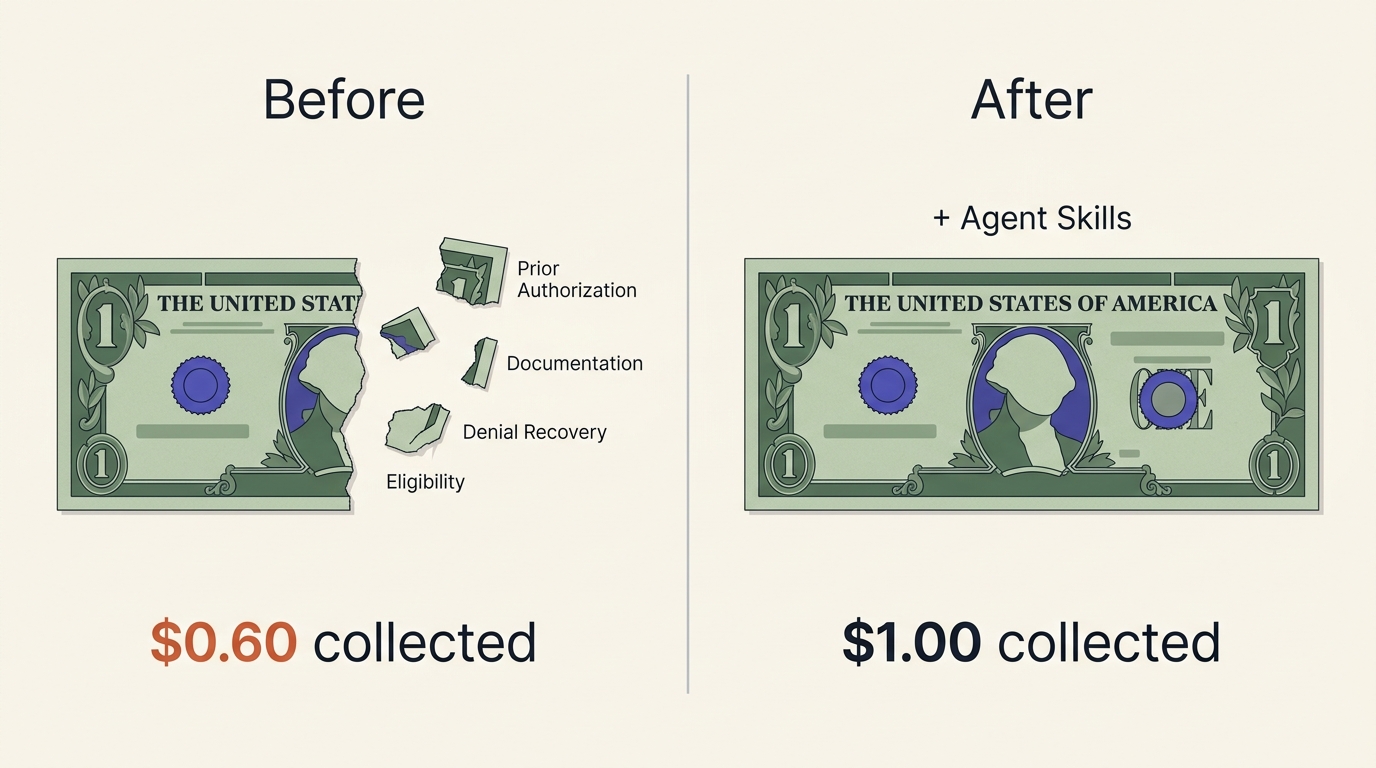
Independent specialty practices collect roughly 60 cents on every gross dollar billed because revenue leaks at four sequential checkpoints — eligibility, prior authorization, documentation, and denial recovery. Approximately 35–60% of denied claims are never resubmitted, leaving already-earned revenue on the table. Automating all four checkpoints with agent skills closes the loop, and the 2026 industry benchmarks now make the financial case decisive.
Table of Contents
- Why do practices only collect 60 cents on the dollar?
- What are the two levers for fixing practice revenue?
- How does the full revenue cycle break down — and where does each dollar leak?
- Why is denial prevention more valuable than denial recovery?
- The problem isn't billing — it's documentation
- What is CMS-0057-F changing in 2026?
- How do agent skills automate the full revenue cycle?
- What does the math look like for a four-physician practice?
- Frequently Asked Questions
- What to do next
Why do practices only collect 60 cents on the dollar?
For every dollar billed at standard charge-master rates, an independent specialty practice collects approximately 60 cents on average after contractual adjustments, denials, and unworked appeals. The 40-cent gap is not a billing failure — it is the cumulative cost of eligibility errors, prior authorization denials, documentation gaps, and write-offs across the revenue cycle.
This pattern is now well-documented in 2026 industry benchmarks. Practices entering 2026 face stagnant revenue growth alongside rising expenses, with reimbursement pressure, higher overhead, and aggressive payer cost-containment tactics. In 2025, average denial rates exceeded 10 percent, yet many small practices still do not track denial rate by payer, specialty, denial reason, or responsible workflow. The 40-cent loss is not random — it accumulates at four predictable checkpoints, each with its own automation profile.
The conventional industry response has been to add staff. The agentic response is to fix the math at each checkpoint.
What are the two levers for fixing practice revenue?
Practices have exactly two levers to improve revenue: see more patients (volume) or collect more of what is billed (collection rate). Volume requires more clinicians, more square footage, and more staff. Collection rate requires fixing what already happens with the patients on the schedule today.
| Lever | What It Requires | Time to Impact | Capital Cost |
|---|---|---|---|
| Volume | New providers, new locations, marketing | 12–24 months | High |
| Collection rate | Workflow automation, denial prevention | 30–90 days | Low |
Agent skills attack lever two. Eligibility verification prevents uncollectable visits before they happen. Prior authorization automation prevents denials at the front end. Denial recovery reclaims revenue already earned. Each layer compounds — upstream fixes shrink downstream work.
How does the full revenue cycle break down — and where does each dollar leak?
The independent practice revenue cycle has four sequential checkpoints, and each one leaks differently. Eligibility errors cause same-day denials. Prior authorization gaps cause delayed denials weeks after the visit. Documentation gaps cause clinical denials at claim adjudication. Unworked appeals leave already-earned revenue on the table.
The full sequence:
- Eligibility verification — confirms coverage, copay, deductible, and active benefits before the visit
- Prior authorization — secures payer approval for procedures, imaging, and high-cost drugs before the service
- Clinical documentation — captures the medical-necessity criteria the payer requires for the specific code billed
- Claim submission, denial, and appeal — files the claim, processes the denial, and pursues reconsideration when warranted
A failure at checkpoint one cascades into checkpoints two through four. According to the 2025 CAQH Index, the healthcare industry spends $43 billion annually on eligibility and benefit verification — a 60% increase that represents the largest share of annual medical administrative spend. That figure measures only the labor cost of verification itself, not the downstream denials it fails to prevent. The American Medical Association reports that 35% of claim denials tie back to eligibility or authorization errors — the upstream miss that drives the largest share of preventable revenue loss.
Why is denial prevention more valuable than denial recovery?
Denial prevention is roughly 4× more valuable than denial recovery because preventing a denial costs cents while recovering one costs hours of staff time and recovers only a fraction of the original claim. Industry studies estimate $25 to $118 per denied claim to rework, depending on complexity, and nearly 65% of denials never get appealed because practices don't have the time or expertise.
The economics:
| Action | Cost per Claim | Recovery Rate | Net Yield |
|---|---|---|---|
| Prevent at eligibility | $0.34 (CAQH 2025) | 100% (denial avoided) | High |
| Prevent at prior auth | $2–$5 | 100% (denial avoided) | High |
| Recover post-denial | $25–$118 | ~35–40% | Low |
The 2025 CAQH Index found that a manual eligibility verification transaction costs approximately $6.78, while an electronic verification costs approximately $0.34 — a savings of $6.44 per transaction. That 20× unit-cost reduction at the cheapest checkpoint is the leverage point. Every denial prevented at eligibility is a denial that never enters the appeal queue, never consumes biller time, and never approaches a timely-filing deadline.
Change Healthcare research has found that 86% of denials are potentially avoidable, and 48% of avoidable denials are not recoverable once they occur. Roughly half the denial dollars that "shouldn't have happened" are gone permanently the moment the claim adjudicates. Prevention is not a nice-to-have — it is the only point in the cycle where 100% of the dollar can still be saved.
The problem isn't billing — it's documentation
Most denied claims are not billing errors. They are documentation errors caught at adjudication when the payer's medical-necessity criteria are not met by what the physician charted. The 60-cent dollar is not lost in the billing department — it is lost upstream, in the encounter note, before the claim is ever submitted.
This is the Clinical Documentation Improvement (CDI) problem. Hospital systems have invested heavily in CDI teams for exactly this reason: documentation drives reimbursement. Independent practices have not had access to that infrastructure, because dedicated CDI staff are uneconomic below a certain practice size.
Agent skills function as a CDI layer for independent practices. Before a claim is submitted, an agent skill can read the encounter note, compare it against the payer's published medical-necessity criteria for the billed code, and prompt the physician with the specific gap. Provider surveys cite inaccurate or incomplete patient data at intake as a primary driver of denials in 68% of cases, with documentation and authorization gaps ranking among the top causes industry-wide.
The shift in framing matters. Practices stop thinking of denials as a billing problem to recover from and start thinking of them as a documentation problem to prevent — at the moment the note is written, not weeks later when the EOB arrives.
What is CMS-0057-F changing in 2026?
The CMS Interoperability and Prior Authorization Final Rule (CMS-0057-F) takes effect January 1, 2026, reshaping the prior authorization checkpoint specifically. The rule applies to Medicare Advantage organizations, Medicaid managed care plans, CHIP entities, and QHP issuers — covering the majority of insured Americans — with CMS projecting approximately $15 billion in savings over ten years.
Key 2026 provisions:
| Provision | Effective | Impact |
|---|---|---|
| Decision timelines | Jan 1, 2026 | Impacted payers must respond within 72 hours for urgent requests and 7 calendar days for standard requests |
| Specific denial reasons | Jan 1, 2026 | Payers must provide specific denial rationale, enabling faster appeals |
| Public reporting | Jan 1, 2026 | PA approval/denial rates published — surfacing payer behavior patterns |
| FHIR-based PA APIs | Jan 1, 2027 | Impacted payers must implement FHIR-based Prior Authorization APIs for electronic submission and real-time tracking |
For independent practices, the 2026 timeline means tighter feedback loops on PA decisions and the first round of public data on payer behavior. Agent skills built for prior authorization now have structured, time-bound payer responses to act on, and the 2027 FHIR API mandate creates a clean integration path that did not exist in any prior generation of practice management software.
How do agent skills automate the full revenue cycle?
Eight production-ready agent skills cover the four checkpoints of the revenue cycle, each one targeting a specific point of revenue leakage. Together they shift the practice from manual, reactive revenue cycle work to proactive, automated prevention with human oversight at the points that matter.
| Checkpoint | Agent Skill | Replaces |
|---|---|---|
| Eligibility | Eligibility Verification | 90 minutes/physician/day of portal logins |
| Eligibility | Benefit Discovery | Pre-visit financial counseling |
| Prior Auth | PA Submission Agent | Manual fax and portal submission |
| Prior Auth | PA Status Polling | Daily payer follow-up calls |
| Documentation | Clinical Documentation Skill | Pre-submission CDI review |
| Documentation | Code Validation | Post-encounter coding review |
| Denial Handling | Denial Triage | Manual denial worklist sorting |
| Denial Handling | Appeal Generation | Letter drafting from clinical notes |
Each skill is bounded — it does one thing, with one auditable input/output pair, and human review where the regulatory or financial stakes require it. None of them replace the physician's clinical judgment or the biller's final sign-off. They eliminate the manual labor that sits between those two human decisions.
What does the math look like for a four-physician practice?
A typical four-physician specialty practice running the full revenue cycle automation captures $400,000–$600,000 in annual recovered revenue at a per-check cost approximately 20× lower than the manual benchmark. The recovery splits across the four checkpoints, with the largest single contributor being prevented denials.
Illustrative annualized impact for a four-physician practice billing $4M in gross charges:
| Source of Recovery | Annual Impact |
|---|---|
| Eligibility-prevented denials | $120,000–$160,000 |
| Prior auth-prevented denials | $140,000–$200,000 |
| Documentation-prevented denials (CDI layer) | $80,000–$140,000 |
| Recovered appeals on existing denials | $60,000–$100,000 |
| Total | $400,000–$600,000 |
These ranges reflect Valley Diabetes & Obesity's deployment trajectory and align with patterns reported in MGMA's denial benchmarking and CAQH's eligibility cost data. For a mid-size practice processing 500 verifications per day, the per-transaction savings translate to more than $3,200 in daily savings on eligibility alone — before any downstream denial-prevention impact is counted.
Frequently Asked Questions
What is the 60-cent dollar in healthcare?
The 60-cent dollar refers to the average gross collection rate for independent specialty practices billing commercial payers. For every dollar billed at standard charge-master rates, the practice collects approximately 60 cents after contractual adjustments, eligibility errors, prior authorization denials, documentation gaps, and unworked appeals. The remaining 40 cents includes both contractually written-off amounts and recoverable revenue that automation of the four revenue cycle checkpoints can reclaim.
How much does manual eligibility verification cost per check in 2026?
Manual eligibility verification costs approximately $6.78 per check according to the 2025 CAQH Index, while electronic verification costs approximately $0.34 — a savings of $6.44 per transaction. For a mid-size practice, this represents thousands of dollars in daily savings on eligibility alone.
Why do most denied claims never get resubmitted?
Approximately 35–60% of denied claims are never resubmitted because manual appeal preparation costs $25–$118 per claim and recovers only about 35–40% of the disputed amount. The economics make appeals unattractive at the per-claim level, even though the cumulative unrecovered revenue is substantial. Agent skills change this by reducing appeal generation cost to a fraction of the manual benchmark.
Is denial prevention different from denial management?
Yes. Denial management is the back-end process of working denials after they occur — triage, appeal letters, payer follow-up. Denial prevention is the upstream work of catching documentation, eligibility, and authorization gaps before claim submission. 86% of denials are potentially avoidable, and roughly half of avoidable denials are not recoverable once they occur — making prevention the only checkpoint where the full dollar can still be saved.
How does CMS-0057-F change prior authorization in 2026?
CMS-0057-F took effect January 1, 2026, requiring impacted payers to respond to urgent prior authorization requests within 72 hours and standard requests within 7 calendar days, with specific denial rationale and public reporting on PA approval rates. FHIR-based Prior Authorization APIs are required by January 1, 2027. Together these provisions create the first structured, time-bound payer interaction layer that PA automation can build against.
Does this work for practices without API access to payers?
Yes. Approximately 30–40% of payer interactions still require portal or fax workflows that lack clean API access. Agent skills handle both API-connected and portal-only payers using screen-agent technology, so the full revenue cycle is covered regardless of payer infrastructure. The 2025 CAQH Index identifies attachments as the most lagging transaction at 24% electronic adoption in medical, highlighting persistent friction for documentation exchange even as broader digitization advances.
What to do next
The full revenue cycle is automatable today, with measurable per-checkpoint ROI and human review preserved at the points that matter. Three concrete next steps:
- Calculate your practice's recovery potential. Multiply your annual gross charges by 0.10–0.15 to estimate the recoverable revenue currently lost to preventable denials.
- Start at eligibility. It is the highest-leverage single checkpoint, and the upstream fix that reduces work at every later stage.
- Add the CDI layer next. Once eligibility and prior auth are automated, the remaining denial volume is almost entirely documentation-driven. The CDI skill closes the last meaningful gap.
The 60-cent dollar is not a permanent feature of independent practice economics. It is an artifact of manual workflows running against modern payer rules. The math changes the moment the workflows do.