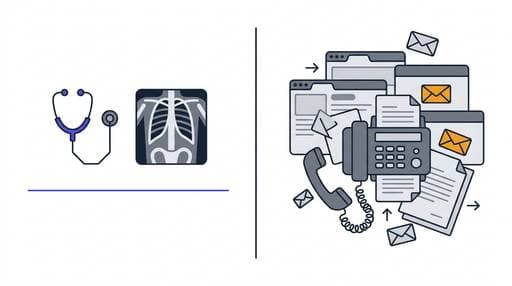
There's a joke that lands too hard in healthcare admin circles: "I'd rather have AI try to diagnose me than figure out how to bill me. And it'd probably do a better job diagnosing." It's funny because it's accurate. Clinical AI gets the magazine covers; the administrative layer that decides whether a practice survives runs on fax machines, twelve open browser tabs, and staff on payer hold lines. The headlines and the outcomes have drifted apart.
Table of Contents
- Why Is Administrative AI Lagging Behind Clinical AI?
- How Bad Is the Administrative Load on Independent Practices?
- Why Is Billing Actually Harder Than Diagnosis?
- What Does an Agent-Based Approach to Administration Look Like?
- Where Does This Matter Most for Independent Practices?
- Frequently Asked Questions
Why Is Administrative AI Lagging Behind Clinical AI?
Clinical AI captured the imagination because diagnosis is a bounded problem with prestigious data. Administrative AI lagged because billing is a sprawling, payer-fragmented mess that nobody finds glamorous — but it's where the money is actually lost. Diagnosis has clean inputs and a satisfying output. Billing has 72,000+ ICD-10 codes, payer-specific formularies, and rules that change county by county.
The result is a strange asymmetry. AI can read a chest X-ray with radiologist-level accuracy. It cannot, out of the box, verify that a patient's Humana plan covers next Tuesday's visit. The first capability is celebrated at conferences. The second is what determines whether the lights stay on at a six-provider practice in Phoenix.
Independent practices feel this gap most sharply. Medical practices spend roughly $20 per claim on administrative processing, with denial rates climbing year over year. Clinical AI doesn't touch that line item. Administrative AI does — when it's actually built for the workflow.
How Bad Is the Administrative Load on Independent Practices?
A typical independent specialty practice runs five to six administrative staff per provider, fields forty to fifty unanswered calls a day, and checks roughly a dozen payer portals manually. The payment cycle from visit to deposit averages ten weeks, and a meaningful share of those claims come back denied on the first pass. The math does not work in any other industry.
Sachin Gangupantula, VP Agentic Healthcare at Agentman and a practicing clinician at Valley Diabetes & Obesity, frames it this way:
"Tell me which other industry you go to work, spend your money, put in your time, and then ten weeks later you might get paid."
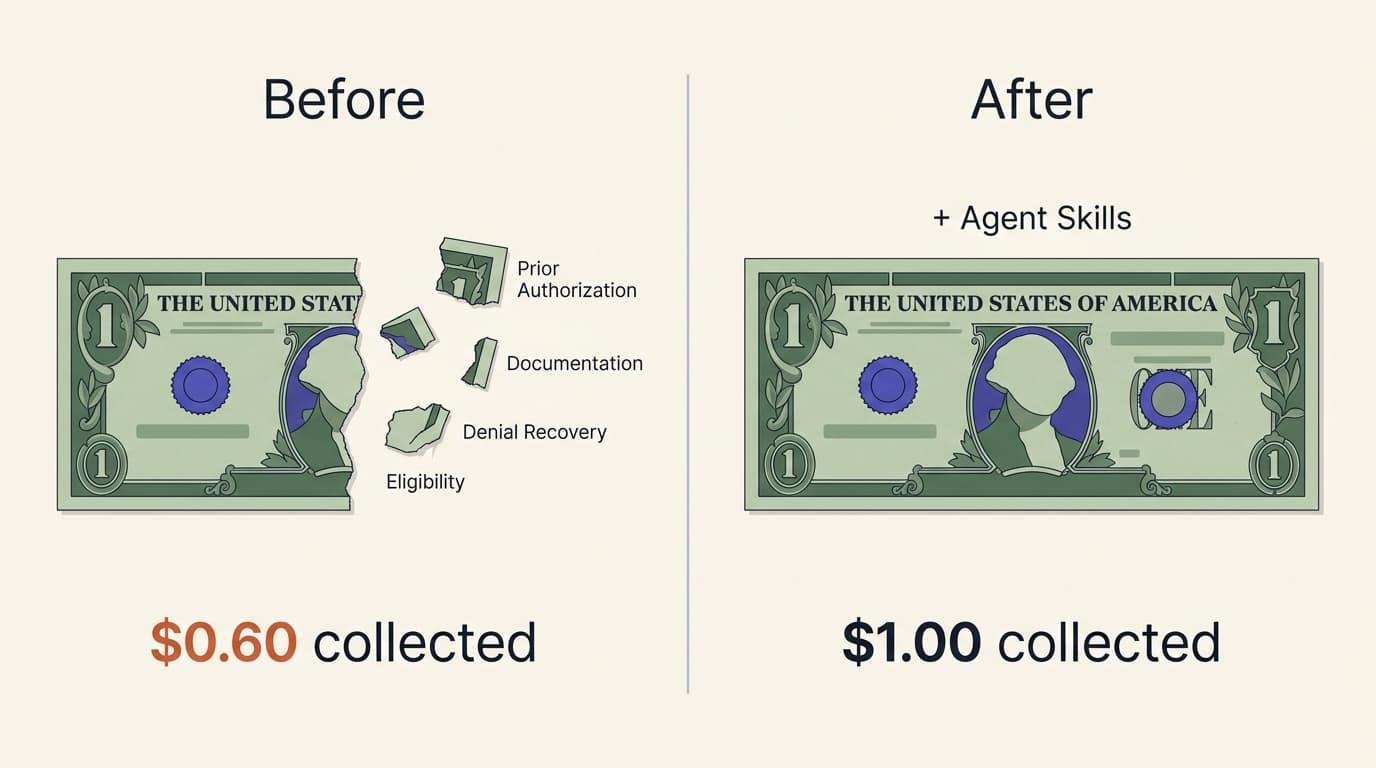
That delay is not a billing inefficiency. It is the operating model. And the operating model is held together by tribal knowledge — the front-desk lead who happens to know that Aetna in this county requires a specific modifier on GLP-1 prescriptions, the biller who remembers which Humana plan needs prior auth for a wound debridement code. When that person quits, the practice loses revenue for months. This is the gap agent skills are built to close.
| Admin reality at a typical independent practice | Number |
|---|---|
| Admin staff per provider | 5–6 |
| Unanswered patient calls per day | 40–50 |
| Payer portals checked manually | ~12 |
| Days from visit to payment | ~70 |
| ICD-10 codes in active use | 72,000+ |
| Diabetes-specific codes alone | 200+ |
Why Is Billing Actually Harder Than Diagnosis?
Diagnosis has converged on standardized inputs — imaging, labs, structured history. Billing has diverged: every payer has different rules, every plan has different coverage, every state has different requirements, and the rules change quarterly. The complexity isn't a bug in the system; it is the system. That's why the joke about preferring AI to diagnose you lands.
Take GLP-1 prescriptions. The clinical decision is relatively straightforward: BMI threshold, comorbidities, prior treatment history. The billing decision involves a different rulebook for every commercial payer, Medicare Advantage carve-outs, state Medicaid formularies that update without notice, prior authorization criteria that vary by plan tier, and step therapy requirements that depend on which formulary version was active when the prescription was written.
A clinician makes one decision. A biller has to make twenty.
This is where the comparison to clinical AI breaks down in a useful way. Clinical AI is being asked to match an expert. Administrative AI is being asked to replace an entire reference library that no human could memorize anyway. The bar is lower in some ways — and the leverage is higher. The same dynamic shows up in why prior authorization is the hardest problem in revenue cycle.
What Does an Agent-Based Approach to Administration Look Like?
An agent-based approach to medical administration captures the tribal knowledge of billing — payer rules, documentation requirements, prior auth criteria — as skills, then pairs them with agents that do the assembly and monitoring while humans verify and submit. The result is staff time shifting from twelve-portal portal-hopping to a fifteen-minute eligibility review. The agent doesn't replace the biller. It removes the parts of the biller's day that should never have been human work.
The architecture is specific. Skills encode the rule sets — what Aetna requires for a 99214 with a specific diagnosis modifier, what UnitedHealthcare's portal calls a "supplemental documentation packet." Agents run the daily operations: pulling eligibility, flagging denial risks before submission, monitoring payer portals for status changes, drafting appeals from denied claims with the correct documentation already attached.
Humans do what humans should do: verify, decide on edge cases, talk to patients, submit final claims. The fifteen-minute morning eligibility review at Valley Diabetes & Obesity replaced what used to be a multi-hour task split across two staff members.
Where Does This Matter Most for Independent Practices?
Denial prevention and prior authorization are the highest-leverage points. Practices typically lose 5–10% of revenue to denied claims that were technically preventable, and prior auth delays push the payment cycle from ten weeks to fourteen. Fix those two workflows and the financial picture changes materially.
Enterprise health systems have started reaching the same conclusion independently. Product leaders at major ambient AI companies have begun naming denial prevention and prior auth triggering as the integration opportunities they want next, without prompting. When the people who built clinical AI start asking for administrative AI, the gap between hype and outcomes is closing. We've written more on that handoff in the baton pass between ambient and agentic AI.
The takeaway for independent practices isn't that they need to build their own AI. It's that the tooling has finally arrived for problems they've been quietly absorbing for a decade.
See how Valley Diabetes & Obesity rebuilt its admin workflow around agents. Read the case study →
Frequently Asked Questions
What is administrative AI in healthcare?
Administrative AI in healthcare refers to systems that automate the non-clinical workflows of running a practice: eligibility verification, prior authorization, claims preparation, denial management, payer portal monitoring, and patient communication. Unlike clinical AI, which supports diagnosis and treatment, administrative AI targets the revenue cycle and back-office operations that determine whether a practice is financially viable.
Why do independent medical practices struggle with billing?
Independent practices struggle with billing because each payer has different rules, formularies change without notice, and there are over 72,000 ICD-10 codes with thousands more added or revised yearly. Most practices rely on the institutional memory of one or two long-tenured staff. When that knowledge walks out the door, claims get denied, payments get delayed, and the practice loses revenue it had already earned.
How long does it take a medical practice to get paid?
The average payment cycle from patient visit to deposited payment runs roughly ten weeks for clean claims, and fourteen or more weeks when denials and appeals are involved. This is one of the longest revenue cycles of any service industry and a primary reason independent practices struggle with cash flow.
Can AI handle medical billing better than humans?
AI handles the rules-heavy, repetitive parts of medical billing — eligibility verification, code lookup, denial pattern detection, prior auth criteria matching — more accurately and consistently than humans, because no individual can hold 72,000 codes and dozens of payer rulebooks in working memory. Humans remain essential for edge cases, patient conversations, and final claim submission.
What is the difference between clinical AI and administrative AI?
Clinical AI supports diagnosis, imaging analysis, and treatment recommendations using structured medical data. Administrative AI automates the operational workflows that surround clinical care: insurance verification, billing, prior authorization, and revenue cycle management. Clinical AI gets more attention; administrative AI typically delivers faster ROI for independent practices.
Special thanks to Sachin Gangupantula, VP Agentic Healthcare at Agentman and a practicing clinician at Valley Diabetes & Obesity, for the field perspective that shaped this piece.