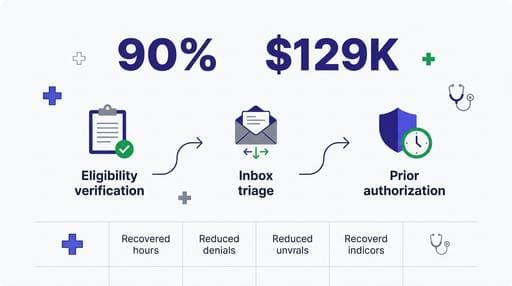
Quick answer: Prior authorization remains the largest single administrative time sink in independent specialty practice. The MGMA 2026 Regulatory Burden Report found that 90% of practices saw prior authorization requirements increase in the past year, and 40% have hired multiple full-time administrative staff per physician to handle payer rules and appeals. Agent skills automate the full PA workflow — triggered by EHR prescriptions, inbox arrivals, or ambient encounter detection — by encoding payer-specific approval criteria, assembling the documentation, and routing to a clinician for one-click approval before submission. Under CMS-0057-F's 2026 timeline shifts, the practices that win are the ones that can submit clean documentation faster, not the ones waiting for the 2027 API mandate.
Table of Contents
- Why is prior authorization the #1 administrative pain point for independent practices in 2026?
- What changed under CMS-0057-F on January 1, 2026 — and what didn't?
- What triggers a prior authorization workflow today?
- How does an agent skill actually handle a prior auth request?
- What does "tribal knowledge" mean in a prior auth skill?
- How does the agent submit when the payer has no API?
- Who monitors outstanding prior auths after submission?
- What is "clean prior auth" and why does it matter?
- FAQ
- Key takeaways
Why is prior authorization the #1 administrative pain point for independent practices in 2026?
Prior authorization is, by every 2026 measure, the largest single administrative drag on independent practice operations. The Medical Group Management Association's 2026 Regulatory Burden Report, released in April 2026 with responses from leaders representing more than 230 medical group practices, found that nearly 95% of respondents reported an increase in regulatory burden over the past three years, with three of the top five administrative challenges directly tied to Medicare Advantage prior authorization, claim denials, and automatic downcoding. 90% of practices said PA requirements increased in the past year alone.
It is not just providers feeling it. A KFF survey published in February 2026 found that patients view prior authorization as the single biggest burden when navigating the health care system beyond cost, with 32% calling it a "major burden" — and among individuals with chronic conditions requiring ongoing treatment, 39% named PA the largest burden, more than twice as much as any other issue mentioned.
The volume baseline has not improved. Practices still complete an average of 39 PAs per physician per week, dedicating roughly 13 hours of physician and staff time to processing them. 40% of practices have hired multiple full-time administrative staff per physician to manage payer rules, audits, appeals, and reporting requirements — resources diverted away from patient care. For an independent specialty practice, that fixed overhead is the difference between profitable and not.
The harm extends to patients. More than 25% of physicians surveyed report that prior authorization has led to serious adverse events for patients, and 93% report that PA delays access to necessary care. Payer-side AI has, if anything, made this worse: an 82% overturn rate on appealed Medicare Advantage prior authorization denials means the system is generating mass wrongful denials by default, and only a small fraction of patients ever appeal — so most harmful denials go permanently unchallenged.
Existing solutions optimize the wrong end of the problem. Outsourced PA services and CoverMyMeds-style portals reduce per-PA effort but still require human assembly of the clinical record. Payer-side automation speeds approvals only when payers want approvals to be fast — which, the appeal data suggests, is rarely.
What changed under CMS-0057-F on January 1, 2026 — and what didn't?
CMS-0057-F, the Interoperability and Prior Authorization Final Rule, took partial effect on January 1, 2026. Standard prior auth decisions must now happen within 7 calendar days, down from 14, and expedited requests must close within 72 hours. Payers must also provide specific denial reasons rather than vague boilerplate. The rule applies to Medicare Advantage, state Medicaid FFS, CHIP FFS, Medicaid and CHIP managed care plans, and Qualified Health Plans on the federal exchanges. Public reporting of PA approval and denial metrics also began in March 2026.
What did not change in 2026: the actual electronic submission infrastructure. The full FHIR API requirements — including the Prior Authorization API that would let providers check requirements and submit requests electronically through a standardized interface — follow on January 1, 2027. Until then, the majority of commercial PAs and a meaningful portion of Medicaid PAs will still require portal and phone workflows.
The practical implication for independent practices in 2026 is that the bottleneck has shifted. The payer's clock now runs faster on their side, but the practice's clock for assembling a clean submission has not changed. The faster the practice can package a clean PA, the more of the new 7-day window converts into actual decision time instead of documentation time. That is exactly the workflow agent skills are designed to compress.
There is one more 2026 wrinkle. In June 2025, more than 50 major health plans — including UnitedHealthcare, Aetna, Cigna, Humana, Elevance Health, Kaiser Permanente, and Centene — pledged to simplify PA processes, commit to real-time approvals for at least 80% of requests, and increase turnaround speed, with the first public progress report expected in spring 2026. Whether the pledge holds is an open question, but the direction is clear: speed wins.
What triggers a prior authorization workflow today?
Three distinct events trigger a prior authorization workflow in a specialty practice. Each one is a different entry point into the same downstream process — and an agentic system has to handle all three to be useful, not just the easy one.
| Trigger | Where it originates | Example |
|---|---|---|
| EHR prescription | Provider prescribes a medication flagged as PA-required | Physician orders a GLP-1 in the EHR |
| Inbox arrival | Fax or email from pharmacy or payer asks for documentation | Pharmacy faxes a PA form for a refill |
| Ambient encounter | AI scribe detects a clinical event during the visit | Physician says "let's get a CT scan" mid-exam |
The third trigger is the most powerful and the least served by existing tools. When ambient AI hears a physician decide on a procedure during the encounter, the downstream PA process can begin before the patient leaves the room. Without that integration, the scribe captures the event and staff still have to start PA from scratch ten minutes later. The baton pass between ambient AI and agentic AI is where the largest staff-hour savings sit.
How does an agent skill actually handle a prior auth request?
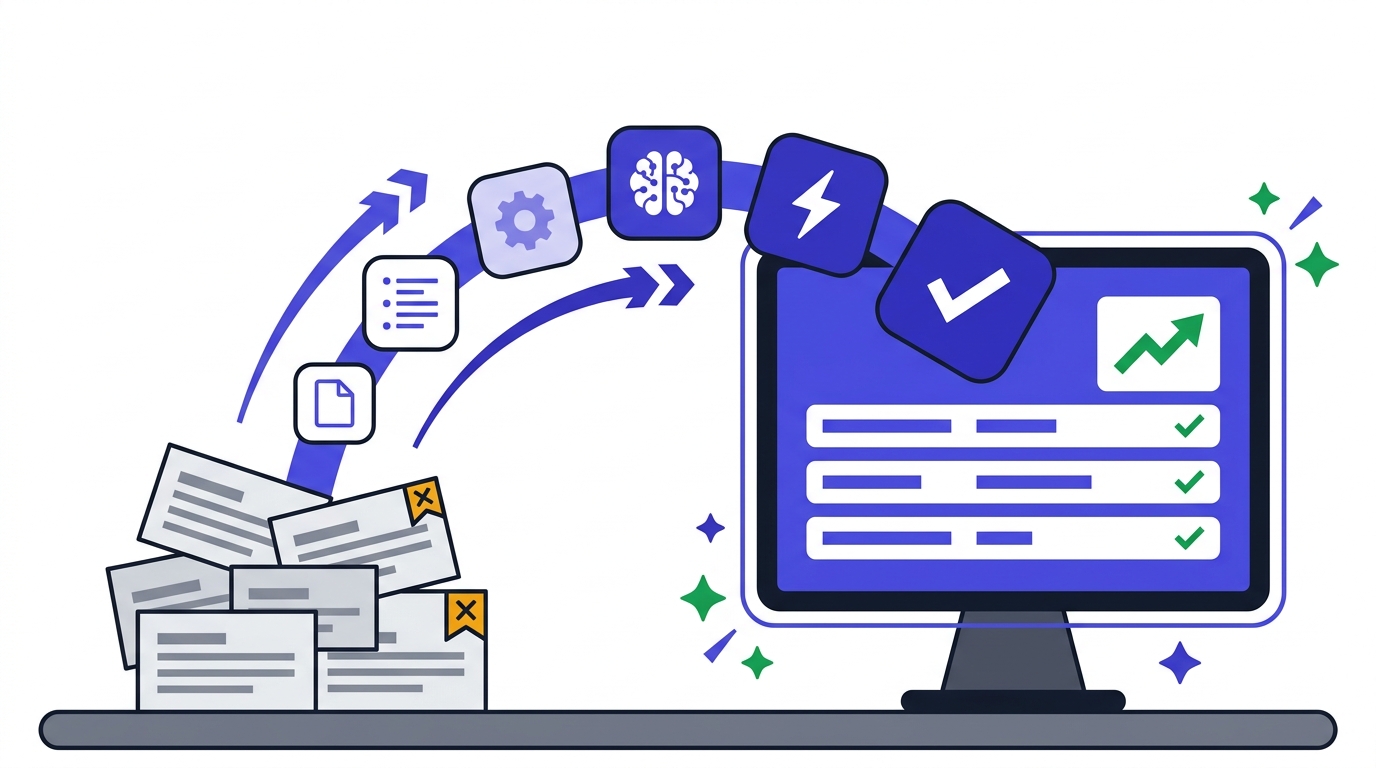
A prior authorization agent skill executes a five-step procedure: detect the trigger, load the payer-and-drug-specific skill, assemble the clinical documentation from the chart, route to a clinician for approval, and submit through the right channel. The clinician approves; the agent does the work. Compliance and clinical judgment stay with the human; the typing, faxing, and portal logins do not.
In practice, the workflow looks like this:
- Trigger detected. The agent receives a signal from one of the three sources above.
- Skill loaded. The agent identifies the payer, the requested item, and loads the skill that encodes the rules for that combination.
- Data assembled. The skill extracts required clinical evidence from the chart: BMI, A1c, comorbidities, prior therapy history, ICD-10 codes, recent visit notes.
- Human review. The agent presents the assembled package to the clinician with the rule it applied and the evidence it found. The clinician approves, edits, or rejects.
- Submission. On approval, the agent submits through the optimal channel: an electronic API where available, payer portal where required, or screen agent automation where neither exists.
The category mix matters for prioritization. Medications consume 40–50% of total PA staff time, with GLP-1s, refills, and continuous glucose monitors as the highest-volume categories. Imaging is the next tier — anything beyond a plain X-ray typically requires PA. DME and specialty procedures round out the volume, with DME getting its own dedicated skill because the documentation pattern is materially different.
The category that the broader market is finally proving works: documentation-first automation. A rheumatology practice using AI to compile complete PA packets saw its first-pass approval rate jump from 62% to 94%, virtually eliminating the need for appeals — and an oncology group using AI-driven policy checks saw its denial rate drop by 42%, simply by ensuring requests were complete and compliant from the start. The mechanism is the same: encode the payer's criteria, check the chart against them, and surface gaps before submission.
What does "tribal knowledge" mean in a prior auth skill?
"Tribal knowledge" is the unwritten, payer-specific approval criteria that experienced staff carry in their heads. A prior auth skill captures that knowledge in code so the next clinic, the next staff member, and the next agent can use it without re-learning it from denial letters.
GLP-1s are the clearest example. Most commercial plans require BMI ≥30, or BMI ≥27 with at least one weight-related comorbidity such as hypertension, type 2 diabetes, dyslipidemia, or sleep apnea — with stricter plans requiring BMI ≥35. First-pass approval rates for obesity-indicated GLP-1s now sit below 40% on many plans, but climb above 80% when documentation is complete and payer-specific criteria are addressed. A staff member who has been there five years knows which boxes the local Blue plan checks before submitting. A staff member in their first month submits, gets denied, and loses two weeks of cycle time.
A skill encodes that rule once and applies it everywhere. When a GLP-1 PA enters the workflow, the skill checks the BMI threshold and the documented comorbidities against the specific payer's criteria before assembling anything else. If a criterion is not met, the agent surfaces the gap to the clinician before submission — which is the entire point of clean prior auth (see below).
This is also why the architecture compounds. Every clinic that teaches a skill how to handle a specific payer-and-drug combination contributes to a knowledge base every other clinic on the platform inherits. The flywheel is not abstract; it is a literal "if BMI threshold not met, flag it" check that did not exist last quarter and exists now.
How does the agent submit when the payer has no API?
A meaningful share of payer interactions still happens on portals with no clean API. CMS-0057-F's Prior Authorization API is a 2027 deadline, not a 2026 reality, and even after that deadline, fully insured commercial plans regulated solely by state insurance departments and self-funded ERISA plans are not subject to the rule at all. Practically, this means PA automation in 2026 looks a lot like commercial PA automation has always looked — browser agents on portals, voice agents on phone lines — with the reasonable expectation that a portion will migrate to FHIR APIs through 2027–2028.
A cloud-only agent stops at the API boundary. A desktop-resident agent does not.
This is where MedMan's screen agent architecture matters. The desktop application can drive a payer portal the same way a human staff member would: log in, navigate to the PA submission form, paste in the assembled documentation, attach the supporting files, click submit. Cloud-only competitors physically cannot do this — their runtime sits on the wrong side of the network boundary. That is not a feature gap that closes with more engineering investment from a cloud vendor; it is an architectural choice that has to be made at the start.
The result is end-to-end submission coverage instead of partial coverage. For a workflow where the long tail of regional, Medicaid, and self-funded payers is exactly where margin compression happens, the last 30% is not a rounding error.
Who monitors outstanding prior auths after submission?
Submission is not the end of the workflow — it is the middle. Every submitted PA generates a status that has to be checked, and every clinician knows the daily routine of logging into multiple portals to see what is pending, what has been approved, and what has been denied. That status-monitoring loop is where the second-largest chunk of PA staff time disappears.
An agent skill closes the loop by polling status across portals continuously and surfacing only the exceptions to the practice command center. Approvals route silently to the chart. Denials and additional-information requests escalate to staff with the relevant context already attached. The clinician's day stops including the line item "log into seven payer portals to check status."
This is the part competitors most often skip. It does not demo well — there is no dramatic moment of automation — but it is where staff time actually leaks. Closing it is the difference between a PA tool and a PA workflow.
What is "clean prior auth" and why does it matter?
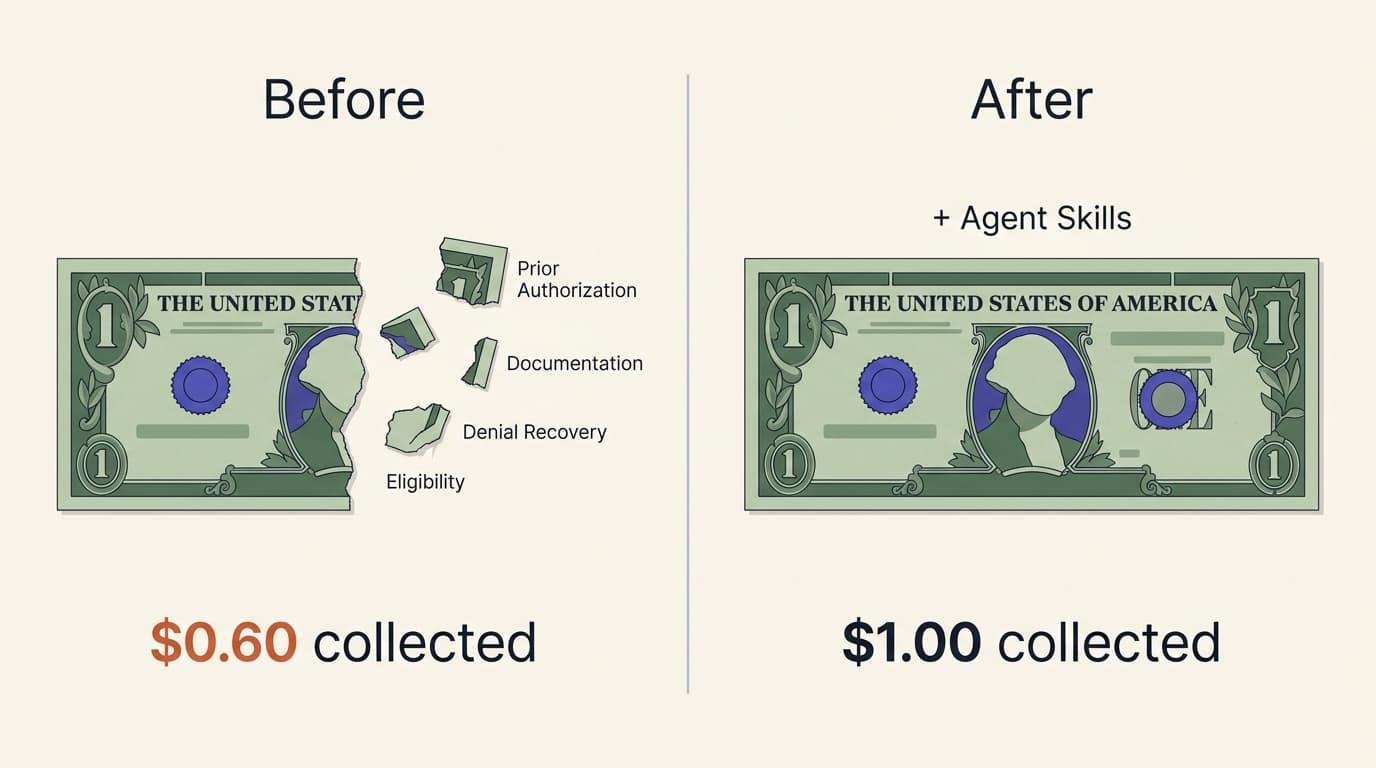
"Clean prior auth" is a PA submitted with all required documentation correct on the first attempt — approved without back-and-forth, peer-to-peer calls, or additional-information requests. The opposite, "dirty PA," is the default state of the industry. Most practices should target 90% or higher first-pass approval rates, but the industry average sits between 70 and 80% — meaning practices with strong documentation and submission processes can significantly outperform typical benchmarks. On GLP-1s specifically, the gap between a dirty submission and a clean one is the difference between a sub-40% first-pass rate and one above 80%.
The connection between PA automation and clinical documentation improvement (CDI) is direct. If the agent knows the payer requires a specific BMI threshold plus documented comorbidities for a GLP-1 PA, it can flag incomplete documentation at the point of care — before the visit ends, before the PA is even submitted. The physician adds the missing comorbidity to the note while the patient is still in the room. The PA goes out clean. Approval comes back without a peer-to-peer.
Clean PA is the version of this product that compounds. Dirty PA automation saves staff time on rework. Clean PA automation eliminates the rework entirely.
Proof point: Valley Diabetes & Obesity launched their PA agent in March 2026. As of week 4, the agent is processing prior authorizations across the three highest-volume drug categories with the clinic's payer-specific knowledge encoded, in production, with human-in-the-loop approval on every submission.
Frequently Asked Questions
How much time does prior authorization actually consume in an independent practice in 2026?
Practices complete an average of 39 PAs per physician per week and dedicate roughly 13 hours of physician and staff time to processing them. The MGMA 2026 Regulatory Burden Report found that 90% of practices saw PA requirements increase in the past year, and 40% have hired multiple full-time administrative staff per physician to manage payer rules.
Does an agent skill replace the clinician's judgment on prior auth?
No. An agent skill assembles the documentation and applies known payer rules, then routes the package to the clinician for approval. The clinician approves, edits, or rejects every submission. The agent handles the typing, faxing, and portal logins; the human handles the clinical judgment.
What happens when the payer has no API?
A desktop-resident agent uses screen automation to drive the payer portal the same way a human would — logging in, completing forms, attaching documents, clicking submit. Cloud-only platforms cannot do this because their runtime sits outside the user's desktop environment.
What changed under CMS-0057-F on January 1, 2026?
Impacted payers must now issue urgent PA decisions within 72 hours and standard decisions within 7 calendar days, must provide specific denial reasons, and began publicly reporting PA metrics in March 2026. The full FHIR-based Prior Authorization API requirement does not take effect until January 1, 2027.
How does the agent know payer-specific approval criteria?
Payer rules are encoded as agent skills — for example, the BMI and comorbidity thresholds required by a specific plan for GLP-1 prior authorization. Each clinic that teaches the system a new rule contributes to a knowledge base every other clinic inherits.
What is the difference between PA automation and "clean prior auth"?
PA automation reduces staff time on rework. Clean prior auth eliminates rework entirely by flagging missing documentation at the point of care, before the PA is submitted. Practices targeting clean submission have moved first-pass approval rates from the 60–70% industry baseline into the 90%+ range in published case studies.
Does this work for imaging and DME, not just medications?
Yes. Medications are the most common entry point and the highest volume. Imaging — anything beyond a plain X-ray — and durable medical equipment each have dedicated skills with their own documentation patterns. Specialty procedures are added per-specialty.
Key takeaways
- The 2026 burden picture has gotten worse, not better: 90% of practices saw PA requirements increase in the past year, and 40% have hired multiple full-time administrative staff per physician to manage them (MGMA 2026 Regulatory Burden Report).
- CMS-0057-F shortened payer decision timeframes in 2026, but the electronic submission API does not go live until 2027 — so the bottleneck has shifted to how fast practices can assemble a clean submission.
- PA workflows trigger from three sources — EHR prescription, inbox arrival, and ambient encounter detection — and coverage of all three is required to actually move the staff-hours number.
- Agent skills encode payer-specific approval criteria and apply them to every relevant submission across the platform.
- Desktop-resident screen agents close the share of payer portals with no API, and self-funded and state-regulated commercial plans that fall outside CMS-0057-F entirely.
- Status monitoring is the often-skipped "last mile" of PA automation; closing it is what turns a tool into a workflow.
- "Clean prior auth" — flagging documentation gaps at the point of care — is the version that compounds. Documented case studies show first-pass approval rates moving from the 60–70% baseline into the 90%+ range when the documentation step is automated correctly.
Next step: If you run an independent specialty practice and your staff is losing a day a week per physician to prior authorization, book a discovery call to see your three highest-volume PA categories mapped to skills.