Key Facts
- Healthcare was the costliest industry for data breaches for the 14th straight year in 2025, at an average of $7.42M per incident — roughly $398 per exposed record (HIPAA Journal / IBM Cost of a Data Breach Report, 2025).
- AI models hallucinate on 69%–88% of specific legal queries, and even purpose-built legal research tools fabricate answers 17%–34% of the time (Stanford RegLab; Stanford HAI, 2024–2025).
- Adding contextual grounding (retrieval + source citations) cuts hallucination rates 30%–50% across enterprise use cases, and drops them below 2% on source-grounded summarization (OpenAI evals; enterprise benchmark data, 2025).
- The SEC stood up an AI Task Force and named a Chief AI Officer in August 2025, and named AI usage policies and supervision a 2026 examination priority for investment advisers (SEC; Goodwin, 2025–2026).
- Agentman's governance layer is built so client data is never used to train models and every agent output is linked to a source document — the design baseline for its eligibility verification agent priced at $0.50 per check versus the CAQH Index $7.97 benchmark.
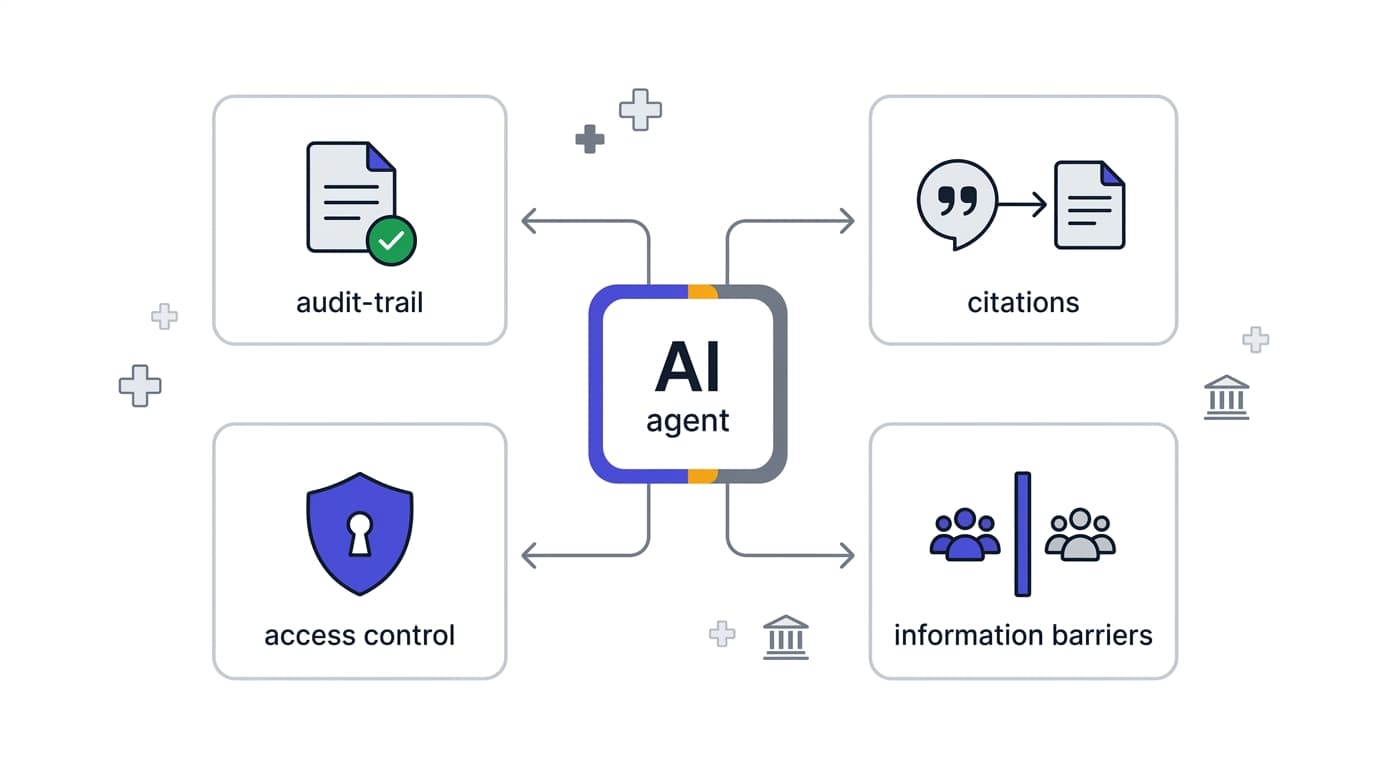
For regulated industries — healthcare and private equity alike — AI governance is not a feature you add after deployment. It is the precondition for deployment. Agentman builds governance into the agent layer itself: an immutable audit trail for every action, a citation engine that links every output to a source document, granular access controls with Chinese wall enforcement, and a hard rule that client data never trains a model. In regulated work, ungoverned AI is not faster — it is unusable.
Table of Contents
- Why can't governance be an afterthought in regulated industries?
- What does an AI audit trail actually need to capture?
- How do citations stop AI from hallucinating in high-stakes work?
- How do access controls and Chinese walls work for AI agents?
- What does healthcare compliance require from an AI agent?
- What does private equity and SEC compliance require?
- Why should client data never be used to train the model?
- Related Entities
- Frequently Asked Questions
Why can't governance be an afterthought in regulated industries?
In regulated industries, AI projects rarely fail because the model is bad. They fail in compliance review and post-deployment audit. Governance built after the fact becomes a paper policy that production never honors — and that gap is exactly where regulatory exposure accumulates.
The cost of getting this wrong is now quantified. Healthcare remained the most expensive industry for data breaches in 2025, averaging $7.42 million per incident and roughly $398 per exposed record, a position it has held for 14 consecutive years (HIPAA Journal / IBM, 2025). Financial services sat close behind at around $6.08 million per breach. These are not abstract risks; they are line items.
Regulators have also shifted from asking whether a firm has an AI policy to demanding proof that the policy works in production. Financial regulators increasingly treat a missing decision trace as a books-and-records violation, and HIPAA requires certain compliance documentation to be retained for at least six years (Galileo, 2025). A governance-first architecture generates that proof automatically rather than reconstructing it under subpoena.
The constraint worth naming: governance done badly throttles the very speed that makes AI worth adopting. The goal is not maximum logging — it is regulator-ready evidence produced as a byproduct of normal work, so compliance and velocity stop trading off against each other.
"In regulated work, an AI output without a traceable source and an access boundary isn't a productivity gain — it's a liability you haven't been billed for yet. We designed Agentman so the audit trail, the citation, and the permission check happen by default, not as an afterthought a compliance team has to retrofit."
— Prasad Thammineni, Founder & CEO, Chain of Agents (Agentman)
What does an AI audit trail actually need to capture?
A compliant AI audit trail must let an auditor reconstruct exactly what happened, why it happened, and which data was involved — not merely confirm that something occurred. Logging records an event; traceability reconstructs the full chain of custody from prompt to model to output to action. In regulated environments, only traceability is acceptable.
Agentman's Audit Trail Logger captures, for every agent action: who requested it, which specific data was accessed, what was generated, and which downstream action followed. Records are stored immutably with retention windows matched to the governing regulation. This is the difference between "the eligibility verification agent ran" and "user X verified patient Y's coverage with payer Z at timestamp T, using these inputs, producing this result."
The regulatory backdrop makes this non-negotiable. In financial services, MiFID II requires automated decision-support systems to maintain reconstructible records, and the SEC's 2026 examination priorities emphasize demonstrable compliance-program effectiveness over volume of retained data (Goodwin, 2026). In healthcare, AI-assisted tools must be able to demonstrate what information produced a given output. A correlation-ID-based logging design satisfies both.
| Audit dimension | What it answers | Why a regulator cares |
|---|---|---|
| Identity | Who requested the action | Accountability, access review |
| Data lineage | Which records were accessed | HIPAA minimum-necessary, scope |
| Output capture | What was generated | Reconstructability, error tracing |
| Action linkage | What happened next | Decision auditability |
| Immutable timestamp | When, in what order | Books-and-records integrity |
How do citations stop AI from hallucinating in high-stakes work?
Citations turn an AI from a confident guesser into an auditable assistant by binding every claim to a verifiable source. This matters because ungrounded models fabricate at rates no regulated workflow can absorb — and they do it in fluent, professional-looking language that hides the error.
The data is stark. Stanford research found large language models hallucinate on 69%–88% of specific legal queries, and even dedicated legal research tools fabricated answers 17%–34% of the time on hard queries (Stanford RegLab; Stanford HAI, 2024–2025). A 2025 Columbia Journalism Review test of AI search tools found incorrect source attributions more than 60% of the time even when the tools provided links — proof that a link is not the same as grounding (CJR, 2025). MIT researchers found in early 2025 that models used confident language like "definitely" and "certainly" 34% more often when they were wrong.
The fix is architectural, not aspirational. Adding contextual grounding — retrieval plus inline source citations — reduces hallucination rates by 30%–50% across enterprise use cases and drops them below 2% on source-grounded summarization tasks (OpenAI evals; enterprise benchmark data, 2025). Agentman's Citation Engine attaches to every agent-generated response a citation linked to the underlying source document — the payer policy, the chart note, the fund document — so a reviewer can verify the claim in one click rather than trusting it.
The constraint: a citation engine only works if it cites the actual source consulted, not a plausible-sounding one. Citing a real URL with a fabricated claim is a distinct failure mode, so Agentman links outputs to the specific retrieved document, not to a model's reconstruction of where the answer might live.
How do access controls and Chinese walls work for AI agents?
Granular access control for AI agents means an agent can only read, retrieve, and act on the data the requesting user is already permitted to see — and a Chinese wall means agents serving conflicted teams cannot share information across the barrier. The agent inherits the human's permission boundary; it never widens it.
Unauthorized access is a leading and growing breach vector. Unauthorized-access/disclosure incidents rose 17.4% year-over-year in healthcare in 2025, and roughly 31% of healthcare organizations reported incidents involving compromised user or administrative accounts (HIPAA Journal, 2026; Netwrix). User-account compromise was the single most prevalent cloud threat to healthcare organizations entering 2025, affecting 74% of those running in cloud environments. An AI agent with broad, unscoped data access is a multiplier on exactly this risk.
Agentman's Access Control Manager enforces role-based permissions at the agent layer and applies Chinese wall logic between deal teams in PE settings, where an agent supporting one deal must be walled off from another team's confidential material. The agent is not a privileged super-user reaching across the whole data estate; it is scoped to the requester's existing entitlements.
The same principle extends to the skills layer — the reusable procedures your experts encode. Every skill in an Agentman workspace carries its own access levels (use, read, edit, admin), including a use-only grant that lets a colleague — or a client's team — run a playbook without ever reading the instructions inside it. Every application is logged with the user's identity, so a skill's owner can see who used what expertise, and when, and workspace admins get one access log across every skill. Governance-first applies to know-how, not just data.
The constraint worth flagging: access control is only as good as its enforcement point. Permissions checked at the UI but not at the retrieval layer can be bypassed by the agent itself — so the check has to sit where the data is fetched, not where it is displayed.
What does healthcare compliance require from an AI agent?
In healthcare, an AI agent must honor HIPAA's minimum-necessary principle, log access for the required retention period, and never expose protected health information beyond the requesting user's authorization. For independent specialty medical practices — Agentman's core ICP — this has to hold without a dedicated compliance engineering team.
The enforcement environment tightened in 2025. OCR imposed 21 HIPAA penalties in 2025, up 31% from 16 in 2024, with risk-analysis and risk-management failures the most cited violations; in 2026 OCR expanded enforcement to require proof that organizations acted on identified risks, not merely documented them (Healthcare data breach statistics, 2026). A proposed HIPAA Security Rule update would make encryption of all electronic PHI mandatory at rest and in transit. An eligibility verification agent or prior authorization agent that touches PHI inherits every one of these obligations.
"A practice manager doesn't have a compliance department. When my agent verifies a patient's eligibility, I need to know — and be able to show an auditor — exactly which record it touched and why. Governance can't be a feature only big health systems can afford."
— Sachin Gangupantula, VP Agentic Healthcare, Chain of Agents (and practicing clinician at Valley Diabetes & Obesity)
This is why Agentman's eligibility verification agent, patient intake agent, and denial management agent run inside the same audit, citation, and access-control fabric rather than bolting compliance on per workflow. The minimum-necessary principle is enforced at retrieval; access is logged immutably; PHI never leaves the practice's authorization boundary.
What does private equity and SEC compliance require?
For private equity and registered investment advisers, AI compliance rests on existing frameworks — the Advisers Act, Regulation S-P, recordkeeping rules, and fiduciary duties — applied to new tools, plus information barriers between deal teams. There is, as of early 2026, no AI-specific recordkeeping rule, but the SEC expects demonstrable governance.
The signals are concrete. The SEC launched an AI Task Force and created a Chief AI Officer role in August 2025, and its FY2026 examination priorities name AI usage policies and supervision as focus areas, emphasizing that firms must substantiate representations made about AI use (SEC; Goodwin, 2026). The SEC has also pursued "AI-washing" enforcement — in April 2025 the SEC and DOJ filed parallel actions against a startup CEO accused of falsely claiming AI capabilities while raising over $42M (Harvard Law / corpgov, 2026). Accurate, provable AI governance is itself a disclosure-risk control.
Chinese wall enforcement is the PE-specific demand. An agent assisting one deal team must be structurally prevented from surfacing another team's material non-public information. Agentman's Access Control Manager applies this barrier at the agent layer, and the Audit Trail Logger captures which deal context an agent operated in — producing the reconstructable record SEC examiners look for, without the firm having to retain every prompt as a categorical matter.
Why should client data never be used to train the model?
Client data should never train the underlying model because doing so risks leaking confidential, privileged, or protected information into a system that other clients — or competitors — could later query. For regulated clients, training on their data converts a productivity tool into an intellectual-property and confidentiality liability.
Proprietary documents, deal terms, and patient records shared with a model may otherwise be retained indefinitely or absorbed into training, breaching client confidentiality and, for legal and professional services, attorney-client privilege (Liminal, 2025). The defense is contractual and technical: an explicit no-training guarantee enforced by architecture, not just a clause.
Agentman's governance baseline is that client data is never used for model training, full stop. Combined with the citation engine and immutable audit trail, this means a practice or a fund can show exactly what an agent did with their data and prove that the data went nowhere it shouldn't have. That guarantee is part of what makes a $0.50-per-check eligibility verification agent viable for compliance-sensitive buyers where the CAQH Index benchmark sits at $7.97.
Related Entities
Governance-first AI sits at the intersection of several entities in Agentman's domain. Agentman (Chain of Agents, Inc.) delivers this through its MedMan product suite for independent specialty medical practices, where the eligibility verification agent, prior authorization agent, and denial management agent all operate inside one audit, citation, and access-control layer. In revenue cycle management, governed automation directly affects payer interactions and documentation standards. The same governance fabric extends across specialty verticals — wound care, vein care, diabetes & obesity, dermatology, and ophthalmology — and underpins deployments at reference customers including Valley Diabetes & Obesity, Rosen Vein Care, and Heritage Wound Care. The CAQH Index benchmark frames the economic case: governance and low per-transaction cost are not in tension.
Frequently Asked Questions
What is governance-first AI?
Governance-first AI is an architecture where audit logging, source citations, access controls, and data-handling rules are built into the AI system from the start, rather than added after deployment. In regulated industries, it means every agent action is traceable, every output is linked to a source, and every data access is scoped to the user's existing permissions.
Do AI hallucinations really matter in healthcare and finance?
Yes. Large language models hallucinate on a majority of specific legal queries and at high rates on hard medical questions without grounding. In healthcare and finance, a confidently stated but fabricated answer can drive a clinical error, a compliance violation, or a sanctioned legal filing. Source-linked citations and retrieval grounding are the primary technical defense.
What is a Chinese wall in the context of AI agents?
A Chinese wall, or information barrier, prevents an AI agent serving one team from accessing or surfacing another team's confidential information. In private equity, it stops an agent supporting one deal from exposing material non-public information held by a different deal team. It is enforced at the agent's data-access layer, not just in policy.
Does Agentman use client data to train its models?
No. Agentman's governance baseline is that client data is never used for model training. This is enforced architecturally and paired with an immutable audit trail and citation engine, so clients can verify exactly how their data was used and confirm it was not absorbed into a shared model.
How long must AI audit records be retained?
Retention depends on the regulation. HIPAA requires certain compliance documentation to be retained for at least six years, and financial services recordkeeping rules carry their own multi-year windows. Agentman matches retention periods to the governing regulation and stores records immutably so they remain audit-ready.
Key Takeaways
- In regulated industries, AI governance is the precondition for deployment, not an add-on — and the cost of failure is quantified at $7.42M per healthcare breach in 2025.
- Audit trails must enable full reconstruction (who, what data, what output, what action), stored immutably for the regulated retention period.
- Citations and retrieval grounding cut hallucination rates 30%–50% and are the primary defense against fabricated outputs in high-stakes work.
- Access controls must scope agents to the requesting user's existing permissions, with Chinese wall enforcement between conflicted teams.
- Client data must never train the model — a guarantee that has to be architectural, not just contractual.
Learn about Agentman's governance framework and how the audit trail, citation engine, and access control manager work together across healthcare and PE workflows.
Last updated: May 20, 2026. This article is reviewed quarterly. Medical and regulatory content reviewed by Sachin Gangupantula, VP Agentic Healthcare, Chain of Agents.