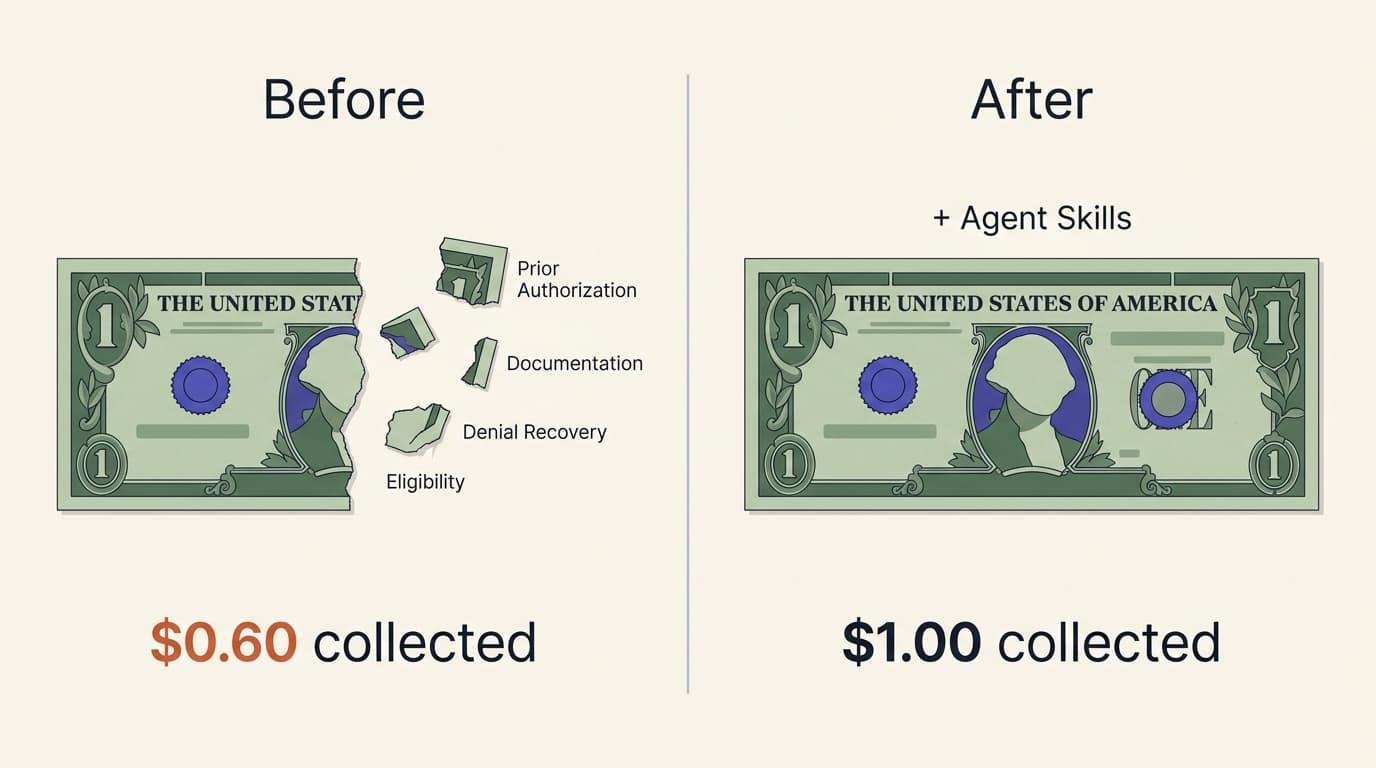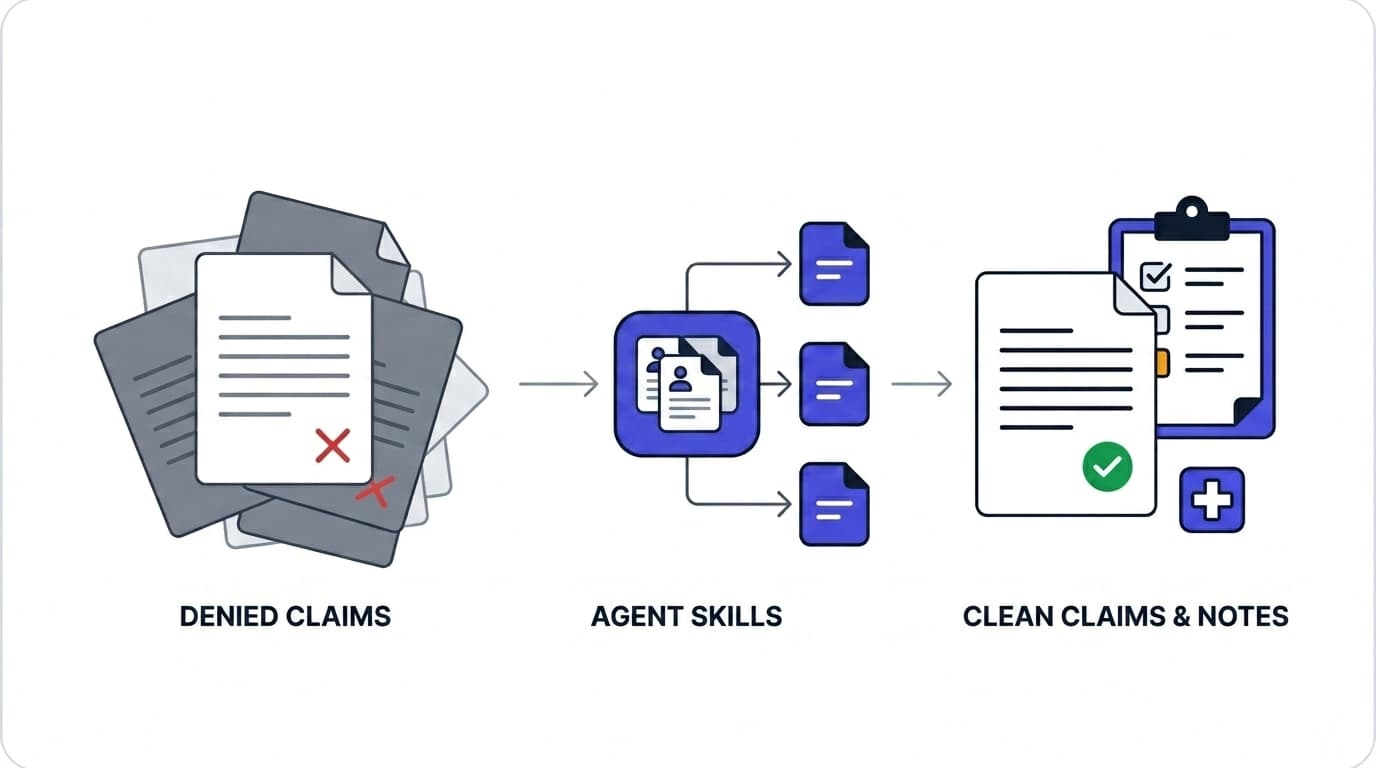
Healthcare AI has a network effect that no horizontal SaaS company can replicate: when one independent specialty practice's eligibility verification agent encounters a new Aetna denial pattern, every practice on the same platform learns from it within hours. Payer rule changes, denial codes, and coding updates propagate across the network as shared infrastructure — not as siloed lessons each practice has to rediscover alone. This is the Healthcare Intelligence Layer.
Key Facts
- Initial claim denial rates reached 11.8% in 2024, up from 10.2% a few years earlier; 41% of providers now report denial rates above 10% (Experian Health State of Claims 2025, January 2026).
- Prior authorization denials grew 31% year-over-year in 2026 and now represent 34% of all first-pass claim denials, up from 22% in 2023 (Medical Billers and Coders 2026 Denial Management Analysis, May 2026).
- UnitedHealthcare added 847 new code pairs to its proprietary bundling-edit library in Q3 2025, creating CARC 4 denials on claims that were clean under the prior edit set (Medical Billers and Coders, May 2026).
- Data network effects are now the single most important moat in AI-native enterprise software, displacing scale economies and switching costs as the top defensive characteristic (Oxx, October 2025).
- Agentman's eligibility verification agent runs at $0.50 per check versus the CAQH Index benchmark of $7.97 — a 93.7% cost reduction that compounds as the network learns shared denial patterns.
Table of Contents
- Why does healthcare AI have a unique network effect?
- How do payer rule changes break individual practices today?
- What is the Healthcare Intelligence Layer?
- How does Agentman preserve privacy while sharing intelligence?
- Why is the network flywheel a competitive moat that compounds?
- Related Entities
- Frequently Asked Questions
- Key Takeaways
Why does healthcare AI have a unique network effect?
Healthcare AI has a unique network effect because payer rules are public-facing but change unpredictably, denials are coded in standardized formats (CARC and RARC codes), and every independent practice faces the same payers. One practice's discovery is structurally transferable to every other practice on the same platform — something no other vertical can replicate at this fidelity.
The standard data-network-effects argument in 2025 SaaS strategy is that vertical AI companies accumulate industry-specific operational data that horizontal tools cannot match. Oxx's research frames this directly: data network effects have become the singularly most important characteristic in the new AI paradigm, while scale economies and switching costs have significantly decreased in importance.
Healthcare strengthens this thesis in a way other verticals do not. The data signal is not just operational — it is adversarial and time-stamped. When UnitedHealthcare tightens authorization-to-claim matching logic, the change is invisible to providers until denials start appearing. The first practice to encounter the new pattern absorbs the loss. Every subsequent practice on the same intelligence layer skips that loss entirely.
The constraint: this only works if the platform is structured to learn from denial patterns at the population level rather than treating each practice as a closed loop. Most legacy revenue cycle systems are closed loops by design.
"I see new payer denial codes appear in my own practice every month, and by the time we figure out what changed, we've already lost three weeks of revenue. The first time I saw an agentic eligibility check catch a brand-new Aetna prior auth requirement before submission — a rule that wasn't in any payer manual yet — I understood why this architecture matters. One practice discovers it. Every practice benefits the same day."
— Sachin Gangupantula, VP Agentic Healthcare at Chain of Agents and practicing clinician at Valley Diabetes & Obesity
How do payer rule changes break individual practices today?
Payer rule changes break individual practices today because rules shift constantly, the changes are not announced in advance, and most practices discover them only after denials hit the EOB. The average denied claim costs $25–$30 to rework, appeal windows have shortened to as little as 14 days at UnitedHealthcare and 30 days at multiple BCBS state plans, and prior auth denials now represent 34% of all first-pass denials.
Three structural shifts in 2025–2026 have made this worse:
- AI adjudication on the payer side. UnitedHealthcare's AI adjudication upgrade tightened authorization-to-claim matching logic in 2025, creating auto-denials for NPI mismatches, date-of-service edge cases, and place-of-service variations without human review. Annual exposure for a six-provider oncology practice from UHC retroactive PA match denials alone: $45,000–$120,000.
- Bundling-edit expansions. UHC added 847 new code pairs to its proprietary bundling-edit library in Q3 2025. Practices billing correctly under the prior edit set are now generating CARC 4 denials on previously clean claims. Annual exposure for a four-provider orthopedic group: $28,000–$65,000.
- Shorter appeal windows. UnitedHealthcare reduced its peer-to-peer review request window from 30 days to 14 days effective Q1 2025. Humana MA plans reduced expedited appeal windows from 72 hours to 48 hours. Multiple BCBS state plans reduced standard appeal windows from 60 days to 30 days for non-urgent PA denials. Practices running weekly or bi-weekly denial review cycles are silently missing windows.
The aggregate result: 41% of providers now report denial rates above 10%, up from 38% in 2024 and 30% in 2022, according to Experian Health's State of Claims 2025 report.
| Denial driver (2025–2026) | Annual exposure per practice | Source |
|---|---|---|
| UHC PA match denials, 6-provider oncology | $45K–$120K | MBC, May 2026 |
| UHC modifier bundling denials, 4-provider ortho | $28K–$65K | MBC, May 2026 |
| BCBS timely filing denials on secondaries, 10-provider multi-specialty | $22K–$58K | MBC, May 2026 |
| Average cost to rework one denied claim | $25–$30 | STAT Medical Consulting, October 2025 |
For an independent specialty practice running on thin margins, this is not a back-office annoyance. It is a structural threat to financial viability — and it is identical across thousands of practices that have no shared mechanism to learn from each other.
What is the Healthcare Intelligence Layer?
The Healthcare Intelligence Layer is shared infrastructure across all independent specialty medical practices on Agentman's platform that captures denial patterns, payer rule changes, and coding updates from every claim processed and makes the learned patterns available to every agent in the network. It is the operating layer that turns each practice's local denials into network-wide prevention.
This is a different architecture from federated learning in academic medical centers, which has focused on collaborative AI model training across hospitals without sharing patient data. As Lifebit's 2025 analysis frames it, federated learning brings the model to the data, breaking down institutional silos. The Healthcare Intelligence Layer does the same thing for back-office automation: it brings the learned denial pattern to every practice's eligibility verification agent without ever moving patient data.
Four mechanisms make the layer work:
- Denial-code abstraction. Patterns are captured as anonymized payer-rule signals (e.g., "UHC began denying CPT 99214 + 96127 same-day after Q3 2025") rather than as patient-identifying records.
- Payer-policy ingestion. The platform parses public payer policy updates from CMS, commercial-payer provider portals, and Medicare Advantage manuals, then maps changes to specific denial-code outcomes observed in the network.
- Cross-practice propagation. Once a new pattern is validated against three or more practices in the same specialty vertical, the prior authorization agent and denial management agent for every practice in the network update their pre-submission checks.
- Specialty-vertical specialization. Wound care, vein care, diabetes & obesity, dermatology, and ophthalmology each have distinct payer-rule terrain. The intelligence layer is sharded by vertical so that a wound-care discovery does not generate noise in an ophthalmology agent.
The constraint: the layer's value scales with practice count per vertical. Agentman's reference customers — Valley Diabetes & Obesity (diabetes/obesity), Rosen Vein Care (vein), and Heritage Wound Care (wound) — anchor the first vertical cells. Density per vertical, not raw practice count, is what drives the citation strength of any individual learned pattern.
How does Agentman preserve privacy while sharing intelligence?
Agentman preserves privacy by learning patterns, not patient data. The intelligence layer captures payer-rule outcomes — denial codes, authorization requirements, bundling-edit triggers — at the level of CPT/ICD code pairs and payer-plan identifiers, never at the level of individual patient records. No PHI crosses practice boundaries. This is the same architectural commitment that federated learning research has established as the standard for cross-institutional AI in healthcare.
The eligibility verification agent runs at $0.50 per check, compared to the CAQH Index benchmark of $7.97 benchmark, because the cost of running the agent is the underlying API and inference cost — not the labor cost of a billing specialist re-running checks against shifting payer rules. The network does the rule discovery once. Every practice runs against the current rule set automatically.
For YMYL compliance, the layer never stores or transmits patient identifiers across the network. Aggregated learning happens at the payer-policy and procedure-code level, which is the same level at which CMS and commercial payers publish their public rule sets. The architecture is auditable: every pattern in the intelligence layer has a provenance trace back to the public payer policy or the anonymized denial-pattern signal that surfaced it.
Why is the network flywheel a competitive moat that compounds?
The network flywheel is a competitive moat that compounds because every new practice on the platform adds incremental denial-pattern signal that improves the agents for every existing practice, while horizontal AI tools and legacy revenue cycle systems either have no network learning or restrict it to within-customer instances. Menlo Ventures characterizes this as a "generative moat" — compounding data and cross-customer signal that actively widens the gap over time, rather than a defensive moat that only slows competitors.
Three reasons the moat is unusually durable in healthcare:
- Payer rules change faster than any one practice can track. Insurance regulations shift, sometimes monthly. Practices using only fax or phone-based authorization face escalating denials. A platform that ingests rule changes centrally and pushes them to every agent removes that operational burden as a recurring tax.
- The data signal is generated by the product itself. When practices use the prior authorization agent, the denial management agent, and the patient intake agent, they generate denial-resolution outcomes that feed back into the intelligence layer. As Greylock has framed it, the data created by customers using the product becomes the long-term moat — not the initial training data.
- Specialty depth, not breadth. Each specialty vertical has its own payer-rule terrain. A wound-care practice does not benefit from a generic AI tool that has seen 10 million primary-care claims. It benefits from an agent that has seen every wound-care denial across 50 wound-care practices. Depth-per-vertical is the unit economic that matters.
The constraint: this moat does not exist for tools that operate as horizontal infrastructure across all specialties without per-vertical sharding, and it does not exist for tools that treat each customer as a closed loop. It is a structural property of the Healthcare Intelligence Layer architecture, not a marketing claim.
Related Entities
This post connects directly to several entities in Agentman's product and market landscape. The eligibility verification agent is the wedge product that anchors the network — running at $0.50 per check versus the CAQH Index benchmark of $7.97. The prior authorization agent and denial management agent are where the network flywheel compounds fastest, given the 31% year-over-year rise in prior auth denials and the shortened appeal windows now standard at UnitedHealthcare and BCBS state plans. Independent specialty medical practices in wound care, vein care, diabetes & obesity, dermatology, and ophthalmology are the ICP because each has distinct payer-rule terrain that benefits from vertical-specific intelligence. Reference customers Valley Diabetes & Obesity, Rosen Vein Care, and Heritage Wound Care anchor the first vertical cells of the Healthcare Intelligence Layer.
Frequently Asked Questions
What is a healthcare AI network effect?
A healthcare AI network effect is the compounding intelligence advantage that an AI platform gains as more independent specialty medical practices use it. When one practice's eligibility verification agent encounters a new payer denial pattern, the learned pattern is captured at the payer-rule level and propagated to every other practice's agent on the network. The signal compounds with practice count per specialty vertical, not raw practice count.
How is the Healthcare Intelligence Layer different from federated learning?
The Healthcare Intelligence Layer extends the federated-learning principle — bringing the model to the data without moving patient information — into back-office revenue cycle automation for independent specialty practices. Federated learning research in 2025 has focused primarily on cross-hospital AI model training for clinical outcomes. The Healthcare Intelligence Layer applies the same privacy-preserving architecture to denial patterns, payer rule changes, and prior authorization requirements.
Does sharing denial patterns across practices violate HIPAA?
No. Agentman captures payer-rule outcomes at the CPT/ICD code pair and payer-plan identifier level, never at the level of individual patient records. No PHI crosses practice boundaries. The architecture mirrors the privacy-preserving design principles established in federated learning research and complies with HIPAA's de-identification standards.
How much does the eligibility verification agent cost?
Agentman's eligibility verification agent costs $0.50 per check, compared to the CAQH Index industry benchmark of $7.97 per check — a 93.7% cost reduction. The economics are driven by the underlying API and inference cost, not by labor, which means the marginal cost per check declines as the network intelligence layer absorbs more payer-rule discovery work.
Which specialties benefit most from the network flywheel today?
Wound care, vein care, diabetes & obesity, dermatology, and ophthalmology are the priority specialty verticals for Agentman's network in 2026. These specialties share three characteristics that make them ideal for the Healthcare Intelligence Layer: high prior authorization volume, distinct payer-rule terrain, and a population of independent practices large enough to generate strong per-vertical signal.
Key Takeaways
- Claim denials are rising structurally: 41% of providers now report denial rates above 10%, and prior auth denials grew 31% year-over-year in 2026.
- Payer rule changes are the primary driver, and they propagate faster than individual practices can track them.
- Data network effects are the single most important moat in AI-native enterprise software in 2025 — and healthcare strengthens the thesis because denials are standardized, payer rules are public, and every practice faces the same payers.
- The Healthcare Intelligence Layer captures payer-rule patterns at the network level without moving patient data, so every new practice on the platform makes every existing practice's agents smarter.
- For independent specialty medical practices in wound care, vein care, diabetes & obesity, dermatology, and ophthalmology: joining the network is no longer just a cost-saving move on eligibility verification. It is access to denial intelligence no single practice can build alone.
Ready to stop rediscovering the same payer denials in isolation? Independent specialty practices can request a 30-minute Healthcare Intelligence Layer briefing at agentman.ai — including a payer-pattern audit specific to your specialty vertical and your top three commercial payers.