A Note to Doctors, Before We Begin
To every physician reading this: I owe you an apology — and an explanation.
What follows is a simplification. I'm going to compare your practice to a hotel, and I know that comparison doesn't capture the years of training, the weight of clinical decisions, the 2 a.m. calls, or the profound responsibility of holding someone's health in your hands. A hotel serves guests. You save lives. That's not the same thing, and I would never suggest it is.
But here's why I'm writing this anyway.
At Agentman, our mission is bringing joy back to practicing medicine. We believe doctors should spend their days doing what they trained to do — caring for patients — not drowning in eligibility calls, denial appeals, and insurance paperwork. To get there, we need investors who understand the problem well enough to fund the solution. And right now, most of them don't.
So this post is for VCs. It strips the business operations of a practice down to something they already understand — a hotel — so they can see the opportunity clearly. The simplification isn't disrespect. It's the fastest path to getting you the help you deserve.
I hope you'll read this in the spirit it's intended: as someone fighting to fix the system that's burying you in paperwork.
How I Learned to See Healthcare Clearly
Nine months ago, I didn't understand healthcare.
I'd spent my career in tech — building platforms, scaling SaaS products, shipping software. When I started Agentman and turned our focus to healthcare, I walked into a world of CPT codes, CARC reasons, ERA remittances, prior authorizations, and payer adjudication rules. I read everything I could. I talked to practice owners, billing managers, and RCM consultants. I sat in on workflows and watched staff navigate payer portals.
And for months, I was lost.
Not because I'm slow. Because healthcare wraps its operations in so much specialized language that even a seasoned operator can't find the underlying business model. The jargon isn't just terminology — it's a wall. And behind that wall is a business that's surprisingly simple once you see it.
The moment that changed everything for me was an analogy. I was talking to a practice owner who was explaining her daily operations, and it hit me: this is a hotel.
Not literally. But structurally — the way capacity works, the way visits flow, the way billing happens — it maps almost perfectly. And once I saw it that way, everything clicked. The pain points became obvious. The automation opportunities became clear. The market opportunity became undeniable.
I've since shared this analogy with dozens of VCs. The ones who get it lean forward. The ones who don't have heard it yet are the ones who pass — not because the market is bad, but because they can't see it through the jargon.
So here it is. The primer I wish someone had given me nine months ago.
A Practice Is a Hotel
Here's the business model stripped to its bones:
A medical practice is a hotel.
A hotel has a fixed number of rooms. A practice has a fixed number of appointment slots per doctor. In both cases, capacity is the constraint. You can't manufacture more rooms. You can't manufacture more hours in a doctor's day. Revenue is a function of how well you fill and monetize that fixed capacity.
That's it. That's the business.
Everything else is operations organized around the people who walk through the door.
The Booking Problem
At a hotel, you make a reservation. At a practice, you make an appointment.
At a hotel, you can cancel your reservation — sometimes without penalty. At a practice, you can cancel your appointment — almost always without penalty.
Here's where it gets painful. If you cancel a hotel reservation late, that room sits empty and the hotel loses that night's revenue. The same thing happens at a practice — except it's worse. About 15% of medical appointments are cancelled last minute or no-showed. To protect themselves, many practices double-book patients. When everyone actually shows up, the doctor is overworked and patients wait an hour past their scheduled time. When they don't, the slot goes unfilled.
Hotels solved this problem decades ago with credit card holds and cancellation fees. Most medical practices still can't.
The Eligibility Check
Before a hotel lets you book a room, they often verify your credit card. They want to know you can pay.
A medical practice has to do the same thing — except instead of running a card, they have to call or electronically verify with your insurance company that you're eligible to see that specific doctor, for that specific type of visit, and that the insurer will actually pay for it.
This is called eligibility verification. It happens before every visit. It's tedious, error-prone, and burns hours of staff time every single day. Hotels run a card in seconds. Practices spend 10–15 minutes per patient navigating payer portals and phone trees.
The Spa Appointment
Some hotels have a spa. If you want a treatment, the hotel checks availability and books it for you.
In healthcare, some procedures require advance permission from the insurance company. This is called prior authorization. The practice has to submit clinical documentation, explain why the procedure is medically necessary, and wait for the insurer to approve it. Sometimes this takes days. Sometimes weeks. Sometimes the insurer says no, and the practice has to appeal.
Imagine calling the Ritz to book a massage and being told: "We need to submit a request to your credit card company explaining why this massage is medically necessary. We'll get back to you in 14 business days."
That's prior auth.
Check-In and the Visit
You check in at both places, and both trigger a cascade of back-office operations.
At a hotel, check-in assigns housekeeping, updates room status, queues turndown service, and activates billing. At a practice, check-in triggers a medical assistant to take your vitals, update your chart, and prepare the doctor for your visit. This is called pre-charting.
The doctor sees you. After the visit, the work multiplies.
At a hotel, you order room service, use the minibar, charge the spa to your room. Someone has to reconcile all of that before you check out.
At a practice, the doctor's notes need to be reviewed. If additional labs or imaging are needed, someone may need to contact the insurer for permission — another prior authorization. A billing specialist reviews the case notes, assigns the correct procedure and diagnosis codes, and prepares a detailed claim to submit to the insurance company.
This is the healthcare equivalent of assembling your hotel bill with every incidental, room service charge, and minibar item — except the bill has to follow a specific format mandated by the payer, reference a codebook with tens of thousands of entries, and survive an automated review system designed to find reasons to pay less.
Getting Paid — The Big Difference
Here's where the analogy reveals the real pain.
A hotel charges your credit card. The money arrives in a few days. The hotel collects 100% of the posted rate (minus standard processing fees).
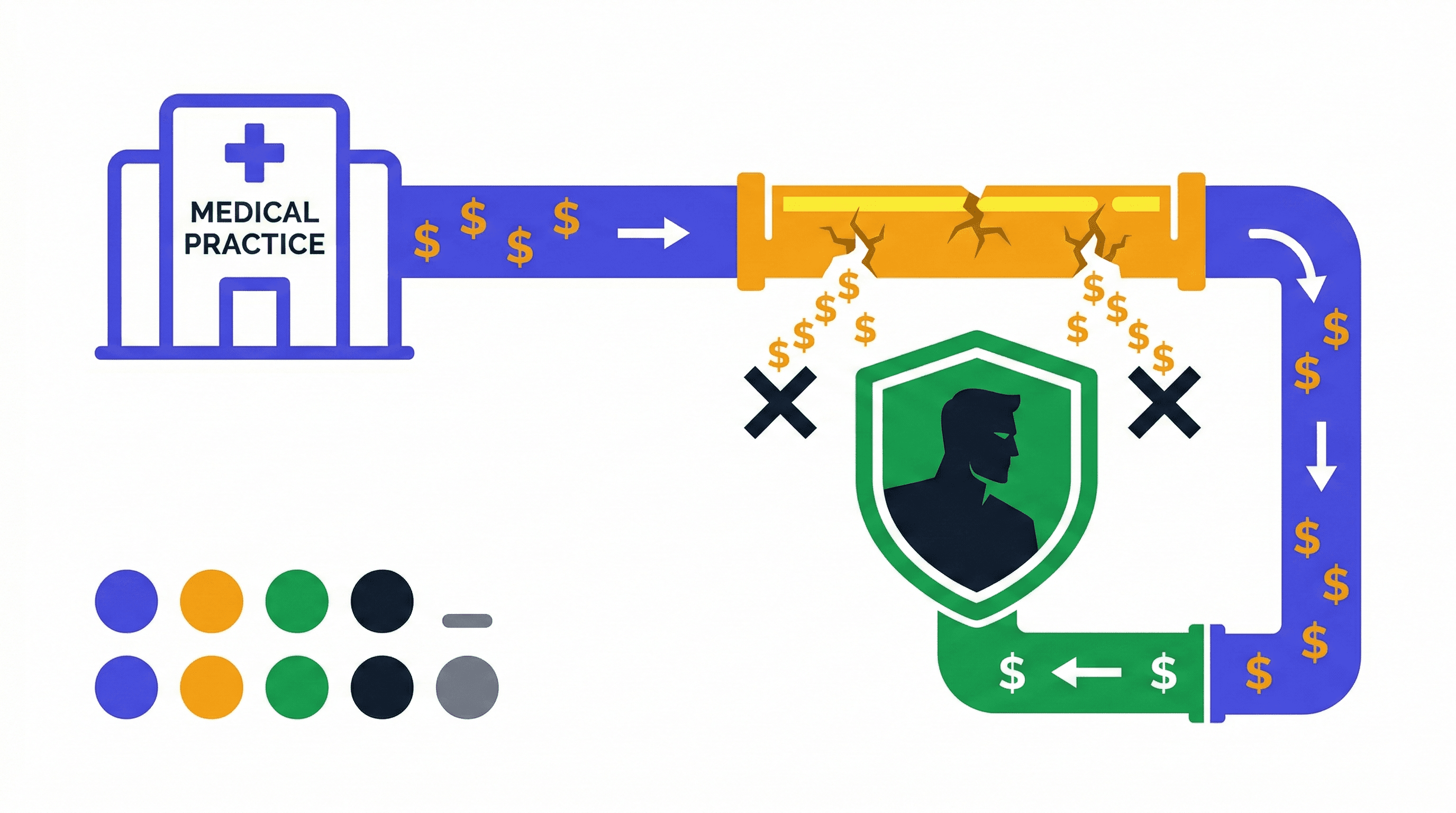
A medical practice submits a claim to the insurance company. The money takes six to eight weeks to arrive — if it arrives at all. And when it does, the practice collects roughly 60 cents on the dollar.
Let that sink in.
The doctor did the work. The staff did the paperwork. The claim was submitted correctly. And the practice gets 60% of what it billed. The other 40% disappears into contractual adjustments, negotiated rates, and payer discounts that the practice has little power to change.
But it gets worse. About 10–15% of claims are denied outright. The insurer sends back a rejection — sometimes for legitimate reasons, sometimes for technicalities that have nothing to do with the care provided. Each denial requires investigation, documentation, and resubmission. Many practices simply write off smaller denials because the cost of fighting them exceeds the recovery.
Imagine running a hotel where Visa pays you 60 cents for every dollar charged, takes two months to send the check, and rejects 10% of your charges — forcing you to prove that yes, the guest really did stay in that room.
That's healthcare billing.
The Repeat Cycle
Here's the final parallel. The next time the same guest checks into the hotel, the entire process starts over. New reservation, new check-in, new housekeeping assignment, new billing cycle.
The same is true at a practice. The next time the same patient walks through the door, the entire operation resets. New eligibility check. New pre-charting. New visit. New billing. New eight-week wait to get paid 60 cents on the dollar.
Every visit is a fresh transaction with the same operational overhead.
Why This Matters for Investors
Here's why I wrote this for VCs specifically.
When you understand the hotel analogy, you start to see something that isn't obvious from the outside: every single back-office operation at a medical practice is a repeatable, rules-based workflow that happens thousands of times a year.
Eligibility verification. Prior authorization. Pre-charting. Coding. Claim submission. Denial management. Patient follow-up. Appeals.
These aren't creative tasks. They don't require clinical judgment. They're high-volume, rules-based operations that consume 60–70% of a practice's non-clinical staff time — and they're almost entirely manual.
That's the opportunity.
Small medical practices — the 1-to-5 physician offices that make up the vast majority of healthcare delivery in America — are running these operations with spreadsheets, phone calls, fax machines, and a billing person who's been doing it for 20 years and is about to retire. They can't afford the enterprise RCM platforms built for hospital systems. They can't hire enough staff to keep up with payer rule changes. And they're losing tens of thousands of dollars a year to preventable denials and missed deadlines.
This is what Agentman automates.
Not the medicine. Not the clinical decisions. The back-office operations that look exactly like hotel operations — except they're slower, more complex, and pay worse.
AI agents that verify eligibility before the patient arrives. Agents that track denial patterns across dozens of payers. Agents that monitor appeal deadlines and assemble documentation. Agents that do the work that runs 24/7 so a three-person billing team doesn't have to.
The Market Nobody Wants to Understand
The reason many VCs pass on this opportunity isn't that the market is small. There are over 200,000 small medical practices in the United States. It's not that the pain isn't real — practices are drowning in administrative work. It's not that the technology doesn't work — we're running these agents in production today.
The reason they pass is that they've never run a hotel that gets paid 60 cents on the dollar, eight weeks late, with 10% of the charges rejected for reasons that change every quarter.
Once you see it that way, the question stops being "is this a good market?" and becomes "how is this not already solved?"
The answer is simple: the tools that exist were built for health systems with 500 beds and a 40-person billing department. Nobody built them for the two-physician family practice with one billing person and a fax machine.
We did. Because doctors didn't go to medical school to fight insurance companies. And we're on a mission to make sure they don't have to.
At Agentman, we're building AI agents that bring joy back to practicing medicine — by automating the back-office work small practices shouldn't have to do manually. If this resonated, I'd welcome the conversation — reach out.