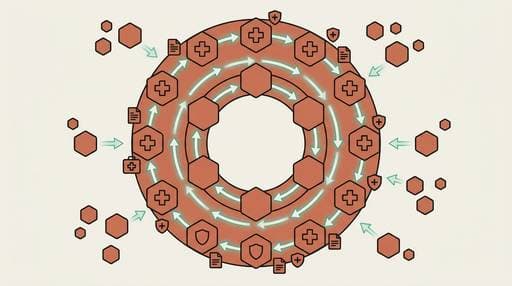
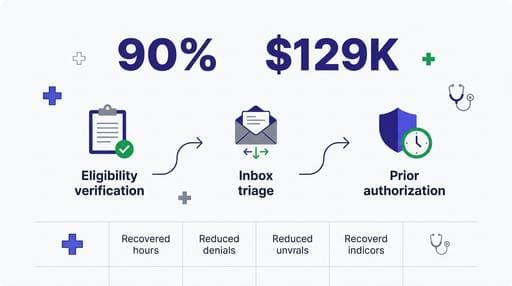
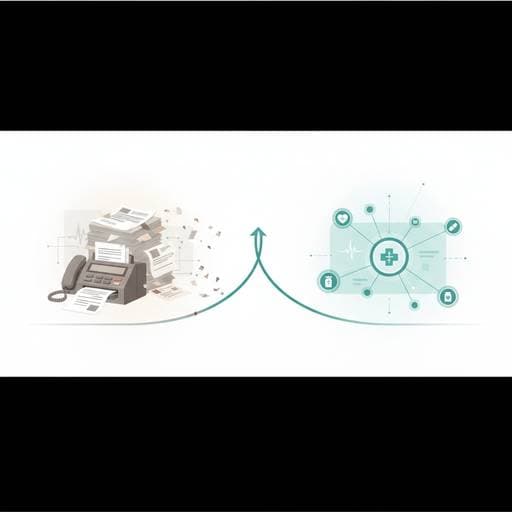
Ambient AI captures the clinical conversation. Agentic AI acts on it. The missing layer in healthcare AI isn't better documentation or better billing — it's the pipeline that connects what a doctor says to what the system does next. A VP of Product at DeliverHealth, a company serving Epic, Cerner, and Athena customers, mapped this pipeline unprompted in a single 50-minute call — and independently identified three use cases that were already on Agentman's roadmap.
Table of Contents
- What Happens When an Enterprise Buyer Reverse-Engineers Your Platform?
- Why Is Denial Prevention the Highest-Leverage AI Integration Point?
- How Does Ambient AI Trigger Prior Authorization at the Point of Care?
- What Makes a Skills Marketplace Different from a Monolithic AI Platform?
- Why Is Billing Harder Than Diagnosis?
- Frequently Asked Questions
- What This Means for Healthcare AI Strategy
What Happens When an Enterprise Buyer Reverse-Engineers Your Platform?
The strongest signal that a platform has real enterprise value isn't an analyst report, a press release, or a sales deck. It's when an enterprise product leader — unprompted, 30 minutes into a discovery call — independently identifies the same use cases you're already building.
That's what happened when Percy Bhathena, VP of Product at DeliverHealth, joined a 50-minute call to understand Agentman. DeliverHealth operates at the intersection of healthcare's biggest EHR systems — Epic, Cerner, and Athena — serving health systems, hospitals, and payer organizations. Percy, formerly of the Cleveland Clinic, came in with decades of revenue cycle and clinical operations experience.
He wasn't pitched a roadmap. He wasn't shown a demo. He listened to the platform thesis and, within half an hour, named three integration points:
- Denial prevention — flagging claims before submission using historical pattern data
- Prior authorization triggering from ambient encounters — kicking off auth workflows the moment a doctor orders an MRI or prescribes a medication
- VA staff augmentation via command center — deploying configurable agent skills as a licensable product for Veterans Affairs operations
None of these were presented to him. All three were already in development.
This is the difference between a feature and a platform. A feature is something you sell. A platform is something enterprise buyers discover they need.
Why Is Denial Prevention the Highest-Leverage AI Integration Point?
Denial prevention — catching claims that won't pass before they're submitted — is the single highest-return AI use case in healthcare revenue cycle management. Healthcare claim denials reached 11.8% in 2024, up from 10.2% just a few years earlier, according to industry data. Hospitals and health systems spent $19.7 billion in 2022 trying to overturn denied claims.
Percy didn't need convincing. He saw it immediately:
"Before we get to trying to reclaim, the prevention — what happened that we coded that's not gonna pass based on historical data? The denial prevention, to me, is maybe the easiest one, because we have the note, we have the code, and then we're trying to get to the next step."
The data backs him up. Experian Health's 2025 State of Claims survey found that 41% of healthcare providers now report denial rates above 10% — up from 30% in 2022. The primary causes: missing or inaccurate data (50%), authorization issues (35%), and incomplete patient registration data (32%).
Here's the critical insight: the clinical note already contains the information needed to prevent most denials. The problem isn't missing data — it's disconnected systems. The note lives in one workflow. The coding lives in another. The payer rules live in a third. By the time a claim is submitted, the prevention window has closed.
An agentic approach changes the sequence. Instead of submit → deny → appeal → rework, the pipeline becomes: capture → validate → flag → correct → submit clean. Among the small percentage of providers (14%) currently using AI for claims management, 69% report that AI has reduced denials or increased resubmission success rates, according to the same Experian survey.
The financial math is straightforward. Reworking a denied claim costs between $25 and $181 per claim. Preventing it costs a fraction of that. For a mid-size health system processing hundreds of thousands of claims annually, shifting from reactive denial management to proactive prevention represents millions in recovered revenue.
How Does Ambient AI Trigger Prior Authorization at the Point of Care?
The ambient-to-agent pipeline's most transformative application is triggering prior authorization workflows directly from the clinical encounter — before the physician has even finished the visit. Prior authorization accounts for roughly $35 billion in annual U.S. healthcare administrative spending, and physicians spend an average of 13 hours per week managing 39 prior authorizations per doctor, according to AMA data.
Percy saw this connection instantly:
"If the doctor says something, whether that's a med or MRI or whatever, we should be able to kick off a process based on that. To me, that's a very logical connection."
The logic is elegant: ambient AI is already listening to the clinical conversation and generating structured notes. If the physician says "let's order a lumbar MRI," the system already has the clinical context — the diagnosis, the patient history, the treatment rationale. Why wait for a separate workflow to manually initiate a prior authorization request?
Ambient clinical documentation is healthcare AI's breakout category, generating $600 million in revenue in 2025 — a 2.4x year-over-year increase — according to Menlo Ventures' State of AI in Healthcare report. Nearly two-thirds of U.S. hospitals on Epic EHR systems were using ambient AI tools by mid-2025. The technology is no longer experimental. It's infrastructure.
But here's the gap: most ambient AI stops at documentation. It captures the note and populates the EHR. The prior authorization process then restarts from scratch in a completely separate system, requiring staff to re-enter the same clinical information that was already captured in the encounter.
The ambient-to-agent pipeline closes this gap. The ambient layer captures the clinical intent. The agentic layer acts on it — matching the order to payer-specific rules, assembling the required documentation, and initiating the authorization request in real time. The physician never touches a prior auth form. The staff never re-keys the data. The process that today takes two business days per week of staff time becomes a byproduct of the visit itself.
This is what Abridge recognized when it announced its collaboration with Highmark Health in late 2025 to co-develop AI-powered prior authorization at the point of care. The industry is converging on the same conclusion Percy reached in 30 minutes: ambient capture and agentic action are two halves of the same pipeline.
What Makes a Skills Marketplace Different from a Monolithic AI Platform?
A skills marketplace treats AI capabilities as modular, configurable, domain-specific units — not a single model that tries to do everything. This architecture is what allows healthcare AI to be payer-specific, specialty-specific, regional-specific, and state-specific without requiring a custom build for every permutation.
Percy articulated this without being prompted, describing back to the Agentman team what they had been building:
"A platform that can execute against its marketplace — the marketplace has a plethora of different agents that are very tailored... payer-specific, specialty-specific, regional-specific, state-specific."
This is a critical distinction. Healthcare's complexity isn't just clinical — it's administrative. There are approximately 5,000 prior authorization codes used across private payers. Each payer has different rules. Each state has different requirements. Each specialty has different documentation standards. A monolithic AI model can't encode all of this without becoming impossibly large, impossibly slow, or impossibly generic.
A skills architecture solves this by decomposing the problem. Each skill is a discrete, validated, updatable unit that handles a specific task within a specific context. A denial prevention skill for Medicare Advantage in Texas operates differently from one for commercial payers in New York — and both can be deployed, tested, and improved independently.
This is also what makes the platform licensable. When Percy identified VA staff augmentation as a potential product, he was describing the natural extension of a skills marketplace: deploy a configured set of agent skills into a new operational environment without rebuilding the platform. The marketplace becomes the product.
Why Is Billing Harder Than Diagnosis?
Healthcare billing is more complex than clinical diagnosis — and the people who work in both domains know it. The irony is that AI may be better positioned to handle the clinical reasoning than the administrative maze that follows it.
Percy put it best:
"I would rather have AI try and diagnose me than try and figure out how to bill me. And they would probably do a better job of diagnosing."
This isn't just a joke — it's a structural insight. Clinical diagnosis follows evidence-based guidelines, published research, and standardized decision trees. Billing follows a labyrinth of payer-specific rules, annually changing code sets, regional variations, retroactive policy changes, and authorization requirements that often contradict each other.
Consider the numbers: coding and billing automation is healthcare AI's second-largest revenue category at $450 million in 2025, behind only ambient documentation, according to Menlo Ventures. Yet only 14% of providers have adopted AI for claims management, even though 67% believe AI can improve the process. The gap between belief and adoption reflects the sheer difficulty of the problem.
The ambient-to-agent pipeline addresses this by keeping the clinical context connected to the billing context throughout the entire workflow. When the ambient layer captures a physician ordering a biologic medication, the agentic layer can simultaneously: check the patient's formulary, identify if step therapy is required, verify prior authorization status, and flag potential coding mismatches — all before the claim is generated. The clinical note and the billing logic never separate.
Frequently Asked Questions
What is the ambient-to-agent pipeline in healthcare AI?
The ambient-to-agent pipeline connects ambient clinical documentation — AI that listens to doctor-patient conversations and generates notes — with agentic AI that takes action on that captured information. Instead of documentation being the end point, it becomes the trigger for downstream workflows like prior authorization, denial prevention, and coding validation. The ambient layer captures clinical intent; the agentic layer executes on it.
How does AI prevent claim denials before submission?
AI-powered denial prevention analyzes claims against historical payer behavior, current coding guidelines, and policy rules before submission. By comparing the clinical documentation, assigned codes, and payer-specific requirements in real time, the system flags claims likely to be denied and suggests corrections. This shifts the process from reactive (deny → appeal → rework) to proactive (capture → validate → correct → submit clean).
Why is prior authorization so expensive for healthcare providers?
Prior authorization accounts for an estimated $35 billion in annual U.S. healthcare administrative spending. Physicians and their staff spend an average of 13 hours per week processing 39 prior authorizations per doctor, according to AMA surveys. Each submission costs providers $20–$30, and 92% of providers report frequent delays in care due to the process. The complexity comes from 5,000+ authorization codes across private payers, each with different rules, documentation requirements, and review criteria.
What is a healthcare AI skills marketplace?
A healthcare AI skills marketplace is a platform architecture where AI capabilities are deployed as modular, configurable, domain-specific "skills" rather than a single monolithic model. Each skill handles a specific task — like denial prevention for a particular payer, or prior authorization for a specific specialty — and can be independently deployed, tested, and updated. This approach allows healthcare organizations to configure AI for their specific payer mix, specialty requirements, and regional regulations.
How does ambient AI connect to revenue cycle management?
Ambient AI captures clinical conversations and generates structured documentation. When connected to agentic AI through a pipeline architecture, this documentation automatically feeds into revenue cycle workflows — triggering prior authorizations, validating coding accuracy, checking payer eligibility, and flagging potential denials. This eliminates the manual re-entry of clinical information into billing systems and reduces the administrative gap between the clinical encounter and the claim submission.
What This Means for Healthcare AI Strategy
The ambient-to-agent pipeline represents the next phase of healthcare AI maturity. Phase one was ambient documentation — capturing the conversation. Phase two is agentic action — acting on what was captured. The organizations that build this pipeline first will own the workflow layer between clinical encounters and administrative execution.
Three takeaways for healthcare technology leaders:
-
Denial prevention outperforms denial management. The shift from reactive appeals to proactive prevention is the highest-ROI investment in revenue cycle AI. The data already exists in your clinical notes — the gap is the pipeline to your payer rules engine.
-
Ambient AI is infrastructure, not a product category. With $600 million in revenue and two-thirds of Epic hospitals adopting ambient tools, the documentation layer is commoditizing. The value is moving downstream to what you do with the captured data.
-
Skills-based architecture beats monolithic AI for healthcare. The payer-specific, specialty-specific, state-specific complexity of healthcare administration demands modular, configurable AI — not one model trying to learn everything. A skills marketplace lets you deploy, test, and update capabilities independently.
When a VP of Product at a company serving Epic, Cerner, and Athena customers independently identifies your roadmap items as their highest-priority integration needs — without a sales pitch — that's not a coincidence. That's market pull. And it's the strongest validation a platform can get.