Independent medical practices lose more than $50,000 per year to unworked faxes, buried prior authorization denials, and voicemails that never get returned. The culprit is the blind inbox — the undifferentiated stream of faxes, emails, and voicemails that arrives without patient names, priority flags, or any indication that something urgent is hiding inside. An AI inbox triage agent eliminates this problem by reading, classifying, and routing every inbound item in near real-time.
Table of Contents
- What Is the Blind Inbox in a Medical Practice?
- How Much Time Does Inbox Processing Cost a Medical Practice?
- What Revenue Is Hiding in Your Unworked Inbox?
- Why Haven't eFax and EHR Integrations Solved This?
- How Does an AI Inbox Triage Agent Work?
- What Results Can a Practice Expect From AI Inbox Triage?
- Frequently Asked Questions
What Is the Blind Inbox in a Medical Practice?
The blind inbox is the undifferentiated stream of faxes, voicemails, and emails that arrives at a medical practice with no patient name, no priority, and no indication of urgency. A fax shows up as "New Fax from +14244005810." A voicemail arrives as an audio attachment. Staff cannot tell whether an item is a routine pharmacy refill or a time-sensitive prior authorization denial without opening every single one.
This problem exists because the healthcare communication infrastructure was never built for seamless information exchange. Every prior authorization request exists because a payer decided a physician's clinical judgment needed additional verification. Every refill request that arrives by fax instead of flowing electronically exists because pharmacies, providers, and payers still lack reliable interoperability. Every discharge summary that lands in a fax tray exists because hospitals and practices cannot exchange structured data through their EHRs consistently.
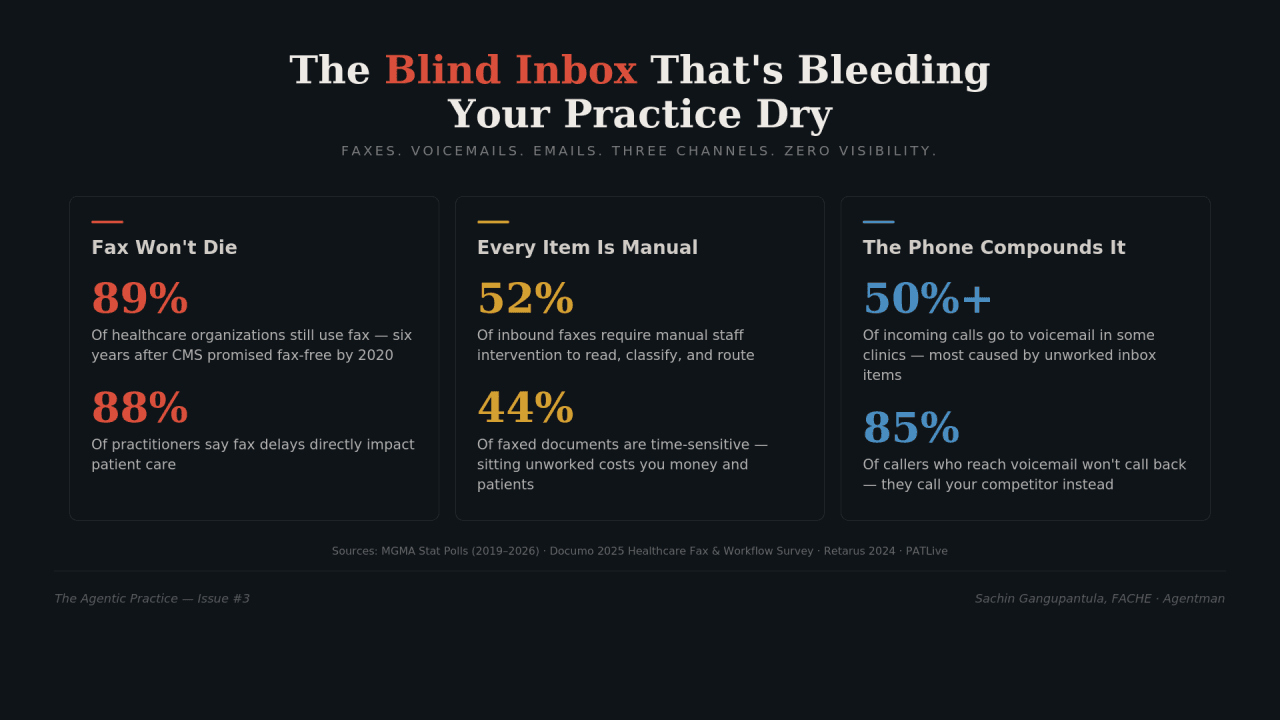
MGMA's polling shows 89% of healthcare organizations still use fax as of 2026. In 2018, CMS Administrator Seema Verma challenged the industry to create fax-free doctor's offices by 2020. That future never arrived. What arrived instead: MGMA's analysis found 68% of practices added or expanded AI use in 2025, with adoption clustering around inbound communications. The path forward is not eliminating fax — it is making fax intelligent.
How Much Time Does Inbox Processing Cost a Medical Practice?
A typical independent practice spends 60 to 160 minutes per day on manual inbox sorting before staff can do any other work. The Documo 2025 Healthcare Fax & Workflow Survey found that 88% of healthcare practitioners say fax-related delays impact patient care, 52% of inbound documents require manual staff intervention, and 44% are time-sensitive.
The math breaks down simply. If a practice receives 30 to 40 faxes per day and each takes 2 to 4 minutes to open, read, classify, and route, that is 60 to 160 minutes of daily processing time. At Valley Diabetes & Obesity, a specialty practice in California, 47 faxes arrive on a typical day alongside a steady flow of voicemails and emails.
The composition of that inbox matters. At Valley Diabetes & Obesity, over 40% of inbound items are pharmacy refill requests. Roughly 30% are prior authorization-related. The remainder includes specialist consultations, hospital discharge summaries, imaging reports, referrals, and insurance correspondence. Each category requires different handling, different staff, and different response timelines — but they all arrive looking identical.
MGMA research shows some clinics have more than 50% of incoming calls going to voicemail. In a five-physician practice receiving 150 to 200 calls per day, 15 to 30% go unanswered during peak hours. And 85% of callers who reach voicemail do not call back — they call someone else. That is lost revenue with every unanswered ring.
What Revenue Is Hiding in Your Unworked Inbox?
Three categories of unworked inbox items generate the largest revenue losses for independent practices: prior authorization denials with expiring appeal windows, hospital discharge summaries that miss care coordination deadlines, and referrals with authorization windows that quietly expire.
Prior authorization denials that start a cascade. A payer denies a GLP-1 medication for a diabetes patient who has been stable on it for months. The denial fax sits unread. The patient calls the pharmacy, learns the medication is not being filled, and calls the practice. Staff now must field the call, locate the denial, pull the chart, and figure out the appeal — while the patient's blood sugar management is interrupted. That is both a clinical disruption and a preventable revenue loss.
Hospital discharge summaries that fall through the gap. A nine-page discharge summary arrives for a patient released from a skilled nursing facility after spinal surgery — medication reconciliation, follow-up schedule, cardiac monitoring instructions. If it sits buried for three days, the care coordination window closes. The next event the practice sees is a 30-day readmission that damages quality scores and shared savings payments.
Referrals that quietly expire. A primary care practice sends a referral with a specific authorization window. If the receiving team does not process it in time, the authorization expires, and the patient starts over — most do not. They go to whoever answers first. Practices do not lose referrals loudly. They lose them silently.
At Valley Diabetes & Obesity, deploying an AI inbox triage agent recovered over $50,000 in revenue from previously unworked items — missed follow-up visits, unscheduled referrals, and expired prior authorizations for consult visits that would have died in the blind inbox.
Why Haven't eFax and EHR Integrations Solved This?
Moving from a physical fax machine to eFax moves the blind inbox from curled thermal paper to Outlook — but does not solve the classification problem. Faxes still arrive as email notifications with a phone number and an attachment. Voicemails still arrive as audio attachments in the same stream. There is no way to scan for urgency without opening every single item.
EHR vendors that integrated fax into their platforms added more clicks, more tabs, and more duplicates — not intelligence. And pharmacies and hospitals do not send consistently through one channel. Refill requests that were flowing through Surescripts into the EHR sometimes stop showing up and start arriving by fax, or the reverse. Staff must check both channels every time. When the same request arrives through both, teams either work it twice or assume the other channel handled it and work it zero times.
The Documo 2025 survey confirms this: more than a third of all inbound healthcare documents are still faxes, and the majority require human intervention to classify and route. The technology to receive faxes digitally exists. The technology to understand what each fax means and what to do about it — that is the gap an AI agent fills.
How Does an AI Inbox Triage Agent Work?
An AI inbox triage agent reads every inbound item — fax, email, and voicemail — in near real-time as it arrives. The agent extracts the full content, identifies the patient, matches them to their record, classifies the document type, assigns a priority level, and writes a specific action recommendation. By the time staff looks at the inbox, every item is already classified and waiting.
Where eFax showed "New Fax from +14244005810," the agent shows structured, actionable entries:
- B.R. — Insurance Auth Denial — HIGH — "Submit PA appeal with additional medical justification for Zepbound; notify patient of the denial."
- L.T. — Medical Records — HIGH — "Review discharge summary and reconcile medications; schedule repeat CBC and monitor for 1st-degree AV block as requested by hospitalist."
The inbox is organized into filtered views: urgent items, refills needing physician authorization, reviews needing clinical judgment, and duplicates. At Valley Diabetes & Obesity, the agent caught 9 duplicate items in a single processing queue — items that would have been worked twice or assumed complete by another channel.
The agent also processes voicemails in near real-time, transcribing, classifying, and routing them alongside faxes and emails. This matters because voicemails are often symptoms of unworked items elsewhere — the patient calling about the refill that arrived by fax two days ago and still sits unprocessed.
The agent does not currently read from or write into the EHR directly. It triages and routes. Connecting it to downstream agents that can file appeals and submit authorizations is the product roadmap. The current layer — capturing and understanding inbound work before it gets lost — is the foundation of the agentic practice.
What Results Can a Practice Expect From AI Inbox Triage?
Valley Diabetes & Obesity deployed an AI inbox triage agent and measured the following outcomes:
| Metric | Before | After | Impact |
|---|---|---|---|
| Daily inbox processing time | 120 minutes | 15 minutes | 87% reduction |
| Revenue recovered from unworked items | — | $50,000+ annually | Previously invisible losses |
| Items auto-routed without manual sorting | ~20% | ~80% | 4× improvement |
| Missed referrals or expired authorizations | Regular occurrence | Zero since deployment | Complete elimination |
| Estimated value per physician per year | — | $63,000 | Direct + indirect savings |
The efficiency gain is significant, but the revenue recovery is the larger story. The $50,000+ in recovered revenue came from items that were already arriving at the practice — missed follow-up visits, unscheduled referrals, expired prior authorizations — but were invisible inside the blind inbox. The agent did not generate new patients. It stopped existing revenue from leaking out.
For physicians, the transformation is equally meaningful. Before deployment, specialist consult notes, cardiology reports, psychiatric progress notes, and discharge summaries sat mixed in with refill requests and fax spam. Now they surface in a dedicated Reviews tab, classified and waiting. The agent handles the volume. The physician handles the judgment.
Frequently Asked Questions
How many faxes does a typical independent practice receive per day?
Most independent practices receive 30 to 50 faxes per day. Specialty practices handling prior authorizations, referrals, and pharmacy communications tend toward the higher end. Valley Diabetes & Obesity processes approximately 47 faxes daily alongside voicemails and emails. The Documo 2025 survey found more than a third of all inbound healthcare documents are still faxes.
What is the biggest revenue risk from an unsorted medical practice inbox?
Prior authorization denials with expiring appeal windows represent the highest immediate revenue risk. When a PA denial sits unread, the appeal window runs, the patient's treatment is interrupted, and the practice loses both the reimbursement and the follow-up visit revenue. Expired referral authorizations and missed discharge follow-ups are the second and third largest sources of silent revenue loss.
Can an AI inbox triage agent integrate with my EHR?
Current AI inbox triage agents operate as a classification and routing layer — they read inbound faxes, voicemails, and emails, then prioritize and assign actions. Direct EHR read-write integration is the next frontier in agentic healthcare. The immediate value comes from ensuring no item goes unworked, unclassified, or unrouted, regardless of EHR connectivity.
How long does it take to deploy an AI inbox triage agent?
Deployment timelines vary by practice size and inbound volume, but the core setup — connecting fax, email, and voicemail channels to the AI agent — can be completed in days, not months. The agent begins learning document patterns immediately and reaches high classification accuracy within the first week of processing real practice communications.
Is healthcare fax going away?
No. Despite CMS's 2018 goal to eliminate fax by 2020, MGMA reports 89% of healthcare organizations still use fax as of recent polling. The industry consensus has shifted from eliminating fax to making fax intelligent through AI-powered classification and routing. MGMA found 68% of practices added or expanded AI use in 2025, with the strongest adoption in inbound communications workflows.
What Should You Do Next?
The blind inbox is a measurable problem with a measurable solution. If your practice processes 30 or more faxes per day and your staff spends over an hour sorting before doing anything else, you are losing revenue to items that arrive but never get worked.
Three steps to take today:
- Count your inbound volume. Track faxes, voicemails, and portal messages for one week. Most practices underestimate by 30–40%.
- Identify your highest-risk categories. Prior authorization denials, referrals with authorization windows, and discharge summaries with follow-up deadlines are where revenue leaks fastest.
- Get a free inbox audit. Agentman analyzes your inbound communication patterns and shows you exactly where revenue is hiding. Request your audit at agentman.ai.
This is what an agentic practice looks like — one workflow at a time.