It's 2026. The most important clinical communication your practice will receive today will arrive by fax.
Not by secure message, not by API notification, not by EHR alert. By fax. And it will land in a stack of 119 others.
This is the daily reality for the average single-physician independent practice: 80 to 90 voicemails and 100 to 120 incoming faxes, according to Sachin Gangupantula, VP of Agentic Healthcare at Agentman and a practicing physician with nearly a decade of clinical operations experience. "My lifeline is really tied to my phone and my fax," Sachin said on a recent episode of the Bridging Healthcare Gaps podcast alongside Prasad Thammineni, co-founder and CEO of Agentman. "Our healthcare industry hasn't gone much further in the last 30-plus years."
The volume would be manageable if every message had equal stakes. The problem is that one of those faxes — somewhere in the middle of the pile — carries a 48-hour deadline, a higher reimbursement rate, and a patient safety obligation. And there is no mechanism in a fax machine to surface it first.
Table of Contents
- The Volume Problem
- The Transition Care Management Window
- What Happens When the Fax Gets Buried
- The Patient Retention Cost Nobody Counts
- How Inbox Agents Change the Prioritization Problem
- Frequently Asked Questions
The Volume Problem
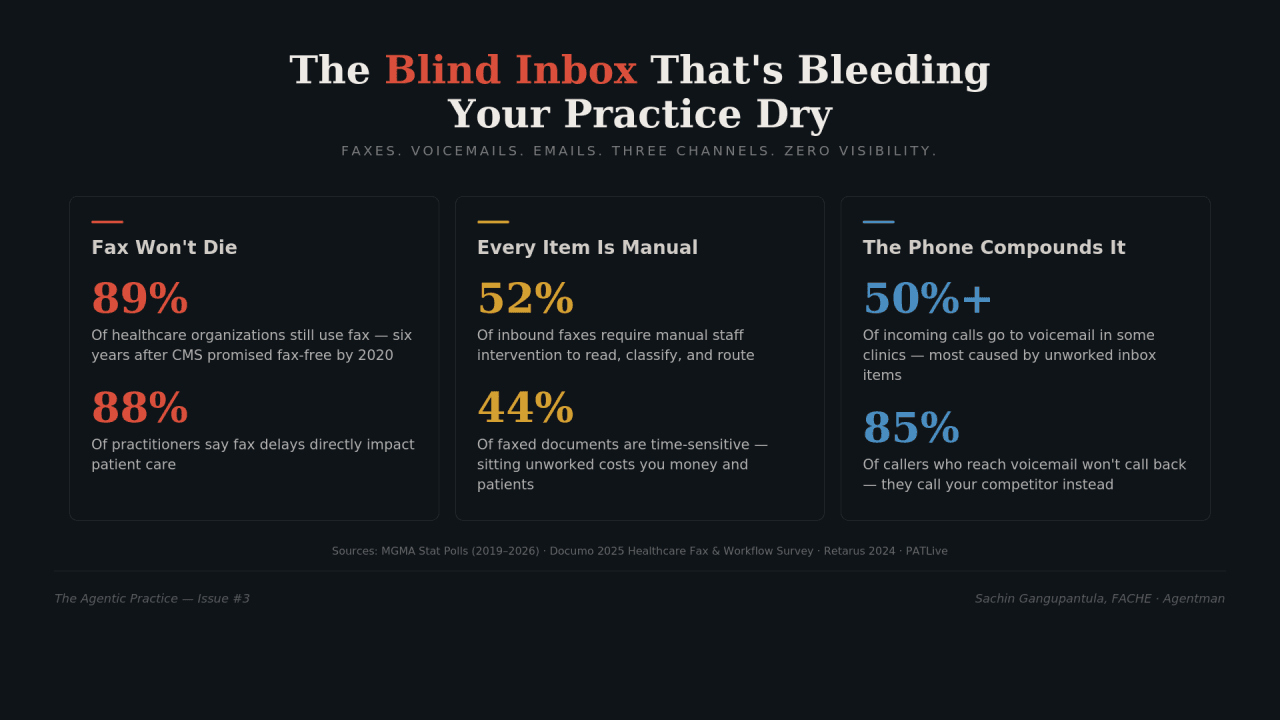
Sachin estimates the average single-physician independent practice receives between 50 and 100-plus calls per day, with staff answering more than half but still unable to keep pace with the full volume. Faxes compound the load: 100 to 120 arriving daily in chronological order, stacked and undifferentiated. Two minutes of processing time per fax comes to over three hours of staff time — before eligibility checks, prior authorization follow-ups, and patient-facing work.
The healthcare industry's reliance on fax is not technological conservatism for its own sake. HIPAA compliance provisions for fax, payer submission requirements that still mandate paper-based communication, and decades of unresolved interoperability between hospital and practice EHR systems have kept fax alive as the default channel for hospital-to-practice and payer-to-practice messaging. The technology has not failed to evolve; the regulatory and operational infrastructure around it has not kept pace.
The result is that practices built around two or three administrative staff members are absorbing the communication load of a medium-sized business, without the routing, triage, or escalation systems that a medium-sized business would have in place.
The Transition Care Management Window
Buried in the daily fax stack is a category of message that carries a specific and unforgiving deadline.
When a patient is discharged from a hospital, the hospital faxes the discharging physician's office. That discharge summary initiates the clock on Transition Care Management (TCM) billing. Under CMS guidelines, TCM services require the practice to contact the patient within two business days of discharge and complete a face-to-face visit within either 7 or 14 days, depending on medical complexity. Successfully billing TCM under CPT codes 99495 or 99496 reimburses at a meaningfully higher rate than an equivalent standard office visit — roughly two to three times higher depending on the payer and complexity level.
"Hospitals don't call us on the phone — they usually fax it, sometimes we get it by mail," Sachin said. For a practice seeing even a modest number of recently discharged patients per month, the cumulative revenue from successful TCM billing is significant. Missing the window on several per month, across a year, represents thousands of dollars in unbilled revenue that simply disappears.
The patient safety dimension is not incidental to this billing structure. Hospital readmissions spike sharply in the 30 days following discharge. The TCM framework exists because post-discharge follow-up measurably reduces readmission risk. When the discharge fax gets buried in the stack and the 48-hour contact window passes without a call to the patient, the financial consequence and the clinical consequence are the same event.
What Happens When the Fax Gets Buried
The current fax workflow has no structural mechanism for surfacing urgent messages. A hospital discharge notification arrives in the same queue as a routine lab result, a prior authorization denial, a payer credentialing letter, and an unsolicited pharmaceutical flyer. They print in the order received. Staff process them in that order.
When the discharge fax sits at position 87 in a 120-fax day, a staff member working through the incoming stack may not reach it until the afternoon. If the queue backed up from the previous day, or if the staff member was out, the 48-hour contact window may close before anyone has seen the document.
The AMA reports that 60% of denied claims are never resubmitted — not because practices choose to abandon them, but because they age out of the appeal window before staff discover them in the stack. The hospital discharge problem follows the same structural logic at higher stakes. A missed discharge fax closes the TCM window and forgoes a higher-value visit, simultaneously. The loss compounds: the visit that doesn't happen on the right schedule is also the visit that reduces readmission risk.
Sachin frames the stakes precisely: getting to a discharge notification two days late means missing both the 48-hour contact requirement and the chance to schedule the face-to-face visit within the TCM window. Revenue gone, and a clinical touchpoint that may not happen when the patient needs it most.
The Patient Retention Cost Nobody Counts
The volume and prioritization problem carries a second cost that doesn't show up in billing reports.
Patients who call a practice and consistently reach voicemail form an impression that drives a real behavior: they find another doctor. "Why do I always have to leave a message? Nobody ever picks up" — Sachin hears this directly from patients at his own practice. For a two-physician office where each active patient represents multiple annual visits across years, patient attrition from this perception translates directly to revenue loss, with no corresponding charge code to track it against.
The administrative burden on staff reinforces the cycle. When staff spend the majority of their day processing faxes and voicemails, there is less time to return the calls those voicemails contain, which in turn means patients reach voicemail again on the callback. Voice AI integrated with the practice scheduling system represents a near-term solution: a patient calling to reschedule reaches an agent connected to the calendar, confirms a new time, and completes the interaction without staff involvement. This capability is on Agentman's near-term product roadmap. The fax prioritization problem is solvable today.
How Inbox Agents Change the Prioritization Problem
The inbox agent does not reduce the volume of incoming faxes. It changes which ones staff see first.
An inbox agent monitors incoming faxes, voicemails, and emails, classifies each message by type and urgency, and surfaces them in priority order. The logic is practice-specific and trainable: anytime a fax arrives from a hospital, that message is flagged as critical and placed at the top of the review queue. "Staff are trained to look at the command center, not dig through faxes," Sachin describes. The hospital discharge notification no longer competes with the pharmaceutical flyer for the next available pair of hands. It appears first.
The same classification logic extends to prior authorization denials with active appeal windows, urgent patient messages, and time-sensitive payer correspondence. The agent applies the practice's own triage rules — rules that existed implicitly before but were never systematically enforced at the speed of incoming volume.
At Valley Diabetes and Obesity, Agentman's live clinical testing environment and a mixed-panel practice running Medicare Advantage, Medi-Cal, and commercial payers, inbox processing time dropped from approximately two hours each morning to twenty minutes of review after deployment. The 83% time reduction came from classification and prioritization: the agent handled the sorting, and staff handled the judgment. The agents free staff from defensive work rather than replacing them, so human attention can go where it actually matters — the discharge follow-up, the denial appeal that needs clinical documentation, the patient who called twice.
As Prasad puts it: "The agent makes sure the right messages reach the right people at the right time." The clinical and billing decision still belongs to the staff member. The difference is that those decisions now happen on the messages with the highest urgency, not the ones that happened to print first.
Agentman builds the agentic layer for independent medical practices. See how the inbox agent works →
Frequently Asked Questions
What is Transition Care Management billing?
Transition Care Management covers the services a physician provides to a patient in the 30 days following discharge from an inpatient facility. CMS requires contact with the patient within two business days of discharge and a face-to-face visit within either 7 or 14 days depending on medical complexity. TCM visits bill under CPT codes 99495 or 99496, both of which reimburse at rates significantly higher than equivalent standard office visit codes.
How many faxes does the average single-physician practice receive daily?
According to Sachin Gangupantula, a practicing physician and VP of Agentic Healthcare at Agentman, the average single-physician independent practice receives 100 to 120 incoming faxes and 80 to 90 voicemails per day. Staff answer more than half of all incoming calls but cannot process the full fax volume in order of urgency without an automated triage system.
Why does healthcare still rely on fax machines?
HIPAA created specific compliance provisions for fax that many electronic channels don't share, and certain payer and hospital submission workflows still mandate fax or mail for particular document types. The interoperability infrastructure that would make fax obsolete — standardized APIs between hospital EHR systems and practice management systems — exists in regulatory frameworks like the CMS Interoperability Rule but is not yet consistently implemented across the payer and health system landscape.
How does an inbox agent prioritize faxes?
The inbox agent classifies incoming messages by type and applies priority rules the practice defines. Hospital discharge notifications are flagged as critical and surface first. Prior authorization denials with active appeal windows are flagged as time-sensitive. Routine lab results and credentialing correspondence are flagged as standard. Staff review a prioritized queue rather than a chronological stack, which means the messages with the highest clinical and financial urgency reach human attention in time to act on them.
Is this different from the blind inbox revenue problem?
The inbox challenge has two related but distinct components. The volume problem — too many messages arriving for staff to process without falling behind — drives the $50,000 annual loss to unsorted communications documented in a previous post in this series. The prioritization problem is a second layer: even with sufficient processing capacity, a system that surfaces messages chronologically rather than by urgency will consistently bury the messages that matter most. The hospital discharge fax is the clearest example of what a prioritization failure costs, in revenue and in clinical outcomes.
Sachin Gangupantula is VP of Agentic Healthcare at Agentman and a practicing physician with nearly a decade of clinical and operational experience. Prasad Thammineni is co-founder and CEO of Agentman, former VP of Frontier AI at Salesforce.
This post is adapted from the Bridging Healthcare Gaps podcast. Listen to the full episode →