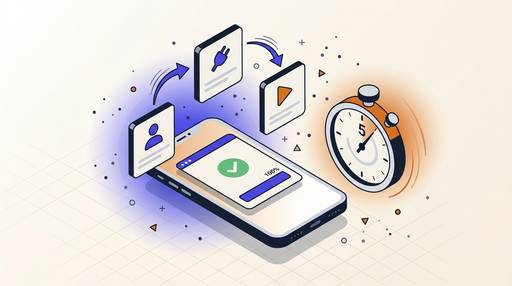
In healthcare, "buying" software usually means booking a demo, sitting through three sales calls, and waiting weeks before anyone in your practice touches the product. Agentman runs a different play. From sign-up to your first eligibility check takes about five minutes — and the doctor doesn't have to be the one doing it.
Table of Contents
- Why Healthcare Software Onboarding Is Broken
- What Does Agentman's 5-Minute Onboarding Actually Look Like?
- How Does the Dropbox-Style Email Activate a Second Agent?
- What About EHR Integration?
- Why Build for the Phone First?
- What Changes When Software Earns Trust in Five Minutes?
- Frequently Asked Questions
Why Healthcare Software Onboarding Is Broken
Healthcare software is notoriously sales-led. The standard buying motion is book a demo, sit through a pre-recorded walkthrough, schedule a follow-up call, and wait weeks before anyone in the practice has actually used the product. For a small independent clinic, that's not a buying experience — it's a part-time job nobody assigned.
The problem isn't that small practices don't want better tools. It's that they don't have anyone whose role is "evaluate software." A solo physician's office is the doctor plus one or two staff running the back office, scheduling, billing, and answering the phone. None of those people clocked in to compare vendors. By the time a multi-week sales cycle ends, the practice has already absorbed the cost of evaluating — and learned nothing about whether the product actually works on their data.
"We come from a consumer product background," said Prasad Thammineni, co-founder and CEO of Agentman, on a recent episode of the Bridging Healthcare Gaps podcast. The team's working assumption is that enterprise healthcare technology can be delivered the way consumer products are: sign up, connect, see a result. No procurement theater, no demo gauntlet.
That assumption shapes everything about how Agentman's onboarding is built.
What Does Agentman's 5-Minute Onboarding Actually Look Like?
Agentman's 5-minute onboarding is a self-serve flow with three steps: visit the website, sign up, and connect to your practice management system. The first eligibility check runs within five minutes of account creation. No sales call, no scheduled demo, no implementation engagement is required to reach a working result.
The mechanics are deliberately minimal:
- Sign up. Click the button on the homepage, create an account.
- Connect. Authorize a connection to your practice management system.
- Run the first check. Watch the eligibility agent verify a patient's coverage in real time.
That's the whole motion. The point is not that five minutes is a marketing number — it's that the practice gets to a real, evaluable result before any human at Agentman has to be involved. The product makes its own case.
This is a structural break from how healthcare software typically demonstrates value. In a sales-led motion, the vendor controls the demo: a prepared dataset, a curated workflow, a salesperson narrating what to look at. In a self-serve motion, the practice controls the demo: their patients, their payer mix, their messy real-world data, their pace. If the product breaks on real data, the practice finds out in five minutes instead of after signing.
Tyler, the podcast host, reacted the way most healthcare buyers do when they hear this for the first time: "Is that really that straightforward? That sounds too good to be true." Sachin Gangupantula, VP of Agentic Healthcare at Agentman and a practicing physician, answered directly: "Yes, it is happening right now."
How Does the Dropbox-Style Email Activate a Second Agent?
When a practice signs up, Agentman issues a unique email address — modeled on the inbound email pattern Dropbox popularized for sending files into a Dropbox folder. The practice forwards their fax-to-email and voicemail-to-email messages to that address. The inbox agent now has a feed and starts triaging.
The reason this matters: the typical independent practice already has fax-to-email and voicemail-to-email configured at the carrier level. Most have used these features for years. There is nothing new to install at the practice. Forwarding to a new address is a one-time configuration change at the email level, not an integration project.
With one signup and one mail-forwarding rule, the practice has activated two agents:
- The eligibility agent, which runs benefit checks against the practice management system.
- The inbox agent, which classifies incoming faxes and voicemails by urgency and routes them to the right reviewer.
The inbox agent is where the second-order revenue impact lives. Independent practices lose over $50,000 annually to unsorted faxes, voicemails, and unworked messages — a problem that compounds when a high-value message gets buried in a 120-fax day. Agentman has written separately about why prioritization matters: a hospital discharge notification stuck at position 87 of the daily stack costs the practice both the Transition Care Management billing window and the patient touchpoint that reduces readmission risk. The Dropbox-style email is the activation path for fixing that prioritization problem on day one, with no IT engagement.
What About EHR Integration?
EHR integration depends on the EHR. Some are ready to connect on day one; others require a quick implementation step. Agentman is built to integrate with any EHR, but the time-to-first-value depends on which system the practice is running. The 5-minute eligibility check does not require a deep EHR integration to start working.
This is the honest version of a story that vendors usually overpromise. The healthcare interoperability landscape is uneven. AdvancedMD, athenahealth, Epic, Cerner, eClinicalWorks, and Practice Fusion all expose different surfaces — some have clean APIs, some require screen-level automation, some need a partner-channel implementation step before data flows. Agentman's architecture handles all of these, but the speed of the connection isn't uniform across them.
What's consistent is that the practice doesn't have to wait for the deepest possible integration to see the product work. The first eligibility check runs against the practice management system, which is typically a faster connection than the full clinical EHR. Inbox triage runs against forwarded messages and doesn't depend on EHR access at all. The practice gets a working baseline in five minutes; the deeper integrations layer in as the relationship grows.
Why Build for the Phone First?
A small practice owner-operator is not at a desk. The doctor is in exam rooms; the office manager is at the front, on the phone, or in the back working denials. The 24/7 operational reality of running a small business is that decisions happen in the increments of time available — between patients, in a parking lot, after hours. Agentman is being built mobile-first because that's where the time actually exists.
This is a different bet than most healthcare AI startups have made. Most clinical AI products assume the workflow is desktop-bound: a clinician at a workstation, a biller at a multi-monitor setup. Back-office automation breaks that assumption. The person who needs to approve an eligibility result, review a flagged denial, or sign off on a prior authorization doesn't need three monitors — they need to glance at a queue, tap to approve or escalate, and get back to the next patient.
Designing for the phone forces a particular kind of discipline:
- Short queues, not infinite tables. The screen shows what needs attention now, not every line item ever.
- Tap-to-act, not click-through-modal. Approvals and escalations happen in one gesture.
- Trustworthy notifications. A push only fires when a human decision is required, not for every agent action.
The phone-first vision is also the reason the 5-minute onboarding is built the way it is. If the product can't be activated from a phone at the front desk, it can't be activated by the people most likely to actually run it.
What Changes When Software Earns Trust in Five Minutes?
Sales-led onboarding asks the practice to trust the demo, the slide deck, and the sales engineer for several weeks before seeing the product touch their data. Self-serve onboarding inverts the order: the product earns trust by working first, on real data, in five minutes. Everything else — pricing, expansion, deeper integration — is a conversation the practice initiates after they've seen the product work.
This is the cultural shift the consumer-product playbook brings into healthcare. The bar isn't "enterprise sales process polished to perfection." The bar is "would a front-desk manager, between patients, sign up, connect, and see something useful happen in the time it takes to drink half a coffee." If yes, the product is doing its job. If no, more sales effort won't fix the underlying friction.
Agentic healthcare gets cited often as a category. The product reality that earns the category — for small practices, where the buyers are the operators — looks like sign-up flows that take five minutes, integrations that match the EHR landscape honestly, and software that activates two working agents from one mail-forwarding rule.
See the eligibility and inbox agents work on your practice's data. Try Agentman →
Frequently Asked Questions
How long does it take to onboard with Agentman?
Sign-up to first eligibility check takes about five minutes. The flow is self-serve: visit the website, create an account, connect to the practice management system, and run the first check. Inbox triage activates with one additional step — forwarding fax-to-email and voicemail-to-email to the unique address the platform issues at sign-up. Neither step requires a sales call, scheduled demo, or implementation engagement.
Do I need to talk to a salesperson before trying Agentman?
No. The product is designed for self-serve activation. Practices can sign up, connect their practice management system, and run a first eligibility check without scheduling a demo or speaking to anyone at Agentman. Sales conversations happen after the practice has seen the product work, when the practice initiates a discussion about pricing, deeper integration, or expansion to additional agents.
What is the Dropbox-style email at sign-up?
When a practice creates an account, Agentman issues a unique email address. The practice forwards their existing fax-to-email and voicemail-to-email messages to that address, which gives the inbox agent a feed to triage. The pattern mirrors how Dropbox lets users send files to a folder by email. It activates the inbox agent without requiring any new software at the practice.
Does the 5-minute onboarding require EHR integration?
The five-minute eligibility check connects to the practice management system, not the full clinical EHR. EHR integration depth varies by vendor — some EHRs are ready on day one, others require a short implementation step. The product is built to integrate with any EHR, but practices don't need a completed EHR integration to see the eligibility agent and inbox agent work.
Why design Agentman to work from a phone?
Small-practice owner-operators are rarely at a desk. The doctor is in exam rooms; the office manager is at the front desk or working denials. Decisions happen in available increments of time between patients. A phone-first product can be approved, escalated, or reviewed in those increments. A desktop-bound product cannot.
How is this different from how healthcare software is usually sold?
Standard healthcare software sales follow a sales-led motion: book a demo, sit through pre-recorded walkthroughs, schedule follow-ups, wait weeks before product use begins. Agentman runs a consumer-style self-serve motion: sign up, connect, see a result in five minutes. The product earns trust by working on real data, not by being narrated in a curated demo.
Special thanks to Prasad Thammineni (co-founder and CEO of Agentman) and Sachin Gangupantula (VP of Agentic Healthcare at Agentman and a practicing physician) for the conversations that shaped this piece.
This post is adapted from the Bridging Healthcare Gaps podcast.