Most people assume that when a physician sees a patient, they get paid. Submit a bill, receive money.
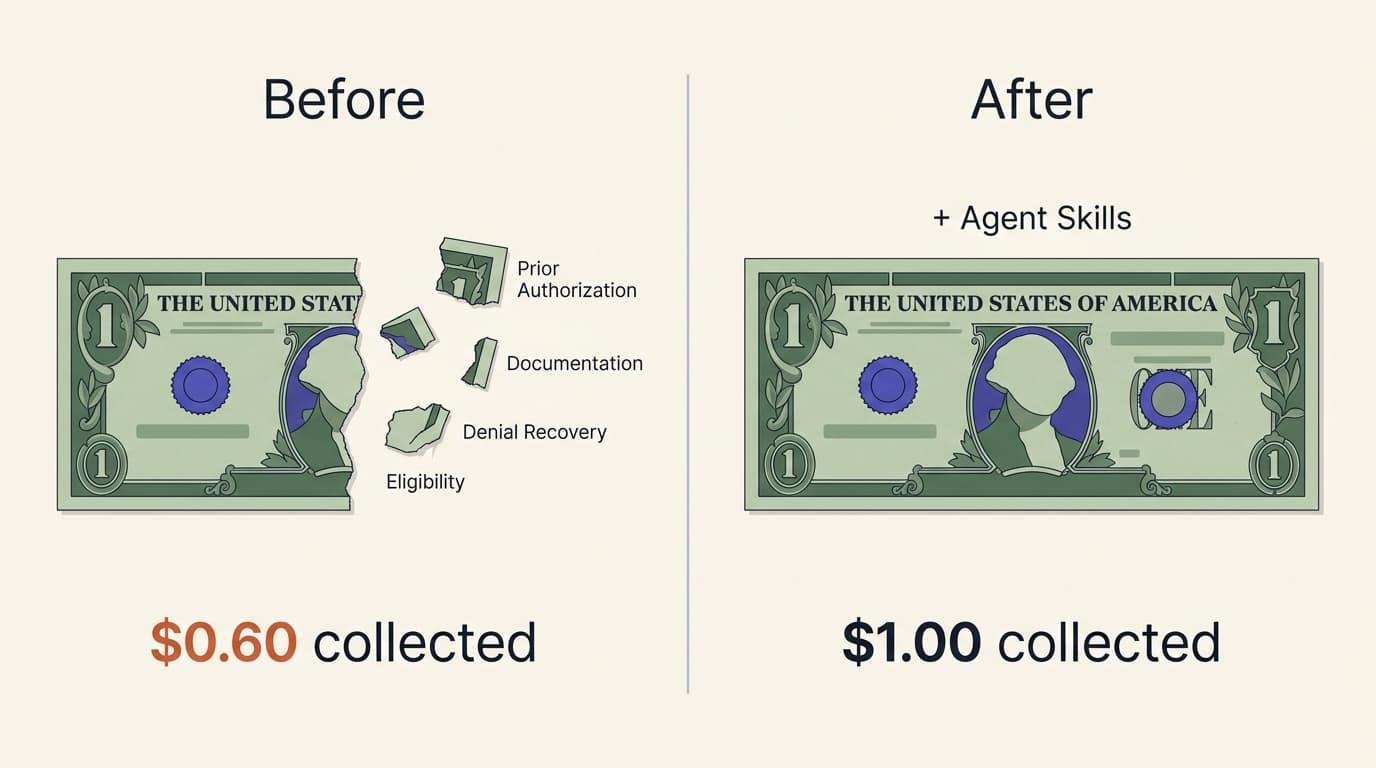
The reality: for every dollar billed to an insurance company, a practice collects about 60 cents on average. The other 40 cents disappears into denials, write-offs, underpayments, and uncollected balances, and the 60 cents that does arrive may take ten weeks to get there.
This is the economic reality Sachin Gangupantula, VP of Agentic Healthcare at Agentman and a practicing physician with nearly a decade of clinical operations experience, described on a recent episode of the Bridging Healthcare Gaps podcast. Together with Prasad Thammineni, co-founder and CEO of Agentman, they unpacked the mechanics of this problem and why AI agents may be the first tool capable of genuinely fixing it.
Table of Contents
- The 60-Cent Dollar
- The Two-Bucket Problem
- The 10-Week Payment Cycle
- The Operational Burden Math
- What COVID Exposed
- How AI Agents Change the Math
- Frequently Asked Questions
The 60-Cent Dollar
Closing the gap between billing and collection comes down to four steps: eligibility verification, prior authorization, clean claim submission, and timely filing. Get all four right and a practice collects more of what it's owed; miss any one and that dollar shrinks further.
The problem is that each step is manual, payer-specific, and nearly impossible to execute consistently with a small administrative team, and that structural tension sits at the heart of every independent practice's financial story.
The Two-Bucket Problem
Revenue flows from two sources that age very differently. Bucket One is money patients owe: copays, deductibles, self-pay balances. Bucket Two is money insurers owe: claims, prior authorization reimbursements, contracted payments. The second bucket represents the bulk of revenue for most practices and is considerably harder to manage.
The aging math is unforgiving: patient A/R over 120 days is largely uncollectible, while insurance A/R over 90 days drops to roughly 60% collectibility as appeal windows close and stale claims face higher denial rates on resubmission.
"Can your practice weather a 90-day disruption?" Sachin asks. For most independent practices, the honest answer is no.
The 10-Week Payment Cycle
A patient comes in today, care is provided, and devices, medications, or prior authorizations may be involved, none of which are paid upfront. The claim goes to the payer, four to six weeks pass, and if it's approved, payment arrives. If it's denied, the appeals process begins: more documentation, resubmission, more waiting, with the full arc from visit to resolution running approximately ten weeks.
"Tell me which other industry where you wait ten weeks to get paid," Sachin says. Restaurants collect at the table. Software companies bill on subscription. Contractors invoice on milestones. Independent practices provide care first and wait months for revenue that may never arrive in full, and a denial that lands nine weeks after service with a two-week appeal window requires immediate mobilization or that revenue is gone permanently.
The Operational Burden Math
Less than 40% of practicing physicians in the U.S. now operate independently, with many absorbed into hospital systems or private equity networks because the economics of independence became unsustainable.
For those who remain, practices typically spend 30 to 40% of revenue on administrative overhead, and a single staff member dedicated solely to eligibility verification and prior authorization costs $40,000 to $50,000 per year in salary alone. "All I'm trying to do is protect my revenue so I don't get denied," Sachin says, and that framing captures the posture most small practices are forced into: administrative staff aren't growing the practice, they're defending it against a system designed to pay out less.
A typical practice needs eight administrative staff to support one physician, and retention is a persistent problem since when a trained billing specialist leaves, the institutional knowledge of payer-specific rules walks out the door with them. Every dollar saved on administrative overhead is direct growth capacity, paying for a specialist, retaining a good hire, or simply preserving the margin that makes independence viable.
What COVID Exposed
When practices couldn't see patients, revenue didn't just slow, it stopped entirely. The practices that survived had to manage three simultaneous failures: technology infrastructure that wasn't built for disruption, payment models that assumed continuous patient flow, and administrative burden that continued even when clinical operations paused, all of it collapsing at once. The margin independent practices had been operating on turned out to be insufficient to weather even weeks of disruption.
COVID was more a diagnostic than a cause, surfacing fragility that had always been there.
How AI Agents Change the Math
The case for AI agents in independent practice is more about changing the economics of the 60-cent dollar than about doing existing work faster. When an eligibility agent checks coverage before every appointment, the practice stops seeing patients whose procedures aren't covered and stops submitting claims that were always going to be denied, recapturing revenue that had previously leaked out before it was ever generated.
When prior authorization workflows run autonomously, the 10-week payment cycle compresses. When claims are clean on first submission, denial rates fall. When an inbox triage agent catches a prior authorization denial with seven days left in the appeal window rather than letting it expire, that revenue is recovered rather than written off.
At Valley Diabetes and Obesity, Sachin's own practice and Agentman's live testing environment, the results are documented: 90% automation of eligibility and inbox workflows, a 65% reduction in eligibility-related denials, and $107,000 to $149,000 in projected annual savings per physician, with staff hours on eligibility calls dropping from 50 per month to 7.
The agents free staff from defensive work rather than replacing them, so human judgment can go where it actually matters: complex prior authorizations, clinical decisions, and the patient relationships that make running an independent practice worth it. As Prasad puts it: "Every dollar saved is a dollar earned. In a small practice, savings aren't just savings. They're capacity."
Frequently Asked Questions
Why do independent practices only collect 60 cents on the dollar?
The gap reflects contractual adjustments between billed charges and payer-contracted rates, claim denials, underpayments, and patient balances that age beyond collectibility. The most preventable portion, driven by eligibility gaps, prior authorization failures, and coding errors, is where AI agents have the most direct impact.
What is the two-bucket problem?
The two-bucket problem refers to the two streams of accounts receivable in a medical practice: money patients owe and money payers owe, each aging differently and requiring different management. Active management of both buckets before they age is the core function of revenue cycle management.
Can AI agents reduce administrative costs for a small practice?
Reallocation is more accurate than elimination here. A staff member previously spending four hours a day on payer portal logins can redirect that time to patient care and complex cases requiring judgment, with the financial gain coming from eliminating the $40,000 to $50,000 annual cost of a dedicated eligibility resource, reducing denial discovery work, and stopping the write-offs from unworked items that age out silently.
How do I know if my practice is losing revenue to administrative gaps?
Two signals matter most: first-pass denial rate and A/R aging. Industry averages run 5 to 10% for in-network claims and up to 22% for non-contracted payers, so if your practice is above those ranges, a significant portion of the gap is administrative rather than clinical. If more than 20% of insurance A/R is over 90 days, you have a compounding collection problem, and an eligibility or inbox audit typically surfaces the specific breakpoints within days.
Sachin Gangupantula is VP of Agentic Healthcare at Agentman and a practicing physician with nearly a decade of clinical and operational experience. Prasad Thammineni is co-founder and CEO of Agentman, former VP of Frontier AI at Salesforce.
This post is adapted from the Bridging Healthcare Gaps podcast. Listen to the full episode →