Independent medical practices face a five-front squeeze — collapsing reimbursement, crushing administrative burden, AI-powered claim denials, staff burnout, and technology that solves one problem while worsening four others. Agentic AI — systems that plan multi-step workflows, take action across platforms, and coordinate complex operations — gives independent practices the first tool capable of fighting back on every front simultaneously.
Table of Contents
- Why Is the Independent Practice Squeeze Accelerating in 2026?
- Why Hasn't Previous Healthcare Technology Fixed the Problem?
- What Makes Agentic AI Different from Previous Healthcare Technology?
- What Does Agentic AI Look Like Inside a Real Practice?
- How Should Independent Practices Evaluate Agentic AI Solutions?
- Frequently Asked Questions
- Key Takeaways
Why Is the Independent Practice Squeeze Accelerating in 2026?
Independent practices are caught between a falling revenue ceiling and a rising cost floor. Medicare physician payment has declined 33% in inflation-adjusted terms since 2001, while practice costs rose 59% over the same period. Commercial and Medicaid rates follow Medicare downward. Physician payment remains the only part of Medicare not tied to annual inflation adjustments.
The reimbursement collapse is only one pressure. The average physician handles 39 prior authorization requests per week, consuming 13 hours of staff time on phone calls alone. 93% of physicians report that prior authorization delays care, and 82% say patients abandon treatment as a result. The most damaging statistic: 81.7% of appealed prior authorization denials get overturned. Payers know their denials are wrong — they're counting on practices not having the resources to fight.
Claim denials have become weaponized at scale. The healthcare industry loses $19.7 billion annually to claim denials. 86% of those denials are avoidable. Denial rates hit 11.8% in 2024, up from 10.2% just a few years earlier. 71% of insurers now use AI for utilization management. One major insurer's algorithm processed 300,000 denials in two months — reviewers spent an average of 1.2 seconds per case.
For small practices, the math is devastating. 65% of denied claims in practices with 1–50 providers are never resubmitted. Billing companies collect 4–10% of revenue — when a $150 claim gets denied, their cut on recovery is $10.50. The incentive to fight simply doesn't exist.
Burnout extends far beyond physicians. Physicians spend 25% of their working hours on administrative tasks. But it's the office managers, billers, and care coordinators who absorb the daily operational chaos. The same person checking patients in is also chasing eligibility calls, filing appeals, managing prior authorizations, and holding the revenue cycle together. Billing role turnover hits 30% annually — and institutional knowledge leaves with every departure.
This isn't one problem. It's a system that squeezes independent practices from every direction simultaneously until the only apparent option is selling to a health system or private equity group.
Why Hasn't Previous Healthcare Technology Fixed the Problem?
Every major healthcare technology category of the past decade addressed one dimension of the independent practice problem while leaving the other four untouched — or worse. The pattern is consistent: point solutions create point improvements and compound the overall complexity.
EHR systems delivered structured data but created a second unpaid shift. AMA data shows physicians spend nearly one hour on EHR tasks — documentation, inbox management, order entry — for every hour of direct patient care. 22.5% of physicians spend more than eight hours on the EHR outside of normal work hours. Layer on MIPS/MACRA quality reporting, prior authorization documentation, and Promoting Interoperability requirements, and the regulatory burden compounds into a 24/7 administrative load.
Billing companies outsourced work but created misaligned incentives. When a billing company earns more money processing volume than recovering denials, the practice trades one problem for another. Billing companies hold the denial category data and write-off patterns but have no financial incentive to surface them. Practices pay 4–10% of collections to fly blind on their own revenue cycle.
AI documentation tools delivered real results — with real liability gaps. AI-powered scribes cut documentation time by 70% and pushed same-day note completion to 95%. Those are genuine improvements. But the documentation burden didn't disappear — it transformed into a review burden. Every AI-generated note requires physician review. The liability equation remains unchanged: the AI vendor holds zero liability for what it produces. The physician holds 100%. Patient safety incidents involving AI misattribution of clinical statements — documented in real practice settings — represent an existential risk for independent practices without large risk management infrastructure.
Value-based care programs worked but demanded bandwidth most practices don't have. Practices achieving Enhanced track ACO performance can drive 60% increases in value-based revenue. But the practice-level investment is enormous: staff training and retraining, evolving documentation requirements, hiring care coordinators, absorbing year-over-year quality measure changes. Most independent practices lack the budget and operational capacity to execute.
The core failure: each tool operates in isolation. Documentation AI doesn't fix denial discovery. Billing companies don't fight the 65% of claims they abandon. EHRs don't solve prior authorization. None of them share data or coordinate workflows.
What Makes Agentic AI Different from Previous Healthcare Technology?
Agentic AI is fundamentally different from chatbots, documentation assistants, or single-task automation. Agentic AI systems plan multi-step workflows, take action across platforms, and coordinate complex operational processes — all with human oversight. The shift is from tools that assist with one task to systems that manage entire operational workflows end to end.
The industry recognizes this shift. Deloitte's 2026 survey found over 80% of healthcare executives expect agentic AI to deliver significant value this year. Microsoft published research in the New England Journal of Medicine. Gartner, BCG, and NVIDIA have all published analyses on agentic healthcare.
The critical gap: none of them are building for independent practices. Every report, keynote, and white paper targets health systems and enterprise buyers with $500K technology budgets. The 400,000+ physicians in practices with 1–50 providers are a rounding error to enterprise healthcare AI companies.
Three capabilities separate agentic AI from previous healthcare technology:
-
Multi-step workflow coordination. An agentic system doesn't just verify insurance eligibility — it checks eligibility, identifies coverage gaps, flags denials likely to follow, and queues corrective action before the claim is ever submitted. Each step informs the next.
-
Cross-platform operation. Agentic AI works across the EHR, clearinghouse, payer portals, and practice management system simultaneously. Previous tools locked into a single platform. Agentic systems connect the data and workflow fragmentation that defines independent practice operations.
-
Compounding intelligence. Every interaction generates data that improves the next one. Denial patterns surface systemic payer behavior. Eligibility checks reveal upstream coding issues. The intelligence compounds across the entire revenue cycle, not within a single silo.
For independent practices, this means technology that fights back on every front simultaneously — reimbursement optimization, denial prevention, prior authorization management, and administrative load reduction — for the first time.
What Does Agentic AI Look Like Inside a Real Practice?
The most credible evidence for agentic AI in independent practices comes from the operators building it for themselves. Valley Diabetes & Obesity in Modesto, California — a primary care and diabetes practice serving high-risk chronic disease patients in the Central Valley — deployed its first agentic AI system in November 2025.
The practice's track record provides essential context. Over nine years, Valley Diabetes & Obesity grew its patient panel 200%, cut 30-day readmissions by 85%, and generated $350K in annual ancillary revenue from care management programs alone. The practice implemented Chronic Care Management, Remote Patient Monitoring, and Transitions of Care programs while operating within a value-based ACO contract.
The first agent deployed was eligibility verification. This is deliberately foundational — eligibility errors cascade through the entire revenue cycle. Incorrect eligibility information leads to claim denials, delayed reimbursement, and staff time burned on preventable corrections. Automating eligibility verification at the point of scheduling eliminates a class of downstream problems before they occur.
The development principle is operator-first. The practice cofounded Agentman — an agentic healthcare platform built specifically for independent practices — with a non-negotiable testing standard: if it doesn't work at Valley Diabetes & Obesity with real patients, real staff, and real payer complexity, it doesn't ship externally.
The current build pipeline includes agents for prior authorization, denial discovery, coding, and denial management. Each agent is designed to operate across platforms and coordinate with the others — the compounding intelligence model that previous point solutions couldn't deliver.
How Should Independent Practices Evaluate Agentic AI Solutions?
Independent practices evaluating agentic AI should apply five criteria that separate genuine operational solutions from enterprise technology repackaged with a smaller price tag. The right solution is built for practices with 1–50 providers, tested in real practice environments, and designed to compound value across the revenue cycle.
| Evaluation Criteria | What to Look For | Red Flag |
|---|---|---|
| Built for independent practices | Pricing, workflows, and UI designed for 1–50 provider operations | Enterprise solution with a "small practice" tier |
| Tested in real practice settings | Named reference customers operating the software in clinical environments | "Pilot programs" with no named sites |
| Multi-workflow coordination | Agents that share data and trigger downstream actions across revenue cycle steps | Point solutions marketed as "agentic" |
| Human oversight model | Clear escalation paths, physician review requirements, liability framework | Black-box automation with no human checkpoint |
| Compounding ROI | Demonstrable improvement over time as the system learns practice-specific patterns | Static rules engine with an AI label |
The most important signal: does the company operate a practice? Technology built by operators who experience the same daily chaos as their customers produces fundamentally different products than technology built by engineers who've never run a billing cycle.
Frequently Asked Questions
What is agentic AI in healthcare?
Agentic AI in healthcare refers to AI systems that plan multi-step workflows, take action across platforms like EHRs, clearinghouses, and payer portals, and coordinate complex operational processes with human oversight. Unlike chatbots or documentation assistants that handle single tasks, agentic AI manages entire operational workflows end to end — from eligibility verification through denial management.
How is agentic AI different from AI medical scribes?
AI medical scribes automate one task: clinical documentation. Agentic AI coordinates across the full revenue cycle — eligibility verification, prior authorization, claim submission, denial discovery, and denial management. Scribes reduce documentation time but don't address the 65% of denied claims that never get resubmitted or the 13 hours per week staff spend on prior authorization calls.
Can small practices afford agentic AI?
Agentic AI platforms built specifically for independent practices price for 1–50 provider operations, not enterprise budgets. The ROI calculation is straightforward: if a practice loses revenue to avoidable denials (86% of all denials are avoidable), recovering even a fraction of currently abandoned claims — the 65% never resubmitted — generates immediate, measurable return.
What should independent practices automate first?
Eligibility verification is the highest-impact starting point. Eligibility errors cascade through the entire revenue cycle, causing claim denials, delayed reimbursement, and wasted staff time on preventable corrections. Automating eligibility at the point of scheduling eliminates a class of downstream problems before they ever occur. Prior authorization and denial management follow as high-priority next steps.
Are payers using AI against independent practices?
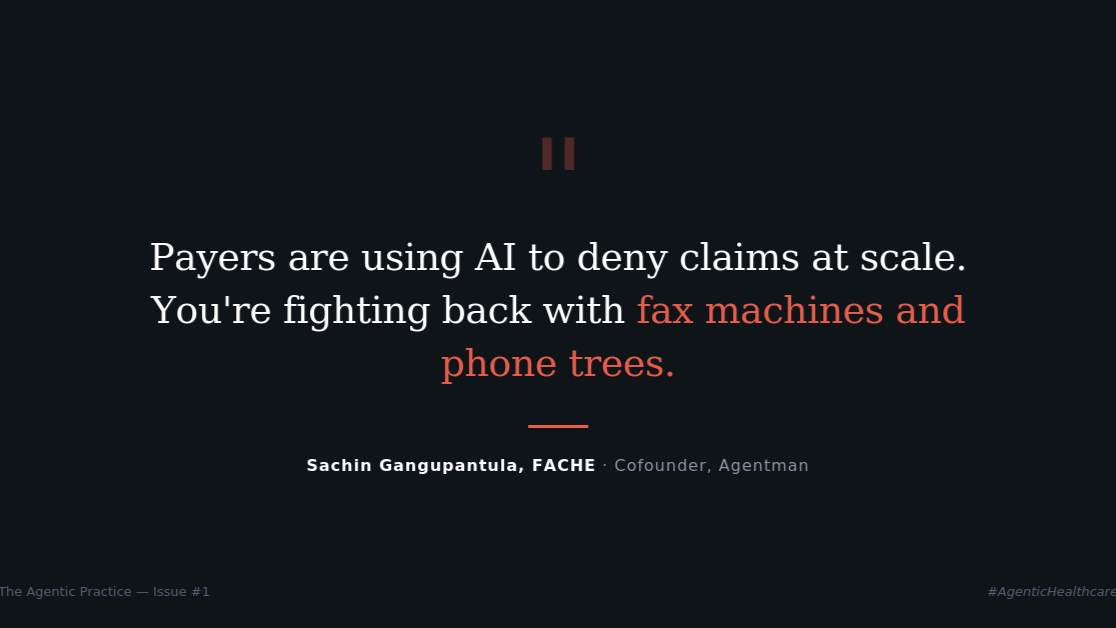
71% of insurers now use AI for utilization management. One major insurer's algorithm processed 300,000 claim denials in two months, with reviewers spending an average of 1.2 seconds per case. Denial rates rose to 11.8% in 2024. Payers are deploying AI at scale to deny claims. Independent practices using manual processes — fax machines, phone trees, and understaffed billing departments — are structurally outmatched.
Key Takeaways
-
The independent practice squeeze is structural, not cyclical. Medicare physician payment declined 33% in inflation-adjusted terms since 2001, while practice costs rose 59%. Commercial and Medicaid rates follow Medicare downward.
-
Previous healthcare technology failed because each tool solved one problem in isolation. EHRs, billing companies, AI scribes, and value-based care programs each addressed a single dimension while the others got worse. None of them coordinate.
-
Agentic AI is the first technology that fights back on every front simultaneously. Multi-step workflow coordination, cross-platform operation, and compounding intelligence address the full squeeze — not one piece of it.
-
The most credible agentic AI solutions are built and tested by practice operators. Valley Diabetes & Obesity deployed its first agentic AI system in November 2025, with agents for eligibility, prior auth, coding, and denial management in the build pipeline.
-
Payers are using AI at scale to deny claims. Independent practices need AI that fights back at scale. 71% of insurers use AI for utilization management. 65% of denied claims in small practices are never resubmitted. The asymmetry is unsustainable.
The practices that will define how this technology gets built aren't waiting for enterprise vendors to care about them. They're building for themselves.
→ Subscribe to The Agentic Practice for weekly insights on how independent practices are deploying agentic AI to reclaim time, revenue, and operational resilience.
Originally published in The Agentic Practice — Issue #1, by Sachin Gangupantula FACHE, MBA, CDH-E
Last Updated: March 23, 2026