The physician says "prescribe Ozempic" and walks to the next room. Twenty seconds later, a payer-specific prior authorization is assembling: clinical documentation pulled from the encounter note, matched against the patient's coverage requirements, a submission queued for human review. The physician never touches the PA portal.
This is the ambient-to-agentic pipeline. It exists architecturally. It is not yet the default state of clinical operations.
The Relay Race
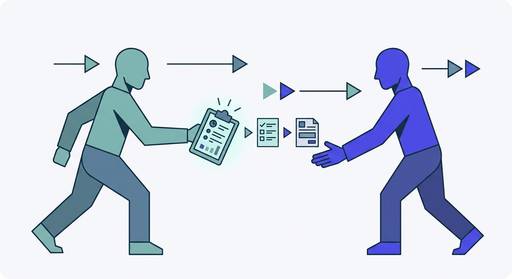
The healthcare AI market is running a relay race with two legs and no clean handoff.
Leg one is ambient AI: platforms like DeliverHealth's InstaNote, Nuance DAX, and Abridge listen during clinical encounters and convert speech into structured documentation. The note becomes the source of truth for everything downstream — coding, claims, prior authorizations, and patient follow-up.
Leg two is agentic AI: based on signals from that note, agents execute the administrative workflows — prior authorization requests, eligibility verifications, denial appeals, claim submissions. This is Agentman's domain.
The baton is the encounter note. The handoff point is clinical event detection: the moment a medication, procedure, or referral appears in the finalized note, an agent should receive a structured signal and load the corresponding workflow. As Prasad Thammineni, CEO of Agentman, puts it: "Ambient AI captures the encounter, passes the baton to Agentman, and the prior auth is assembled by the time the physician exits the room."
Why the Baton Is Still Being Dropped
Ambient AI and agentic AI developed in parallel rather than in sequence. Neither side built the standard handshake that converts a clinical event into an agent trigger, and the gap is where staff time disappears.
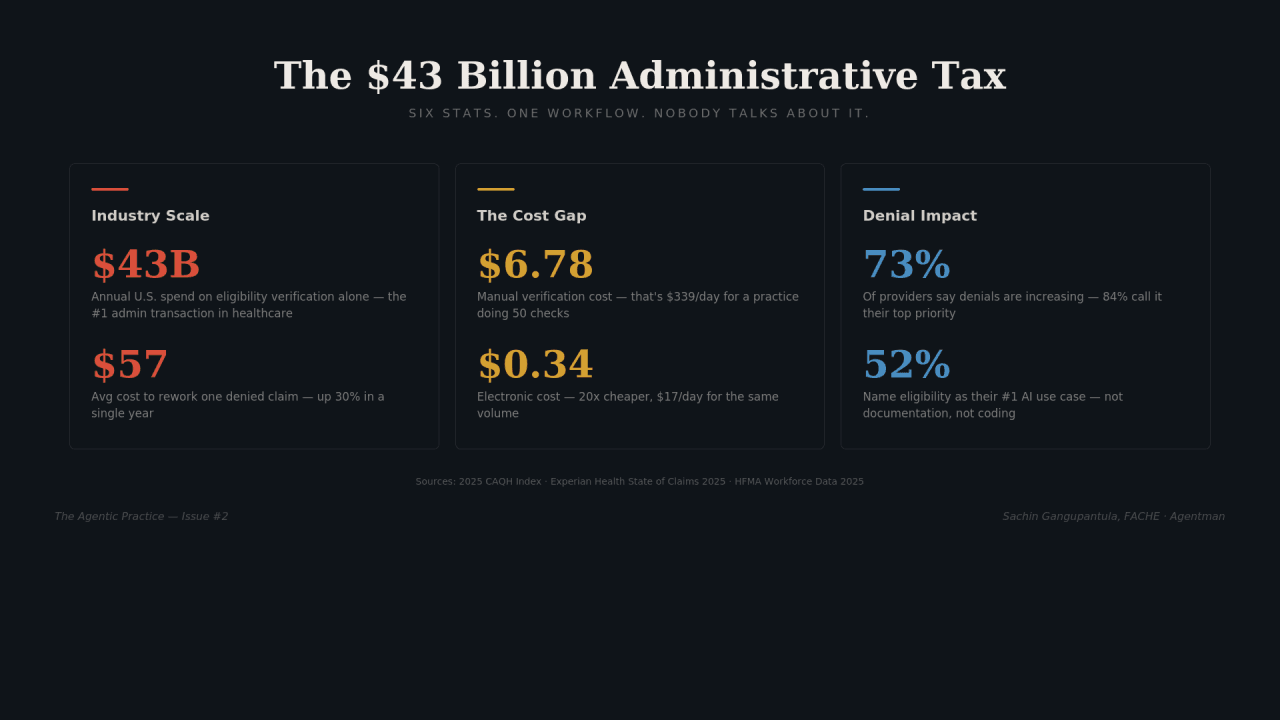
Today, a physician finishes dictating, the coding engine assigns CPT codes, and the prior authorization process begins manually. Staff log into payer portals and re-enter the exact diagnosis and medication details the encounter note already contains. According to the American Medical Association, U.S. physicians spend approximately two hours on administrative tasks for every one hour of direct patient care, with a significant share of that burden sitting in this gap.
The integration opportunity is clear: if the doctor says something — a med, an MRI, a referral — that clinical event should automatically kick off the downstream process. Payer-matched, documentation-assembled, queued for human review. That is the baton pass.
What the Integration Looks Like
When the encounter is finalized, an agent reads the note and identifies actionable signals: a new medication requiring prior authorization, a procedure requiring payer approval, a referral needing scheduling. Each signal triggers the corresponding payer-specific skill. The Aetna GLP-1 skill encodes the required lab values and step therapy documentation; the Blue Shield imaging skill knows the evidence format for CT approvals. The agent assembles the submission from the encounter note and queues it for human review. The staff member sees a completed request, not a blank portal form.
What makes this defensible at scale is the skill library behind the agents. Every submission outcome refines the payer-specific intelligence, and that intelligence propagates across every practice on the platform. A new endocrinology practice onboarding inherits the GLP-1 authorization skills that similar practices have already refined in production.
The Human Always Finishes the Race
Agents assemble. Humans approve. That is the architecture, not a constraint layered on afterward.
Every output is a finished work product queued for review, not an autonomous submission. Staff confirm before anything goes to a payer. The value is not eliminating staff but changing what they do: a billing coordinator who previously spent hours in payer portals can instead review a far larger volume of submissions that agents have already prepared — for a significantly larger patient panel with faster turnaround.
Agentman is building the agentic layer for healthcare operations. If you're building the ambient layer, let's talk.
Frequently Asked Questions
What is the difference between ambient AI and agentic AI in healthcare?
Ambient AI converts clinical encounters into structured documentation. Agentic AI receives signals from that documentation and executes downstream administrative workflows. They are complementary layers — ambient captures the encounter, agentic acts on it.
Why does prior authorization still require manual work if the encounter note contains the clinical information?
Because the integration between the two layers has not been standardized. Staff extract clinical signals from the note manually and re-enter them into payer portals, because no system currently passes that information automatically to a prior authorization agent.
Are prior authorizations submitted automatically once the agent assembles them?
No. Agents prepare the submission and queue it for human review. Staff confirm before anything is filed. The transformation is not that staff are removed from the process — the assembly work shifts to agents, allowing staff to manage a significantly higher volume in the same time.
Prasad Thammineni is co-founder and CEO of Agentman.