Key Facts
- 86% of corporate and private equity leaders have integrated generative AI into their M&A workflows, and 65% did so within the past year (Deloitte 2025 GenAI in M&A Survey).
- GenAI adoption clusters in pre-sign work: 40% of adopters apply it to strategy and market assessment, 35% to target screening, and 35% to due diligence (Deloitte, 2025).
- Only 7% of private equity firms have fully integrated AI into operations; 41% remain in nascent adoption stages (S&P Global, via World Economic Forum, 2025).
- The Agentman PE Intelligence Platform is a full stack of 40 agent skills across 8 capability layers, composing into 6 packaged solutions on Agentman's Agent OS — 16 live in the library today, the remainder on the platform roadmap or provided as platform capabilities (Agentman, 2026).
- 47% of limited partners now closely monitor their GPs' AI adoption, making governance a fundraising question, not just an operational one (Private Equity International LP Perspectives 2026 Survey).
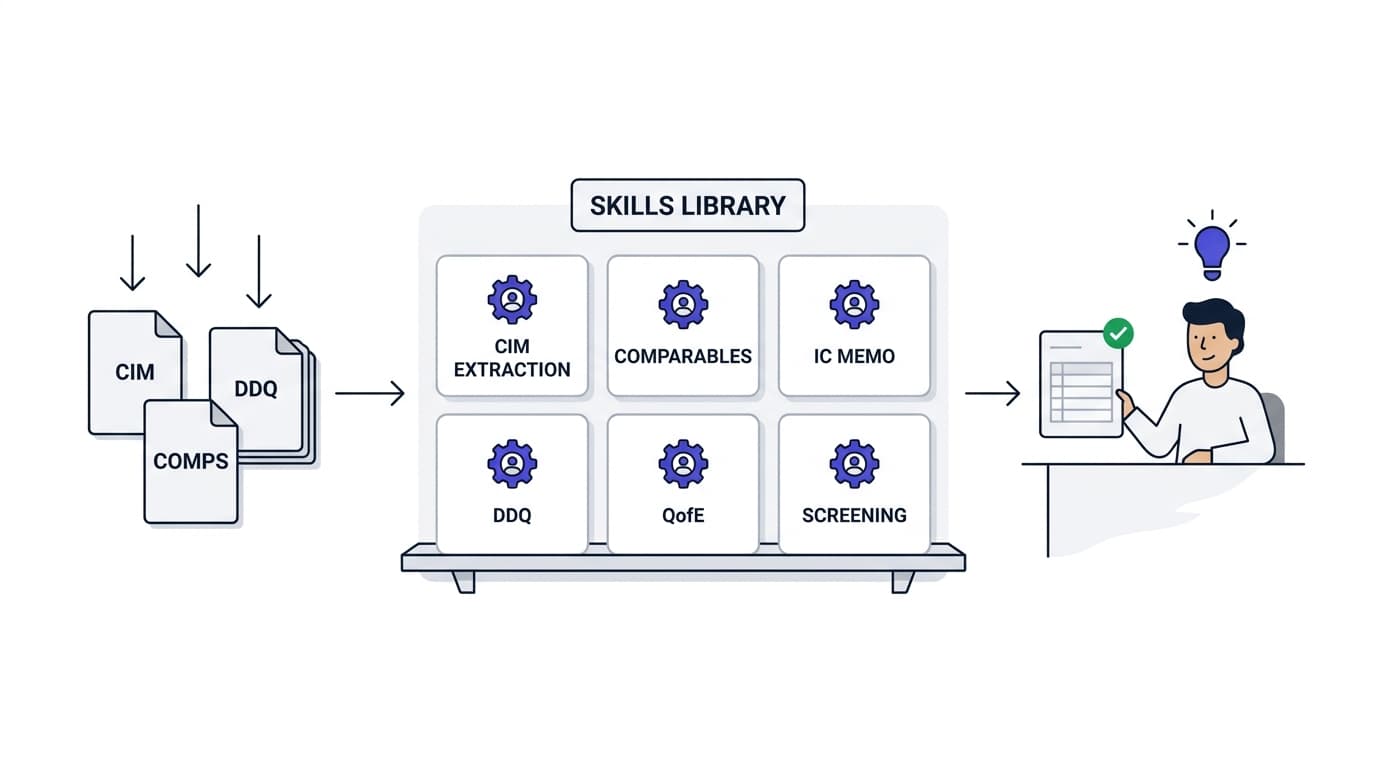
The PE Intelligence Stack is Agentman's full-stack agent skills platform for private equity: 40 agent skills organized into 8 capability layers — from data intelligence at the base, through deal screening, diligence, valuation, monitoring, and investor relations, up to governance and workflow orchestration — composing into 6 packaged solutions. Skills are versioned, auditable procedures running on the Agent OS platform, not prompts.
Status key: ● live in the library today · ◐ provided by the Agent OS platform · ○ on the roadmap. Of the 40 skills in the full stack, 16 are live today, 12 are platform-native capabilities, and 12 are planned releases.
What is the PE Intelligence Stack?
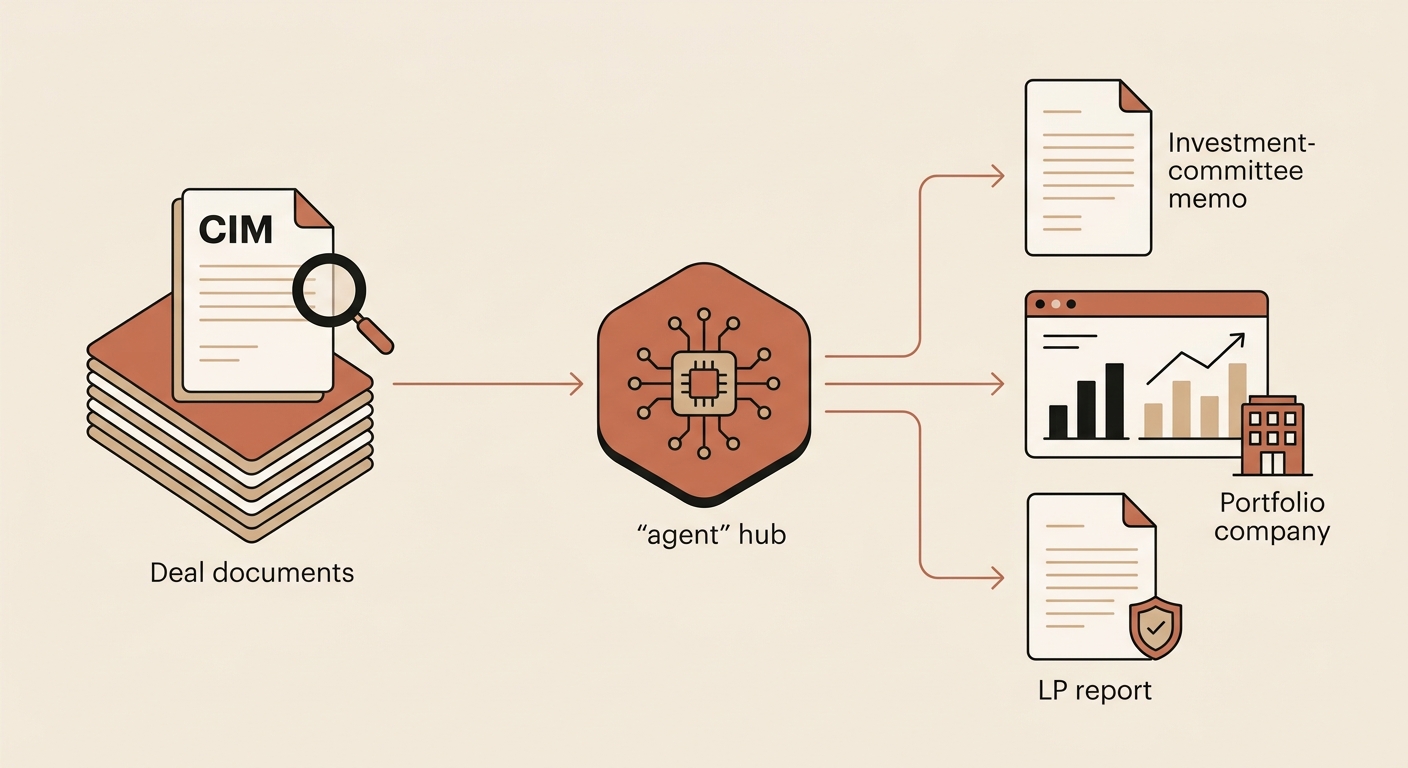
The PE Intelligence Stack is a full-stack, composable platform of 40 agent skills, grouped into 8 capability layers, that assemble into 6 packaged solutions for private equity and adjacent asset classes. Each skill encodes a specific firm procedure — extract these metrics, flag these risks, populate this template — as a versioned, inspectable artifact rather than a one-off prompt.
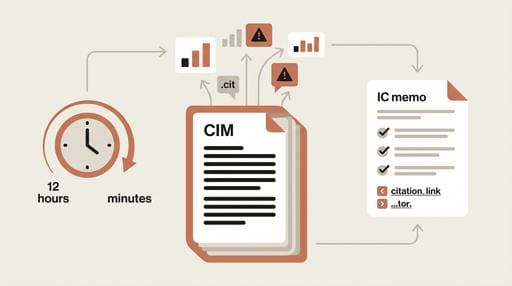
The distinction matters. Most "AI for PE" is a chat window bolted onto a model that knows the internet but not your investment criteria. The PE Intelligence Stack inverts that: domain logic lives in the skill, the Agent OS platform handles data ingestion, orchestration, and governance, and every output carries a citation trail back to the source document.
A full-stack design is what makes the platform more than the sum of its parts. Data intelligence sits at the base, deal-stage and fund-stage skills in the middle, and governance and orchestration across the top — each codified or provided as a layer, each reusable across deals. The result compounds: the same CIM Analyzer that opens a screening workflow also feeds the valuation models, the risk taxonomy, and the IC memo.
"A monolithic 'AI for PE' tool ages the moment your thesis changes. A skills library doesn't — you update one skill, and every workflow downstream of it gets smarter. That's the difference between buying a feature and owning an intelligence layer."
— Prasad Thammineni, Founder & CEO, Agentman (Chain of Agents, Inc.)
Why are PE firms adopting agent skills right now?
Adoption has crossed from experiment to expectation. 86% of corporate and PE leaders have integrated generative AI into M&A workflows, and 65% of them did so in the past year alone (Deloitte 2025 GenAI in M&A Survey). The pressure is no longer whether to adopt, but how fast a firm can scale beyond pilots.
The work is concentrated where the stack is strongest. Deloitte found GenAI adoption weighted toward pre-sign activity: 40% in strategy and market assessment, 35% in target screening, and 35% in due diligence (Deloitte, 2025). These are exactly the stages the Deal Sourcing and Due Diligence layers automate.
Yet a capability gap remains wide open. S&P Global found that only 7% of PE firms have fully integrated AI, 13% are at advanced implementation, and 41% are still in nascent stages (via World Economic Forum, 2025). The firms that operationalize a full stack now gain a structural edge while most peers are still scoping point tools.
The scale advantage is concrete, not theoretical. In deal sourcing, AI can identify 195 relevant companies in the time it takes a junior analyst to evaluate one (World Economic Forum, 2025). Coverage that once required headcount now requires a configured skill.
What are the 8 capability layers?
The 8 capability layers run from raw data ingestion at the base to workflow orchestration across the top. Each skill is marked ● live today, ◐ Agent OS platform, or ○ roadmap.
| # | Capability Layer | Count | Skills |
|---|---|---|---|
| 1 | Data Intelligence | 6 | Firm Knowledge Indexer ◐, Market Data Connector ◐, CRM Sync ◐, Document Parser ◐, Entity Resolution ◐, NL Query ◐ |
| 2 | Deal Sourcing & Screening | 5 | Target Screener ●, Company Profiler ○, Outreach Drafter ○, Comparable Finder ○, Thesis Matcher ○ |
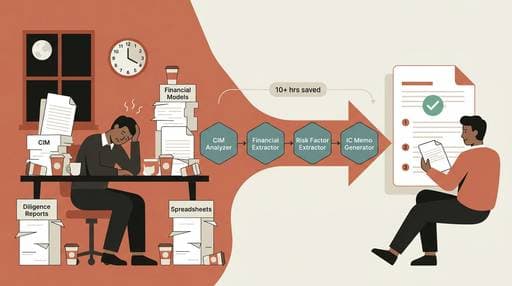
| 3 | Due Diligence & Analysis | 7 | CIM Analyzer ●, Contract Comparator ●, IC Memo Generator ●, Risk Factor Extractor ●, Financial Extractor ○, Expert Call Summarizer ○, Market Study Analyst ○ |
| 4 | Valuation & Modeling | 4 | LBO Modeler ●, DCF Valuator ●, IPEV Valuator ●, Waterfall Calculator ● |
| 5 | Portfolio Monitoring | 6 | Portfolio Monitor ●, Performance Narrator ●, Board Deck Generator ●, Dashboard Builder ○, News Monitor ○, Value Creation Tracker ○ |
| 6 | Investor Relations | 4 | LP Report Generator ●, LP Communication Drafter ●, DDQ Responder ○, Fundraising Deck Builder ○ |
| 7 | Governance & Compliance | 5 | Compliance Checker ●, ESG Reporter ●, Audit Trail ◐, Citation Engine ◐, Access Control ◐ |
| 8 | Workflow Orchestration | 3 | Multi-Step Engine ◐, Template Manager ◐, Notification Router ◐ |
That is 40 skills across the full stack: 16 are live in the library today, 12 are Agent OS platform capabilities, and 12 are on the roadmap. The newest layer is Valuation & Modeling — four production-ready skills (LBO Modeler, DCF Valuator, IPEV Valuator, Waterfall Calculator) that turn a parsed CIM into entry pricing, returns, and fund economics.
The Valuation & Modeling and Due Diligence layers are the densest live capability for a reason. Together they hold 8 of the 16 live skills, because that is where analyst hours disappear: reading data-room documents, building LBO and DCF models, running independent valuation cross-checks, and synthesizing findings into a memo. AI can cut that cycle from weeks to days — but only when the logic follows the firm's taxonomy, not a generic one.
The skills are built to chain, not just to run. The Risk Factor Extractor, for example, builds a deal risk taxonomy directly from the outputs of the Contract Comparator, CIM Analyzer, and Target Screener — three upstream skills feeding one downstream synthesis, with the Workflow Orchestration layer handling the handoffs.
How do the skills compose into 6 solutions?
The 6 solutions are pre-assembled bundles of skills configured for a specific buyer and workflow. A solution isn't a new product — it's a curated path through the same full stack, so a firm adopting Private Credit and one adopting Investment Banking draw from a shared, compounding skill base.
| Solution | Skills it draws on | Core job-to-be-done |
|---|---|---|
| PE Deal Intelligence | Target Screener ●, CIM Analyzer ●, LBO Modeler ●, IC Memo Generator ● | Turn inbound deal flow into scored, memo-ready intelligence |
| Private Credit | Contract Comparator ●, Risk Factor Extractor ●, Portfolio Monitor ●, Compliance Checker ● | Underwrite and monitor credit with a full audit trail |
| Real Estate | Target Screener ●, DCF Valuator ●, Value Creation Tracker ○ | Screen assets and track fund performance at scale |
| Investment Banking | CIM Analyzer ●, DCF Valuator ●, IPEV Valuator ●, IC Memo Generator ● | Accelerate document-heavy valuation and pitch work |
| Investor Relations | LP Report Generator ●, LP Communication Drafter ●, Waterfall Calculator ●, Board Deck Generator ● | Generate LP reports, capital notices, and fund-economics distributions |
| Hedge Funds | Performance Narrator ●, News Monitor ○, Compliance Checker ● | Track positions and narrate performance continuously |
Composition is where the economics shift. With 2 skills you have one possible pairing; at full build, 40 skills create 780 two-skill combinations before you count longer chains. Every skill added to the platform raises the value of the skills already in it — the stack's defining property.
The reuse is literal. The DCF Valuator built for PE Deal Intelligence becomes a cross-check inside an Investment Banking valuation workflow without modification. The skill didn't change; the orchestration layer simply made it one step in a workflow worth far more than the standalone task.
What makes an agent skill different from a prompt or a point tool?
An agent skill is a structured, versioned procedure — extraction logic, decision rules, templates, and edge cases — that any agent can execute consistently. A prompt says "summarize this CIM." A skill says extract these specific data points, flag them against this risk taxonomy, score against these active theses, and cite every finding to its source page.
That structure is what makes the output trustworthy enough for an investment committee. Generic AI produces generic analysis and the occasional confident error — a real concern when 35% of organizations cite AI's potential for mistakes as a reason for hesitation (Deloitte 2025 State of Generative AI). A skill constrains the model to the firm's method, and the Agent OS governance layer makes every output reviewable line by line.
Point tools solve one problem and stop. A full skills stack solves one problem and then composes. This is why scaled deployments are starting to show hard numbers: Apollo Global Management documented AI-driven cost reductions of 40% in content production and 15–20% in lead generation across portfolio companies (MIT Sloan Management Review, 2025). Value at that level comes from redesigned workflows running on shared data and orchestration layers, not bolted-on features.
The constraint worth naming: a skill is only as good as the judgment encoded in it. The platform makes a firm's best practices systematic and fast — it does not replace the partner-level judgment that decides which deals are worth doing.
How do governance and orchestration work across the stack?
Governance and orchestration are full layers of the stack, not afterthoughts. The Governance & Compliance layer pairs two live skills — the Compliance Checker, which validates against SEC Form ADV/Form PF and LPA covenants, and the ESG Reporter, aligned to EDCI and Invest Europe frameworks — with Agent OS infrastructure that provides audit trails, citation, and access control on every skill. The Workflow Orchestration layer chains skills so outputs feed inputs automatically through its multi-step engine, templating, and routing.
This is increasingly a fundraising issue. 47% of LPs now closely monitor their GPs' AI adoption, and a further 46% hold mixed views driven by risk concerns (Private Equity International LP Perspectives 2026 Survey). A firm that can show an audit trail answers the LP's question before it's asked.
Regulation is tightening on the same timeline. The EU AI Act reaches its most consequential enforcement phase in August 2026, with penalties reaching up to €35 million or 7% of worldwide turnover for non-compliant high-risk systems. Built-in compliance validation, citation, and data lineage turn a looming burden into a readiness advantage for prepared firms.
Related Entities
The PE Intelligence Stack sits within Agentman's broader Agent Skills platform, running on the same Agent OS that powers Agentman's healthcare product, Medman, and its legal vertical. The Valuation & Modeling layer's LBO Modeler, DCF Valuator, and IPEV Valuator map onto the private equity deal lifecycle — deal sourcing, due diligence, portfolio monitoring, and investor relations — while the Governance & Compliance and Workflow Orchestration layers address LP scrutiny, EU AI Act readiness, and end-to-end automation. The platform's value rests on skill composability: a full stack where each new skill raises the value of the rest.
Frequently Asked Questions
What is the PE Intelligence Stack?
The PE Intelligence Stack is Agentman's full-stack agent skills platform for private equity: 40 agent skills across 8 capability layers that compose into 6 packaged solutions on the Agent OS platform. Sixteen skills are live in the library today; the rest are platform-native capabilities or planned releases. Each skill is a versioned, auditable procedure rather than a prompt.
What can AI agents do in private equity?
AI agents in private equity automate document-heavy, multi-step work: screening targets against an investment thesis, extracting metrics from CIMs and contracts, building LBO and DCF models, drafting IC memos, monitoring portfolio KPIs, and generating LP reports. Each task runs as a structured skill with a full citation trail to its source.
How is an agent skill different from a ChatGPT prompt?
A prompt is a single instruction with variable output. An agent skill is a versioned procedure that specifies exactly what to extract, how to flag it against a firm's taxonomy, and where to place it — producing consistent, citable, review-ready output every time, with orchestration and governance handled by the platform.
Is AI in private equity compliant and auditable?
It can be, when governance is a layer of the stack. Agentman's Governance & Compliance layer provides compliance validation against SEC and LPA requirements and EDCI-aligned ESG reporting, while the Agent OS platform supplies audit trails, citation, access control, and data lineage — addressing both LP due-diligence questions and EU AI Act requirements taking effect in August 2026.
How many AI skills does a PE firm need to start?
One. Most firms clone a single high-value skill — a CIM Analyzer or Target Screener, both live today — configure it to their criteria, and run it in days. Value compounds as additional skills are chained into end-to-end workflows across the full 8-layer stack.
Where to start
The PE Intelligence Stack is built to be entered at any layer and scaled into a full workflow:
- Start with one measurable skill — a CIM Analyzer or Target Screener configured to your firm's criteria.
- Chain skills so outputs feed inputs — the Workflow Orchestration layer is where analyst hours are recovered.
- Lean on the platform layers — data intelligence and governance come built in, so audit trails and citation answer LP and regulatory questions before they're raised.
- Let the library compound — every skill you add raises the value of the ones already running.
Explore the full PE skills inventory at agentman.ai/agentskills — browse the production-ready library, see what each skill does, and clone your first one.