Key Facts
- Anthropic launched Agent Skills — the feature most users know as Claude Skills — in October 2025 and published the spec as an open standard at agentskills.io on December 18, 2025 (Anthropic, 2025).
- As of June 2026, roughly 40 skills-compatible products appear on the official agentskills.io showcase, including OpenAI Codex, GitHub Copilot, Cursor, Gemini CLI, and VS Code (rywalker.com analysis, 2026).
- Community directories now index enormous catalogs — SkillsMP alone lists about 1.9 million public skills scraped from GitHub (SkillsMP, 2026).
- Catalog size is not quality: SkillsBench analyzed 47,150 public skills and found an average quality score of 6.2 out of 12, while curated skills raised agent pass rates by an average of 16.2 percentage points (SkillsBench, 2026).
- A security audit of 22,511 skills found 140,963 issues, and Snyk's ToxicSkills research detected prompt injection in 36% of skills tested (Agensi/Snyk, 2026).
In under nine months, agent skills went from a single Claude feature to a cross-vendor standard with dozens of compatible platforms and millions of published skills. The ecosystem is real, fast-moving, and uneven: distribution is solved, but quality and security are not. Curated, reviewed skill libraries are now the part of the market that actually moves agent performance.
Table of Contents
- What is the agent skills ecosystem, and why did it form so fast?
- Who is building agent skills, and where do you find them?
- Which platforms support agent skills today?
- Which skill categories are growing fastest?
- Enterprise versus indie: who is actually building?
- What is working in agent skills — and what is the catch?
- What is next for the agent skills ecosystem in H2 2026?
- Where does Agentman fit?
What is the agent skills ecosystem, and why did it form so fast?
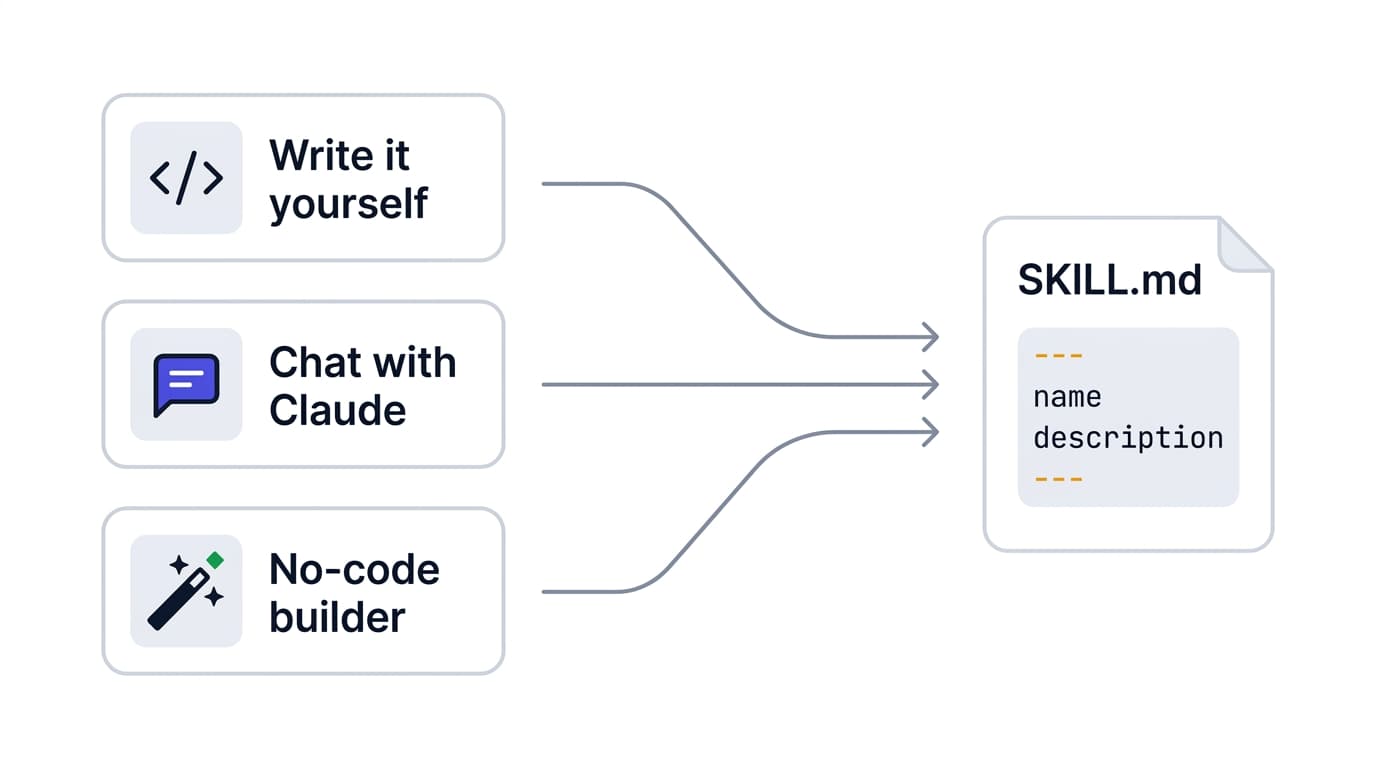
The agent skills ecosystem is the network of standards, directories, platforms, and builders that create and distribute SKILL.md packages — folders of instructions, scripts, and resources that teach AI agents to perform specialized tasks consistently. It formed quickly because the format is simple, portable, and open.
Anthropic introduced Agent Skills in October 2025, then published the specification as an open standard on December 18, 2025 (Anthropic, 2025). The design principle is "progressive disclosure": an agent pre-loads only a skill's name and description, then loads the full instructions when a task matches. This keeps the context cost of a large skill library low.
The open-standard move mirrors Anthropic's earlier playbook with the Model Context Protocol, which it donated to the Linux Foundation on December 9, 2025 (Unite.AI, 2025). Where MCP standardizes how an agent connects to tools, Agent Skills standardizes how an agent learns a procedure. The two are complementary layers, not competitors.
"MCP gave agents hands. Skills give them judgment. The reason this ecosystem exploded in nine months isn't the format — it's that a skill written once now runs in Claude, Codex, Cursor, and a dozen other tools without a rewrite. Portability is the whole game, and curation is the next one."
— Prasad Thammineni, Founder & CEO, Agentman (Chain of Agents, Inc.)
The constraint worth naming early: the spec's simplicity is also its weakness. Skills are "just markdown in folders," which makes them trivial to write and trivial to ship without review — a dynamic that defines both the growth and the risk in today's market.
Who is building agent skills, and where do you find them?
Skills come from three sources: Anthropic and its launch partners, enterprise software vendors, and a long tail of independent builders publishing to community directories. Where you look determines what you get — curation and catalog size trade off directly against each other.
Anthropic ships a small, manually curated directory inside Claude Code and maintains a partner directory with skills from Atlassian, Canva, Cloudflare, Figma, Notion, Ramp, Sentry, Stripe, and Zapier (AI Business, 2026). Everything there is reviewed. The community directories are the opposite: huge, open, and largely unaudited.
The table below maps the major directories on the axes that matter — catalog size, curation, and security review.
| Directory / Marketplace | Approx. catalog | Curation model | Security review |
|---|---|---|---|
| Anthropic official directory | Small | Manually curated by Anthropic | Verified |
| Skills.sh (Vercel-backed, launched Jan 2026) | Hundreds of thousands | Open, npm-style CLI install | Builder-side auditing |
| SkillsMP | ~1.9 million | Scraped from public GitHub | None — inspect before installing |
| SkillHub | 7,000+ | AI-evaluated | Automated scoring |
| Agensi | Smaller, curated | Reviewed before listing | 8-point security scan |
| ClaudeSkills.info | Medium | Community-vetted for Claude Code | Community review |
| Agentman (myAgentSkills.ai) | 90 production skills | Practitioner-authored, reviewed | Spec-compliant, curated |
Sources: SkillsMP (2026), Agensi (2026), Agentman (2026). Catalog figures move week to week; treat them as directional.
One more layer sits underneath all of this: more than 2,500 Claude Code plugin marketplaces are now registered at claudemarketplaces.com, ranging from polished collections by teams like Vercel Labs to abandoned repos (Agensi, 2026). Discovery is no longer the bottleneck. Judgment is.
Which platforms support agent skills today?
Agent skills are now portable across roughly 40 products listed on the official agentskills.io showcase as of June 2026 (rywalker.com analysis, 2026). A skill written for Claude Code can run, unmodified, in a competitor's coding agent — the clearest sign that the standard has crossed from one vendor's feature into shared infrastructure.
| Category | Representative platforms with skills support |
|---|---|
| Anthropic | Claude, Claude Code, Claude Cowork |
| Coding agents | OpenAI Codex, GitHub Copilot, VS Code, Cursor, Gemini CLI, JetBrains Junie |
| Open-source agents | Goose, OpenCode, Amp, Factory, Kiro, Roo Code |
| Enterprise data platforms | Databricks Genie Code, Snowflake Cortex Code |
| Other model vendors | Mistral Vibe, Spring AI |
The convergence was not just announced — it was discovered. OpenAI had quietly shipped a structurally identical implementation in Codex and ChatGPT before the open standard formalized it, using the same file naming, metadata format, and directory layout (VentureBeat, 2025). Tooling has kept pace: Claude Code 2.1.0, released in January 2026, added skill hot-reloading so skills update mid-session without a restart (The New Stack, 2026).
Which skill categories are growing fastest?
Developer and engineering skills dominate the ecosystem by volume, but business functions — product, marketing, data, and operations — are now the fastest-growing long tail. The category mix on Skills.sh, one of the largest open catalogs, shows where builders are spending effort.
| Skill category | Approx. published skills (Skills.sh) |
|---|---|
| Development & Engineering | 288,811 |
| Product Management | 86,948 |
| Marketing | 74,510 |
| Data & Analytics | 69,187 |
| Operations | 51,007 |
| Sales | 42,570 |
| Design | 25,743 |
| Legal | 17,624 |
| Finance & Accounting | 14,932 |
| Healthcare & Life Sciences | 6,354 |
Source: Skills.sh / agentskill.sh category index (2026).
The pattern is informative. Software engineering leads because models already have strong coding coverage and developers were the first audience. Regulated, expertise-heavy domains like legal, finance, and healthcare sit far down the list by raw count — yet these are exactly the domains where skills deliver the largest measured gains, as the next section shows. Volume and value point in opposite directions.
Enterprise versus indie: who is actually building?
Enterprises and independent builders are building different things for different reasons. Enterprises build governed, internal skill libraries; indie builders publish portable, single-purpose skills to public catalogs. The standard is the same; the distribution model is not.
On the enterprise side, Anthropic added organization-wide management for Team and Enterprise plans, letting admins provision and default-enable skills centrally, and shipped stock plug-ins for finance, legal, and HR in February 2026 (TechCrunch, 2026). The driver is control: companies want tailored workflows with audit trails and clean separation between teams. The broader signal is that 68% of production agent deployments have adopted MCP or an equivalent standardized tool layer (Digital Applied enterprise survey, 2026), and skills sit naturally on top of that foundation.
On the indie side, builders optimize for reach. A well-built skill published to a community directory can be installed across every compatible platform with a single command — Skills.sh popularized the npm-style npx skills add install in January 2026 (Agensi, 2026). The incentive is distribution, not governance, which is why the open catalogs grow fastest and review the least.
What is working in agent skills — and what is the catch?
What works is curation. The first peer-reviewed benchmark of agent skills proved that well-built skills improve performance dramatically — and that most public skills are not well-built. This is the single most important finding in the ecosystem, and it reframes how to evaluate every directory above.
SkillsBench, built by researchers from Stanford, CMU, Berkeley, Oxford, and BenchFlow, tested 84 tasks across 11 domains and 7,308 trajectories. Curated skills raised pass rates by an average of 16.2 percentage points, with healthcare gaining 51.9 points — the largest of any domain (SkillsBench, 2026). The more organizational expertise a domain requires, the more skills matter.
The catch is quality variance. The same benchmark analyzed 47,150 publicly available skills and found an average quality score of just 6.2 out of 12; the researchers used only top-quartile skills (scoring 9 or above) in their tests (SkillsBench, 2026). Focused skills also beat bloated ones: 2–3 targeted skills delivered +18.6 points, while monolithic "put everything in one document" skills actually reduced performance by 2.9 points.
Security compounds the quality problem. An audit of 22,511 skills across four sources surfaced 140,963 issues — about 6.3 per skill — and Snyk's ToxicSkills research found prompt injection in 36% of skills tested (Agensi/Snyk, 2026). Skills execute bundled scripts, so an unaudited skill is an unaudited dependency with code-execution rights. The practical rule: treat community skills like any open-source package and review the source before installing.
What is next for the agent skills ecosystem in H2 2026?
Expect the competition to shift from catalog size to trust infrastructure. With distribution and portability largely solved, the open questions for the back half of 2026 are governance, verification, and quality.
- Security scanning becomes table stakes. After the ToxicSkills findings, directories that cannot certify a skill is safe will lose enterprise buyers to ones that can. Verification, not volume, becomes the selling point.
- Spec governance gets contested. As an Anthropic-originated standard stewarded through the Agentic AI Foundation, agentskills.io will face the same neutrality scrutiny MCP did. Adopters are betting on neutral stewardship (The New Stack, 2026).
- Quality benchmarks drive procurement. SkillsBench is the first; expect buyers to demand quality scores the way they demand security scores, and for curated registries to advertise them.
- Business-function skills outgrow coding skills. Developer skills lead today, but product, marketing, operations, and regulated-vertical skills are growing faster and carry higher measured value per skill.
- Vertical depth beats horizontal breadth. Generic skills are commoditizing toward zero; the durable value is in deep, domain-specific procedures that encode how a particular kind of business actually works.
Where does Agentman fit?
Agentman is positioned on the quality-and-curation side of the ecosystem rather than the volume side. Its library holds 90 production-ready skills authored by practitioners and structured to the Anthropic Agent Skills specification, spanning healthcare, sales, marketing, and back-office operations (Agentman, 2026).
That choice follows directly from the SkillsBench data. If the average public skill scores 6.2 out of 12, a scraped catalog of two million skills is mostly noise — and the value lives in the reviewed top quartile. Agentman builds and curates that top-quartile layer, then makes it portable across Claude, ChatGPT, and any MCP-compatible agent through a single connection.
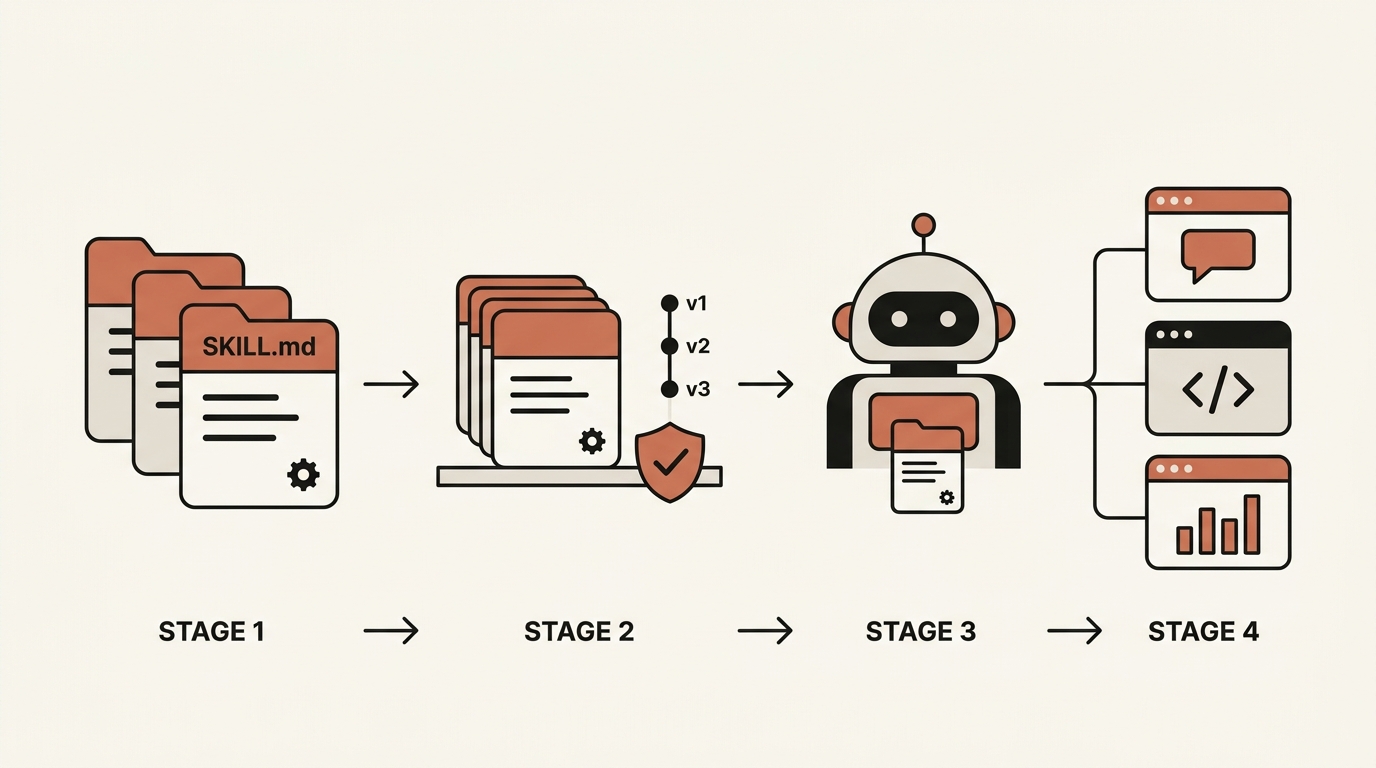
Curation is only half the platform. Agentman is also a sharing layer with version control: every skill is a first-class object with named inputs, typed outputs, source citations, and a full revision history, so teams can publish a change behind review, track who shipped what and when, and roll back any release in one click (Agentman, 2026). On top of that shared library, Agent Builder turns skills into working agents — assembled visually, with no code required — collapsing agent development from custom engineering into assembly. The skills are the raw material; the platform is what makes them safe to share and simple to build on.
The same skills power Medman, Agentman's live back-office automation suite for independent specialty medical practices, where the eligibility verification agent runs checks at $0.50 each against the $7.97 CAQH Index benchmark (Agentman, 2026) — proof that curated skills hold up in production, not just in a benchmark.
Related Entities
This report connects to several entities in the broader agent skills landscape: the Agent Skills open standard and its specification site agentskills.io; the SKILL.md format and its progressive-disclosure design; the Model Context Protocol (MCP) as the complementary tool-connectivity layer; SkillsBench, the first peer-reviewed skills benchmark; and Agentman's own products — the Agent Skills library at myAgentSkills.ai, the Agent Builder platform, and Medman, the healthcare back-office suite proven with design partners including Valley Diabetes & Obesity and Rosen Vein Care.
Frequently Asked Questions
What is an agent skill?
An agent skill is a folder containing a SKILL.md file plus optional scripts and resources that teach an AI agent how to perform a specific task consistently. The agent reads the skill's name and description to decide when to use it, then loads the full instructions only when a task matches.
Is the Agent Skills standard open?
Yes. Anthropic published the Agent Skills specification as an open standard at agentskills.io on December 18, 2025, and stewards it through the Agentic AI Foundation. A skill written to the spec runs across compatible platforms without modification.
Which AI tools support agent skills?
As of June 2026, roughly 40 products on the agentskills.io showcase support the standard, including Claude, OpenAI Codex, GitHub Copilot, VS Code, Cursor, Gemini CLI, Goose, OpenCode, Databricks Genie Code, and Snowflake Cortex Code.
Are community skills safe to install?
Not automatically. A 2026 audit found prompt injection in 36% of tested skills, and skills can execute bundled scripts. Review the source of any community skill before installing it, exactly as you would an open-source dependency.
Do bigger skill catalogs mean better skills?
No. SkillsBench found the average public skill scores 6.2 out of 12, and only top-quartile skills meaningfully improved agent performance. Curation and review matter more than catalog size.
Key Takeaways
- Agent skills became a cross-vendor standard in under nine months, with ~40 compatible platforms and millions of published skills.
- Distribution and portability are solved; quality and security are not.
- Curated skills raise agent pass rates by 16.2 points on average, but the average public skill is too low-quality to help.
- The H2 2026 battleground is trust infrastructure: security scanning, spec governance, and quality benchmarks.
- Vertical, reviewed, production-grade skills are where durable value sits.
Build on the curated side of the ecosystem. Explore Agentman's production-ready, practitioner-authored skill library and start building agents that work the same way every time, in every AI tool — at agentman.ai/agentskills.