
Key Facts
- Physicians complete an average of 40 prior authorizations per week, consuming 13 hours of physician and staff time (AMA Prior Authorization Physician Survey, 2026).
- Only 24% of physicians report seeing the qualified clinical review that the June 2025 prior authorization pledge promised (AMA, 2026).
- In Medicare Advantage, four in five appealed denials are overturned, and only one in nine denials is appealed (KFF).
- AHIP reports an 11% reduction in prior authorization requirements since the June 2025 pledge — a figure produced by the insurers themselves, with no service-level or insurer-level breakdown (AHIP, July 2026).
- At Valley Diabetes & Obesity, the inbox triage agent already recognizes an incoming prior authorization, attaches the payer and drug, and creates the task — after ten months in production with zero missed referrals (Agentman customer data, 2026).
Prior authorization fails independent practices at the routing layer, not the technology layer. The fax machine works. E-prescribing works. What breaks is that thirty payers each publish their own rules, accept submissions through different front doors, and change both without telling anyone — so the practice absorbs the coordination cost as staff time.
A patient of ours needs a continuous glucose monitor. It happens every day in a primary care and diabetes practice, and every time, before our coordinator can start the prior auth, she has to answer a question no patient would believe is a question: where does this one go?
Table of Contents
- Why does the same device get submitted three different ways?
- Why do patients find out about a prior auth at the pharmacy counter?
- Did the 2025 prior authorization pledge actually change anything?
- How does a practice build its own prior auth maze?
- What does prior auth look like inside our practice today?
- How should an agentic prior authorization chain actually run?
- Frequently Asked Questions
Why does the same device get submitted three different ways?
Payers route the same service through different channels, so a single order can require a fax, a third-party portal, or the payer's own portal depending on which plan the patient carries. Knowing who wants what where, then chasing each channel for a status, is the job — and every step of it is a person on the payroll.
For that continuous glucose monitor, one of our payers wants the package faxed to the DME supplier. Another routes it through a third-party portal that handles their utilization review. A third takes it on the payer's own portal. This patient's plan, a Blue plan, takes it by fax. So our coordinator faxes it, calls two days later to confirm it arrived, and calls again for a status.
Nothing in that sequence is a technology failure. It is a routing failure that only a practice pays for.
Why do patients find out about a prior auth at the pharmacy counter?
Patients learn a drug needs prior authorization at the pharmacy counter because the requirement is close to invisible at the moment of prescribing. The payer knows. The EHR often does not. So the pharmacy becomes the notification system, and the practice finds out secondhand.
The same day as that CGM, a GLP-1 prescription goes to the pharmacy. The pharmacy discovers it needs a PA and sends a message back to our office to start one. The patient finds out at the counter. We find out from the pharmacy. The payer knew all along.
Three things make the requirement invisible at the point of care:
- The formulary flag is unreliable. 27% of physicians told the AMA the flag inside the EHR is rarely or never accurate.
- Benefit assignment changes the answer. Whether the drug sits under the pharmacy benefit or the medical benefit determines which rules apply.
- The real PA list is a PDF. It lives on a payer portal and is updated whenever the payer feels like it — across roughly thirty contracted payers.
No coordinator can track thirty changing drug lists by hand in real time. That, in one sentence, is the job I want software to take off my staff.
Did the 2025 prior authorization pledge actually change anything?
The June 2025 AHIP pledge produced no independently verified improvement one year on. Every progress number comes from the insurers themselves, the public dashboards promised at launch were never built, and the physician-side survey data moved in the opposite direction.
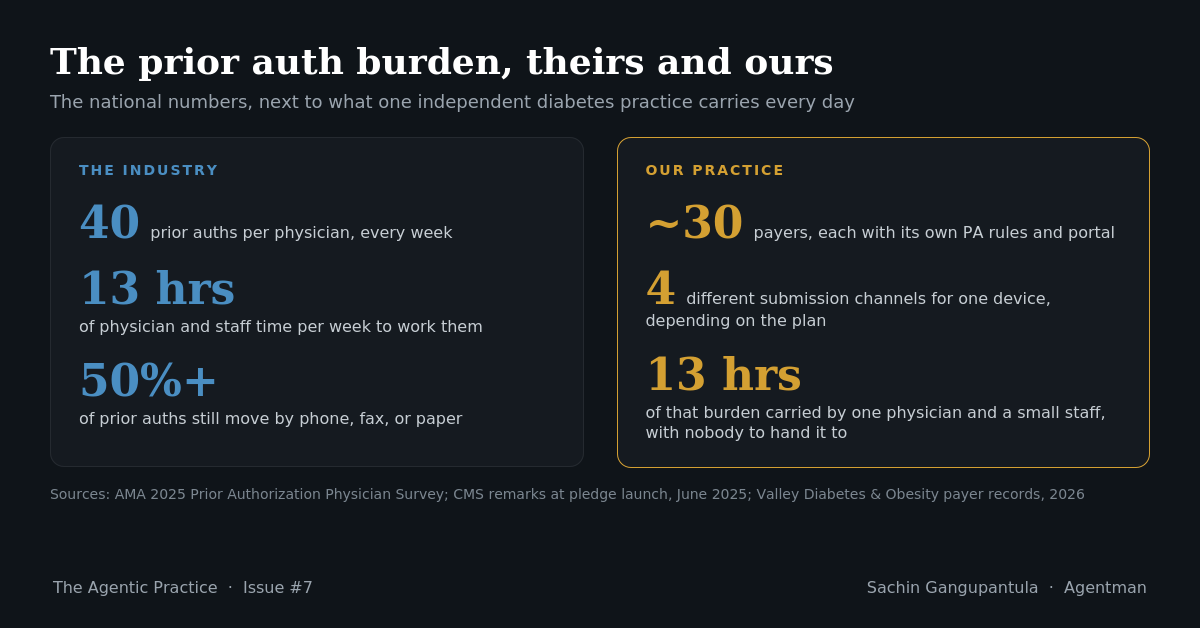
On June 23, 2025, insurers covering roughly 270 million people signed a voluntary pledge through AHIP to simplify prior auth. Here is the scorecard a year in, split by who is doing the counting.
| Claim | Source | What can be verified |
|---|---|---|
| 11% reduction in medical prior authorizations | AHIP, 2026 | Self-reported; no statement of which services or which insurers |
| Public accountability dashboards | Promised at the June 2025 launch | Never built |
| First mandated payer filings | KFF, August 2026 | Denial rates as percentages with no counts, nothing by service, no drugs, and nothing at all from self-funded employer plans |
| 40 prior auths per physician per week, 13 hours of staff and physician time | AMA, 2026 | Only 24% of physicians report seeing the qualified clinical review the pledge promised |
Two of the six pledge commitments were already federal requirements, which Colin Banas of DrFirst called taking credit for something you had to do anyway.
The appeal math is the part practices should sit with. In Medicare Advantage, four in five appealed denials get overturned, and only one in nine denials is appealed. The rest disappear — not because they were correct, but because appealing costs more staff time than the claim is worth.
One scope note before anyone plans around 2027. The electronic prior authorization mandate covers Medicare Advantage, Medicaid, and exchange plans, for medical services only. Drugs sit in a separate proposed rule. Self-funded employer plans have nothing. Check your payer mix before you assume 2027 fixes anything.
Nobody outside the payers is checking any of this. Not CMS, not HHS, not a third-party auditor. Which leaves you, with whatever you can measure inside your own practice.
How does a practice build its own prior auth maze?
A practice builds its PA maze one reasonable workaround at a time, and the accumulated result is a process no single person designed. A payer adds a portal, so someone gets a login. A second payer wants fax, so the fax stays. A denial gets overturned after the coordinator includes a specific lab, so she remembers it next time. A carrier carves PA out to a separate company, so that's a new login and new rules.
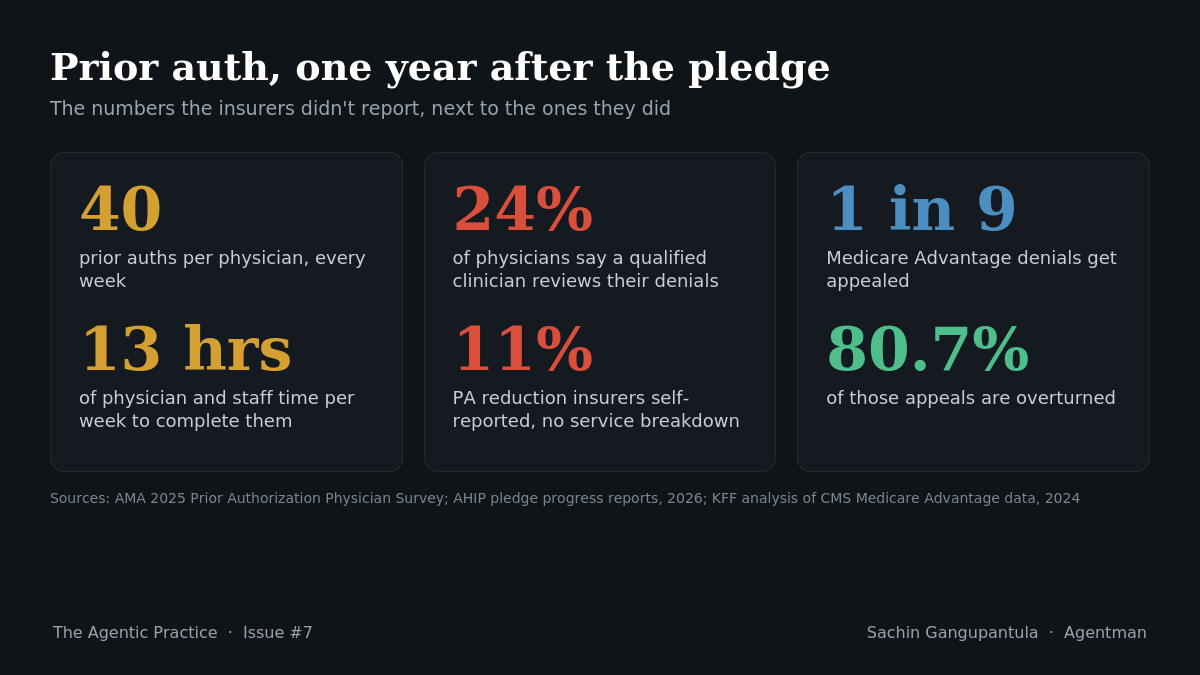
After nine years you have six front doors, no map, and one person who knows where everything is.
"Every workaround we normalized is a debt, and at our practice most of it is owed to one coordinator's memory."
— Sachin Gangupantula, FACHE, MBA, CDH-E, VP of Practice Operations at Valley Diabetes & Obesity
Now bolt the 2027 mandate onto that maze. An electronic connection to a Medicare Advantage plan delivers the same request faster. It will not move the PA check to the moment of care, tell the patient where her request sits, or capture what our coordinator knows about that plan's real rules. The fax gets faster. Nothing else changes.
The uncomfortable part is how much of this we built or accepted ourselves — which is also the encouraging part. The pharmacy-counter PA, the fax-and-callback loop, and the six browsers for six payers were all choices made inside the practice. That means the practice can change them without waiting for a payer or a regulator.
What does prior auth look like inside our practice today?
Two of our four workflow stages already run without a person. The chain then stops, and a human opens six browser tabs.
What we see on the ground at Valley Diabetes & Obesity:
- Carve-outs multiply the doors. Two of our national carriers route PA through a separately branded utilization management company, so the same denial arrives under a different logo and another login.
- The winning rules are undocumented. Our coordinator knows which local payer accepts the specific keywords, which plan wants an HbA1c from the last 90 days, and which accepts 180. None of it is written anywhere. If she gives notice, it leaves with her.
- We cannot measure ourselves. Our EHR logs the PA as a task and nothing else. I can tell you what a national carrier reported to CMS. I cannot tell you our overturn rate by payer.
Here is what the two live agents already do with a PA today. The inbox triage agent reads every incoming fax and portal message; when the pharmacy sends back that GLP-1 request, it recognizes it as a prior auth created on CoverMyMeds, pulls the patient, and creates a task with the payer and drug attached. That is the same agent that went ten months without a missed referral and took our inbox from two hours a day to fifteen minutes — numbers I published in June because they were measured, not projected. The eligibility verification agent has already confirmed the plan, including which company actually handles PA for it.
Then the chain stops. The task lands in a queue and a person opens six browser tabs. We are building the prior authorization agent to cover that distance. No results yet.
How should an agentic prior authorization chain actually run?
An agentic prior authorization chain runs as a sequence of specialized agents that hand work to each other until the request is submitted or a person is needed for judgment. In this newsletter, "agentic" means exactly that: several agents, each with a job, passing the request along with its context attached.
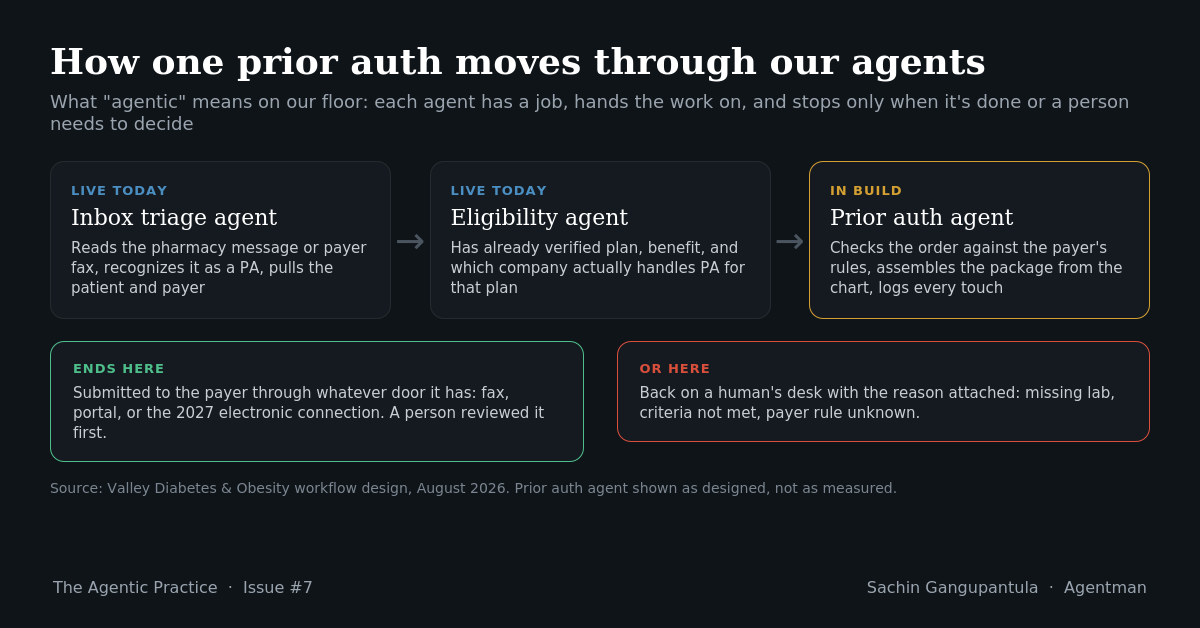
| Stage | What runs it | What it produces |
|---|---|---|
| Trigger | Inbox triage agent | Catches the pharmacy message or payer fax, hands over request, patient, and payer |
| Coverage | Eligibility verification agent | Plan, benefit, and the carve-out entity that actually handles PA |
| Rules | Live payer rules layer | Current published rules plus the unpublished ones the coordinator learned the hard way |
| Assembly | Prior authorization agent | Package built from the chart, routed through fax, portal, or the 2027 electronic connection |
| Close | Human review | Submitted with a person's sign-off, or handed back with the reason attached |
Four design decisions carry the weight:
- Check the rules while the physician is still in the chart. For new orders, the agent checks that payer's current requirements before the prescription leaves the room. That is where the pharmacy-counter surprise goes away.
- Treat payer rules as a living layer, not a PDF. The agent holds every payer's current PA rules, published and unpublished, and keeps them current as payers change them without telling anyone. Every quirk the coordinator knows becomes a rule the agent applies whether or not she is at her desk.
- Do not rebuild the workflow when a payer moves its front door. The package assembles once and goes out through whatever channel that payer uses today.
- Always hand back with a reason. Missing lab, criteria not met, payer rule unknown. Most automation skips the hand back, and skipping it is how a tool fails quietly.
Every touch gets logged as a byproduct: request, payer, drug or service, channel, decision, days, appeal, outcome. That log is the practice-side PA metric set nobody else will produce for you, and it feeds the denial management work we wrote about in June.
The bigger prize, if we get it right: a rule one practice learns about a Blue Cross plan should not have to be relearned by the next practice facing the same plan. We have designed for that and have not yet measured it.
The test I would apply to any PA tool, ours included: does it connect the order in the chart to the reversal on appeal, or does it speed up one piece?
Related Entities
This issue sits inside Agentman's work on agentic back-office automation for independent specialty medical practices, delivered under the product name Medman. The prior authorization agent takes its handoff from the inbox triage agent and the eligibility verification agent (priced at $0.50 per check against the $7.97 CAQH Index benchmark for a manual verification), and feeds the denial management agent with the payer-level outcome data most practices never capture. The work spans revenue cycle management for specialty verticals including diabetes and obesity, wound care, and vein care, with reference customers Valley Diabetes & Obesity, Rosen Vein Care, and Heritage Wound Care.
Frequently Asked Questions
How many prior authorizations does a physician handle each week?
Physicians complete an average of 40 prior authorization requests per week, and prior authorization consumes about 13 hours of combined physician and staff time weekly, according to the AMA's 2026 prior authorization physician survey. Two in five physicians employ staff who work exclusively on prior authorization tasks.
What is a prior authorization agent in a medical practice?
A prior authorization agent is software that receives a PA request with its patient and payer context already attached, checks the payer's current requirements, assembles the clinical package from the chart, and routes it through that payer's submission channel. A staff member reviews and submits. Nothing is sent to a payer without human review.
Does the 2027 electronic prior authorization mandate fix prior auth?
No. The mandate covers Medicare Advantage, Medicaid, and exchange plans for medical services only. Prescription drugs sit in a separate proposed rule, and self-funded employer plans are not covered. An electronic connection delivers the same request faster; it does not move the requirement check to the point of care or capture a payer's unpublished rules.
Why are prior authorization denials so rarely appealed?
Appealing costs staff time that often exceeds the value of the individual claim, so most denials are never challenged. In Medicare Advantage, four in five appealed denials are overturned but only one in nine denials is appealed, which means most denials are absorbed as write-offs rather than resolved on the merits.
What prior authorization metrics should a practice track itself?
Track request, payer, drug or service, submission channel, decision, days to decision, whether it was appealed, and the appeal outcome. Payer-reported federal data is published as aggregate percentages with no service-level detail, so a practice's own log is the only source that shows which payers cost it the most.
What to do next
Four things any independent practice can do this month, none of which require a payer or a regulator to move first:
- Draw your PA workflow end to end before you buy anything. Order in the chart to reversal on appeal. Mark every place a human waits, calls, or re-enters something. I had never drawn ours until this summer.
- Start practice-side PA metrics now. A spreadsheet until you have something that fills itself in. Three months of that beats any industry survey in a payer conversation.
- Write down what your PA coordinator knows. Every quirk and shortcut missing from the official policy. Right now, it leaves with a two-week notice.
- Get a written compliance date from your EHR and e-prescribing vendor for the 2027 electronic connection. Not "committed to interoperability." A date.
Quick question for the comments: what is your overturn rate on appeal with your worst payer? If you don't know, that's the answer.
If you run an independent specialty practice and want to see how the Medman agent suite would handle your prior auth queue, talk to us.
Sources
- American Medical Association. "AMA survey: Prior authorization reform pledge falls short with physicians," 2026. https://www.ama-assn.org/press-center/ama-press-releases/ama-survey-prior-authorization-reform-pledge-falls-short-physicians
- KFF. "Prior Authorization Metrics Provide New Insights into Insurer Practices, but Gaps Remain," August 2026. https://www.kff.org/patient-consumer-protections/prior-authorization-metrics-provide-new-insights-into-insurer-practices-but-gaps-remain/
- KFF Health News. "Insurers Hedge on Trump-Backed Pledge To Improve Denials Process," July 2026. https://kffhealthnews.org/insurance/prior-authorization-insurance-denials-reform-pledge-year-later/
- AHIP. "Health Plans Are on Track to Streamline Prior Authorization," July 2026. https://www.ahip.org/news/articles/health-plans-are-on-track-to-streamline-prior-authorization
- AHIP. "Health Plans Take Action to Simplify Prior Authorization," June 2025. https://www.ahip.org/news/press-releases/health-plans-take-action-to-simplify-prior-authorization
I have been away from this newsletter longer than I planned — two open positions, a diabetes outcomes project, and a wave of IPA referrals, each with its own PA rules. That summer gave me this issue.
Sachin Gangupantula, FACHE, MBA, CDH-E — VP of Practice Operations, Valley Diabetes & Obesity; VP, Agentic Healthcare, Agentman
The Agentic Practice publishes when the practice lets me write it.