Key Facts
- State-of-the-art AI results increasingly come from compound systems built of multiple specialized components, not single monolithic models (Zaharia et al., Berkeley/MIT/Databricks, 2024).
- Initial healthcare claim denials reached 11.8% in 2024, up from 10.2% in prior years (Experian Health, State of Claims 2025).
- A manual prior authorization costs providers about $10.97 per transaction versus $5.79 when fully electronic (CAQH Index, 2023).
- Agentman's eligibility verification agent runs at roughly $0.50 per check, against the CAQH Index benchmark of $7.97 (Agentman, internal benchmark).
- Gartner projects 40% of enterprise applications will embed AI agents by the end of 2026, up from under 5% in 2025 (Gartner, 2026).
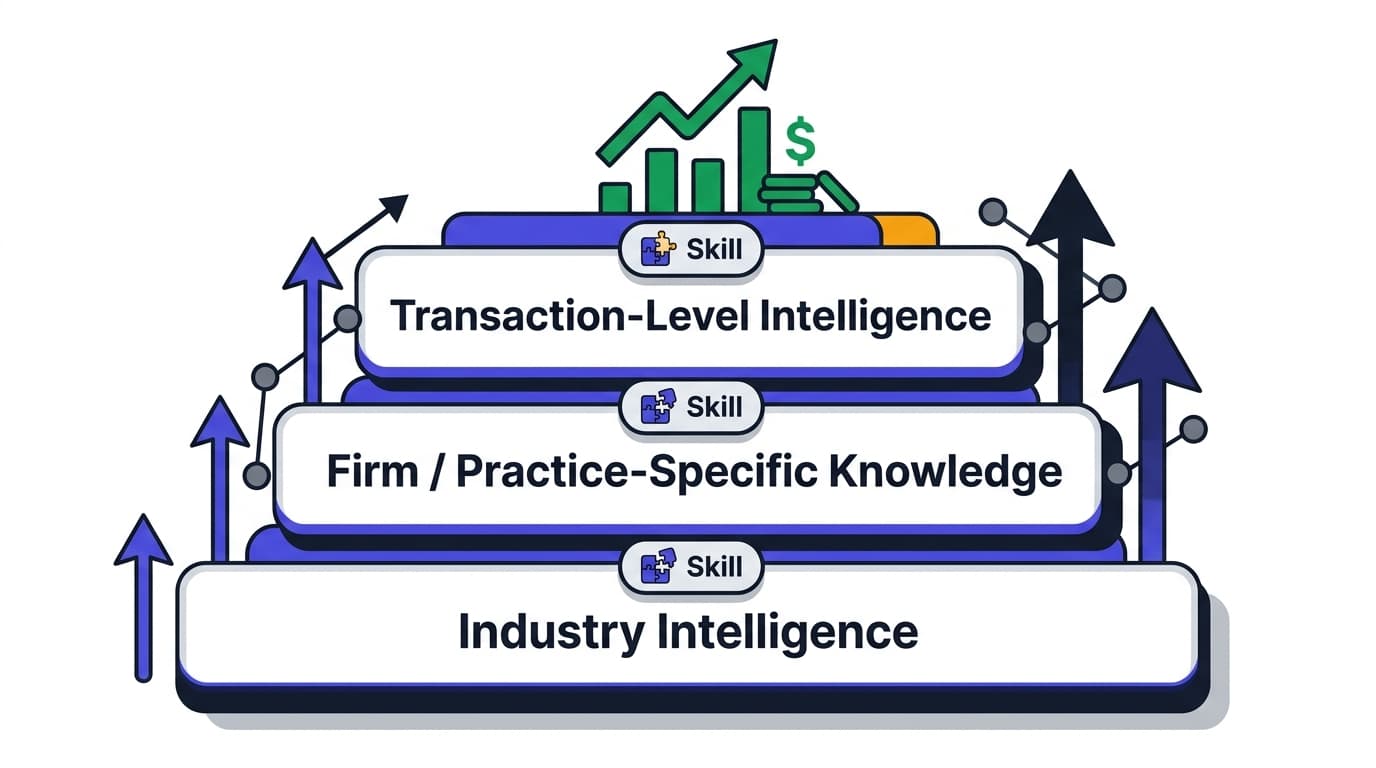
A three-layer intelligence model structures AI into three independent tiers: industry intelligence at the base, firm- or practice-specific knowledge in the middle, and transaction-level intelligence on top. Each tier is codified as a skill, built and maintained on its own. The base ships out of the box; teams build the upper layers, and the top layer gets smarter with every transaction it handles.
What is the three-layer intelligence model?
The three-layer intelligence model splits agentic AI into industry intelligence, firm-specific knowledge, and transaction-level intelligence. The bottom layer holds knowledge true for everyone in a sector. The middle layer holds what is true for one firm or practice. The top layer holds the work that changes daily — the live transactions an agent processes.
The model maps cleanly across verticals. In healthcare, the layers run Healthcare Intelligence → Practice-Specific → Payer & Encounter. In private equity, they run PE Intelligence → Firm-Specific → Team & Functional.
| Layer | What it holds | Healthcare | Private equity |
|---|---|---|---|
| Base — Industry intelligence | Knowledge shared across the whole sector | Coding rules, payer policy patterns, regulatory standards | Diligence frameworks, valuation methods, market taxonomies |
| Middle — Firm/practice-specific | What is unique to one organization | Specialty workflows, fee schedules, referral networks | Investment thesis, sector focus, deal screens |
| Top — Transaction-level | The work that changes every day | Each eligibility check, prior auth, denial | Each deal memo, data-room review, portfolio update |
The base layer is the foundation: it is broad, stable, and reusable. The top layer is volatile: it captures the specific transaction in front of the agent right now. The middle layer connects them, translating shared industry knowledge into one organization's way of working.
This structure matters because most teams try to buy a single, all-knowing model and then wonder why it never quite fits. A layered model fits because each layer can be sourced differently — bought, configured, or learned.
Why does a layered architecture beat monolithic AI?
A layered architecture beats monolithic AI because specialized, composable components outperform a single general-purpose model on real-world work. Research from UC Berkeley's AI systems group shows compound systems consistently beat single-model deployments by decomposing problems into specialized parts. Modularity also lets each part improve on its own, without rebuilding the whole.
The strongest statement of this comes from the researchers who named the pattern. A team from Berkeley, MIT, and Databricks argued that leading AI results now come from compound systems with multiple components rather than monolithic models (Zaharia et al., 2024). The market has followed: roughly 60% of large language model applications already use retrieval, and about 30% use multi-step chains (industry analysis, 2026).
The constraint is real, though. Compound systems add coordination and observability challenges that single-model setups never face. A layered model only pays off when each layer has a clear owner and a clear interface — otherwise modularity becomes sprawl.
"The mistake teams make is shopping for one model smart enough to do everything. Production work needs structure. When you separate what's true for the industry from what's true for your practice from what's true for today's transaction, each layer can be built, tested, and improved independently — and the whole system stays predictable instead of drifting."
— Prasad Thammineni, Founder & CEO, Agentman
The payoff shows up in adoption forecasts. Gartner projects that 40% of enterprise applications will embed AI agents by the end of 2026, up from under 5% in 2025 (Gartner, 2026). The teams reaching production are composing systems, not prompting a single model and hoping.
How does each layer get built and maintained?
Each layer is codified as a skill — a discrete, versioned unit of capability that is built, managed, and maintained independently. The bottom layer ships out of the box, because industry knowledge is shared. Teams build the upper two layers, because firm knowledge and live transactions are specific to them.
This division of labor is the practical heart of the model. A new practice or fund does not start from zero. It inherits the industry layer immediately, then layers its own configuration on top.
Building and maintaining the layers follows a consistent pattern:
- Adopt the base layer. Install the industry-intelligence skills that ship ready to use — coding rules, regulatory standards, or diligence frameworks.
- Configure the middle layer. Encode firm- or practice-specific knowledge as skills: fee schedules, referral logic, investment screens.
- Let the top layer run. Transaction-level skills handle the daily flow and feed observed patterns back into the layers above.
- Version and review. Because each layer is a separate skill, teams update one without breaking the others.
Treating capability as skills, rather than as one fused model, is what keeps the system maintainable. When a payer changes a policy, you update one industry skill — not the entire agent.
What does the model look like in healthcare?
In healthcare, the three layers run Healthcare Intelligence → Practice-Specific → Payer & Encounter, and they directly target the revenue-cycle work that drains independent specialty practices. The base layer encodes coding and payer-policy patterns. The practice layer encodes one clinic's specialty, fee schedule, and workflows. The transaction layer handles each eligibility check, prior authorization, and denial as it arrives.
The problem these layers attack is large and growing. Initial claim denials reached 11.8% in 2024, up from 10.2% in prior years, and 41% of providers now report denial rates above 10% (Experian Health, State of Claims 2025). Industry analyses estimate roughly $262 billion in claims were denied in 2024, and between 35% and 60% of denied claims are never resubmitted (AHIMA Journal, cited 2026).
Prior authorization is the clearest case for a transaction layer that learns. Physicians complete an average of 40 prior authorizations per week and spend about 13 hours of physician and staff time on them, while 94% say the process contributes to burnout (American Medical Association, 2025 Prior Authorization Physician Survey). A denial-management agent that recognizes a payer's denial patterns — the middle and top layers working together — turns that recurring pain into a handled workflow.
The economics favor automation decisively. A manual prior authorization costs about $10.97 per transaction versus $5.79 fully electronic, and CAQH estimates the industry could save more than $20 billion a year by moving remaining manual transactions to fully electronic workflows (CAQH Index, 2023–2024). Agentman's eligibility verification agent illustrates the gap at the transaction layer: roughly $0.50 per check against the CAQH Index benchmark of $7.97 (Agentman, internal benchmark).
"Denials aren't random. A wound care practice sees the same handful of payer rejection patterns over and over. Once the agent has the practice's specifics layered on top of the payer rules, it stops treating every denial as a surprise and starts handling them like the routine work they actually are."
— Sachin Gangupantula, VP Agentic Healthcare, Agentman, and practicing clinician at Valley Diabetes & Obesity
Reference practices such as Valley Diabetes & Obesity, Rosen Vein Care, and Heritage Wound Care span exactly the specialty verticals — diabetes and obesity, vein care, wound care — where layered intelligence has the most to compound.
What does the model look like in private equity?
In private equity, the three layers run PE Intelligence → Firm-Specific → Team & Functional, applying the same structure to deal work instead of claims. The base layer holds diligence frameworks and valuation methods. The firm layer holds the investment thesis and sector focus. The transaction layer holds each live deal: the data-room review, the deal memo, the portfolio update.
The appetite is clear. In Deloitte's 2025 M&A generative-AI study, 88% of private equity firms reported investing $1 million or more in the technology for their deal teams (Deloitte, 2025). An EY survey found 50% of PE respondents believe generative and agentic AI will be the most transformative force in their industry over the next three years (EY, 2025).
A firm layer matters most in deal sourcing, where coverage is the constraint. Private equity firms typically see only about 16–18% of relevant deals in their target markets (Deal Origination Benchmark, 2024). An agent that carries the firm's thesis as a middle-layer skill — and analyzes each new opportunity at the transaction layer — widens that field of view without adding headcount.
The caution mirrors healthcare. McKinsey found 88% of firms using AI but only 39% reporting EBIT impact (McKinsey, cited 2026), and a common cause is generic, monolithic deployments that never encode the firm's specifics. Layering fixes that by making firm knowledge an explicit, owned component rather than an assumption buried in a prompt.
How do the layers compound over time?
The layers compound because the transaction layer feeds patterns back into the layers above, so the system gets smarter with every transaction. Each denial, each deal review, each eligibility check adds a data point. Over time, recurring patterns at the top become codified knowledge in the middle, and broadly shared patterns can graduate to the base.
This is the core promise in the title. A monolithic model is frozen at training time. A layered, skills-based system improves continuously, because new knowledge attaches to the layer where it belongs without disturbing the rest.
The constraint is discipline. Compounding only works if transaction-level signals are captured and reviewed, not discarded. Content and capability also have a half-life: competitive knowledge ages in months, so the layers need a regular refresh cadence to keep their edge.
Related Entities
This model sits at the center of Agentman's product approach. The base and middle layers are codified as Agent Skills and published in the skills library, while Medman applies the model to revenue cycle management for independent specialty medical practices. The transaction layer is where Agentman's eligibility verification agent, prior authorization agent, and denial management agent operate, displacing manual benchmarks such as CAQH Index. Reference customers Valley Diabetes & Obesity, Rosen Vein Care, and Heritage Wound Care span the wound care, vein care, and diabetes and obesity specialties the model serves.
Frequently Asked Questions
What is the three-layer intelligence model in AI?
The three-layer intelligence model organizes AI into three independent tiers: industry intelligence as the shared base, firm- or practice-specific knowledge in the middle, and transaction-level intelligence on top. Each tier is built and maintained as a separate skill, and the top layer learns from every transaction it processes.
Why is layered AI better than a single large model?
Layered AI is better because specialized components can be built, tested, and improved independently, and research shows compound systems outperform single monolithic models on real-world tasks (Zaharia et al., 2024). Layering also lets a new team inherit a ready-made base layer instead of training one from scratch.
How does the three-layer model reduce claim denials?
The model reduces denials by combining shared payer-policy rules at the base layer with a practice's specific workflows in the middle layer to handle each claim and denial at the top layer. Because initial denials reached 11.8% in 2024 and many are never resubmitted, an agent that recognizes recurring payer patterns recovers revenue that would otherwise be lost (Experian Health, 2025).
What to do next
Three points carry the model:
- Separate your layers. Decide what is true for your industry, your firm, and today's transaction — and treat each as its own component.
- Inherit the base, build the top. Adopt industry-intelligence skills out of the box, then encode your own knowledge above them.
- Let it compound. Capture transaction-level patterns so the system gets smarter over time instead of staying frozen.
Explore the skills library and see how each layer is codified at agentman.ai/agentskills/library.
Sources
- Zaharia, M. et al., "The Shift from Models to Compound AI Systems" (Berkeley/MIT/Databricks), 2024.
- UC Berkeley AI systems group — compound systems outperform single-model deployments.
- Gartner — 40% of enterprise apps to embed AI agents by end of 2026.
- Experian Health — State of Claims 2025 (denial rates 11.8% / 41%).
- Industry analysis — denials of ~$262B; AHIMA on non-resubmission.
- American Medical Association — 2025 Prior Authorization Physician Survey (40 PAs/week, 13 hours, 94% burnout).
- CAQH Index — per-transaction prior auth costs ($10.97 vs $5.79).
- CAQH Index 2024 — $20B+ automation savings opportunity.
- Deloitte — 2025 M&A Generative AI Study (88% of PE invested $1M+).
- EY — 50% of PE see generative/agentic AI as most transformative.
- Deal Origination Benchmark — PE deal coverage (~16–18%).
- McKinsey — 88% AI adoption vs 39% EBIT impact.