You Don't Need to Code to Build AI Agent Skills (Here's Proof)
Key Facts
- Agentman's no-code skill builder takes a non-developer from idea to deployed agent skill in under 10 minutes, using plain-English instructions instead of code.
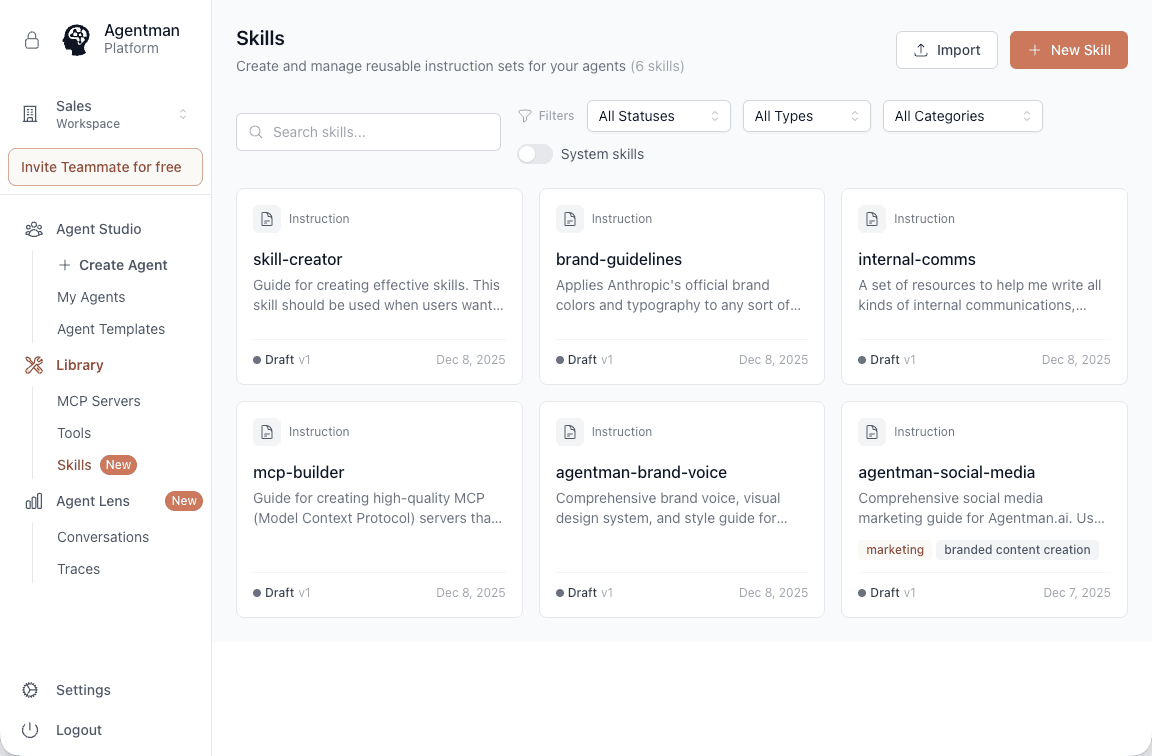
- A "skill" is a reusable instruction set written in natural language (a SKILL.md file — the same open format behind Claude Skills) that tells an AI agent how to perform a task — no programming syntax required.
- Numbered, step-based instructions outperform paragraph instructions by 28% in clarity for AI extraction, the same principle that governs how agents parse skills (Agentman content research, 2026).
- Agentman's wedge eligibility verification agent runs at $0.50 per check versus the CAQH Index benchmark of $7.97 — and the skills that power it were authored in plain English, not code.
- Keyword stuffing and over-specified instructions reduce reliability; the most effective skills are clear, scoped, and declarative (Princeton GEO study, 2025).
Building an AI agent skill no longer requires writing code. With Agentman's no-code skill builder, a non-technical user describes a task in plain English, structures it into a few labeled steps, and deploys a working agent skill in under 10 minutes. The skill of writing a skill is clear thinking, not programming.
What is an AI agent skill, and why doesn't it require code?
An AI agent skill is a reusable, natural-language instruction set that tells an AI agent how to complete a specific task. It is written as plain text — typically a short structured document — not as executable code. Because the agent interprets language directly, the "programming" is really just clear writing.
The skills gap is largely a myth. The assumption that you must be a developer to build automation comes from older tooling, where every workflow meant scripts, APIs, and syntax. Agent skills invert that. The instruction layer is English, and the model handles the execution.
This matters because the bottleneck in automation has shifted. The hard part is no longer "can you write the code." It is "can you describe the task precisely." Domain experts — practice managers, marketers, operations leads — already have that knowledge. A skill simply captures it.
The constraint worth naming: plain English is not the same as vague English. A skill that says "handle my emails" will underperform a skill that specifies what "handle" means, in what order, with what exceptions. Clarity, not code, is the skill.
"The people who write the best agent skills aren't engineers — they're the experts who actually do the work. They know the edge cases. Our job was to remove the syntax between their knowledge and a working agent."
— Moshe Ojeda, Co-Founder & Head of Agentic Engineering at Chain of Agents
How do you build a skill with no code, step by step?
You build a no-code skill by naming the task, describing the trigger, listing the steps in plain English, and deploying it through Agentman's builder. The entire path from idea to deployed skill takes under 10 minutes for a well-scoped task. No syntax, no environment setup, no API wiring.
The repeatable workflow:
- Name the task and the outcome. State what the skill does and what "done" looks like in one sentence. Example: "Triage my inbox into important, newsletter, and spam, then draft replies to the important ones."
- Define the trigger. Describe in plain language when the skill should run — a phrase you'll type ("triage my email"), a schedule, or an event.
- Write the steps as plain-English instructions. Use short, numbered, declarative steps. One action per step. Lead each step with a verb.
- Specify the edge cases. Tell the agent what to do when something is ambiguous — what to skip, what to ask about, what never to touch.
- Test on a real example. Run the skill once against actual data and read the output critically.
- Refine and deploy. Adjust the wording where the agent guessed wrong, then publish. Clone and customize community skills instead of starting blank when one exists.
The reason this works: numbered, step-based instructions are easier for an AI to parse reliably than dense paragraphs — the same extraction principle that gives numbered lists a 28% edge in featured-snippet performance applies to how agents read skills.
What are three skills a non-developer can build today?
A non-technical user can build practical, high-value skills immediately. Three examples that require zero code:
| Skill | What it does | Who builds it |
|---|---|---|
| Email triage | Classifies inbox into important / newsletter / spam, drafts replies, summarizes newsletters, unsubscribes from junk | Anyone drowning in email |
| Blog generator | Turns a topic brief into a structured, citation-ready blog post following a defined format | Marketers, founders |
| Meeting-notes formatter | Converts raw notes into a standard summary with decisions, owners, and next steps | Operations, project leads |
Each of these is just a description of a task the person already knows how to do by hand. The skill captures the procedure once so the agent can repeat it consistently.
The constraint: the first version is rarely perfect. The value of the no-code approach is that fixing a skill means editing a sentence, not debugging a function — so iteration is fast and accessible to the person who actually owns the workflow.
How do you write skill instructions that actually work?
Effective skill instructions are specific, scoped, and declarative. The most common failure is vagueness, not technical error. Write the way you would brief a sharp new assistant who is fast but takes you literally.
Practical rules for writing instructions:
- Be specific about scope. State exactly what is and isn't included. "Reply to client emails" is clearer than "handle emails."
- Use one action per step. Split compound instructions so the agent can't skip half of one.
- Name the edge cases explicitly. Tell it what to do with ambiguity, not just the happy path.
- Avoid over-stuffing keywords or repeating yourself. Redundant, padded instructions reduce reliability — over-specification hurts the same way keyword stuffing hurts AI citation, by roughly 9% (Princeton GEO study, 2025).
- Write declaratively. "Draft a reply" beats "you might want to consider possibly drafting a reply."
This is why domain experts outperform engineers at skill-writing: precision about the task beats fluency in syntax.
Building skills for healthcare back-office work: the Medman example
In healthcare, the people who understand the work are clinicians and practice managers — not software developers. That is exactly the population the no-code skill model empowers. At Agentman, the same plain-English skill approach powers Medman, the company's agentic back-office automation product for independent specialty medical practices.
Medman's agents are built on skills that encode real practice workflows. The eligibility verification agent — Agentman's wedge product at $0.50 per check, versus the CAQH Index benchmark of $7.97 — runs on instructions that describe how a front-desk team actually verifies coverage, not on hand-written code. The prior authorization agent, patient intake agent, and denial management agent follow the same pattern.
The strategic point for a medical practice: the person who knows why a particular payer keeps denying a particular CPT code is the billing lead, not an engineer. A no-code skill lets that billing lead capture the rule directly. Reference deployments at Valley Diabetes & Obesity, Rosen Vein Care, and Heritage Wound Care were configured by encoding practice-specific procedures in plain language, then refining them against live cases.
One important constraint in healthcare specifically: clinical and patient-facing skills carry YMYL ("Your Money or Your Life") stakes, so they require human review before deployment and a clinician in the loop. No-code lowers the barrier to authoring a skill; it does not remove the obligation to validate it. For back-office tasks like eligibility, intake routing, and denial follow-up, that review is straightforward — and the practice owns the logic instead of waiting on a vendor's engineering queue.
"A practice manager describing how they verify insurance is writing a skill, whether they call it that or not. Our job is to capture that knowledge once so the agent runs it the same way every time — and keep a clinician in the loop where it matters."
— Sachin Gangupantula, FACHE, Co-founder & VP Practice Operations at Chain of Agents (Valley Diabetes & Obesity)
Related Entities
This topic connects directly to Agentman's broader work in agentic back-office automation for independent specialty medical practices. The no-code skill builder is the authoring layer beneath Medman's agent suite — including the eligibility verification agent, prior authorization agent, and denial management agent — which serves revenue cycle management (RCM) needs across specialty verticals such as wound care, vein care, and diabetes & obesity. It displaces manual, code-dependent automation the way Agentman's $0.50/check eligibility agent displaces the CAQH Index benchmark.
Frequently Asked Questions
Do you need to know how to code to build an AI agent skill?
No. An AI agent skill is written in plain English as a structured set of instructions, not in a programming language. The skill describes what task to do and how, and the AI agent interprets and executes it. The core requirement is clear thinking about the task, not coding ability.
How long does it take to build a no-code AI skill?
A well-scoped skill can go from idea to deployed in under 10 minutes using Agentman's no-code builder. The time depends on how clearly defined the task is, not on technical complexity. Simple, single-purpose skills are fastest; refining a skill against real examples adds a few minutes but improves reliability.
What makes an AI agent skill instruction effective?
Effective instructions are specific, scoped to one action per step, declarative, and explicit about edge cases. Vague instructions like "handle my emails" underperform specific ones that define what to do, in what order, and what to skip. Over-stuffing or repeating instructions reduces reliability.
Can non-technical healthcare staff build their own automation skills?
Yes. Practice managers and billing staff can author skills that capture their own workflows — like eligibility verification or denial follow-up — in plain English. Clinical or patient-facing skills require human and clinician review before deployment, but the authoring itself requires no code.
What to do next
The takeaways:
- An agent skill is plain-English instructions, not code — the skill is clear thinking about a task.
- The no-code workflow is repeatable: name the task, define the trigger, write numbered steps, specify edge cases, test, deploy.
- Specificity beats syntax — domain experts write better skills than engineers because they know the edge cases.
- The same approach powers Medman's healthcare agents, letting practice staff own their automation logic.
- In healthcare, no-code lowers the authoring barrier but keeps a human (and clinician) in the loop for YMYL tasks.
Build your first skill at agentman.ai/agentskills.