Key Facts
- Agentman estimates roughly 80% of a junior private equity analyst's hours go to data extraction and formatting, leaving about 20% for judgment — a skills library is built to invert that ratio.
- Agentic AI systems now execute multi-step analytical workflows "the way a junior analyst would, but faster and more consistently," automating data gathering so analysts focus on judgment and strategy (V7 Labs, 2026).
- A focused skills pilot on a single workflow such as CIM extraction can be live in 2–4 weeks; full integration with a mid-sized firm's stack typically takes 3–6 months (V7 Labs, 2026).
- Junior analyst turnover is structural and accelerating: by 2025, buy-side recruiting had compressed junior tenure into cycles as short as 18 months, prompting JPMorgan to threaten dismissal of analysts who accept future-dated offers and Goldman Sachs to run quarterly loyalty attestations (Jensen Partners, 2025; M&A Community, 2025).
- A skills library is owned infrastructure — it does not forget last quarter's analysis or leave for a competitor.
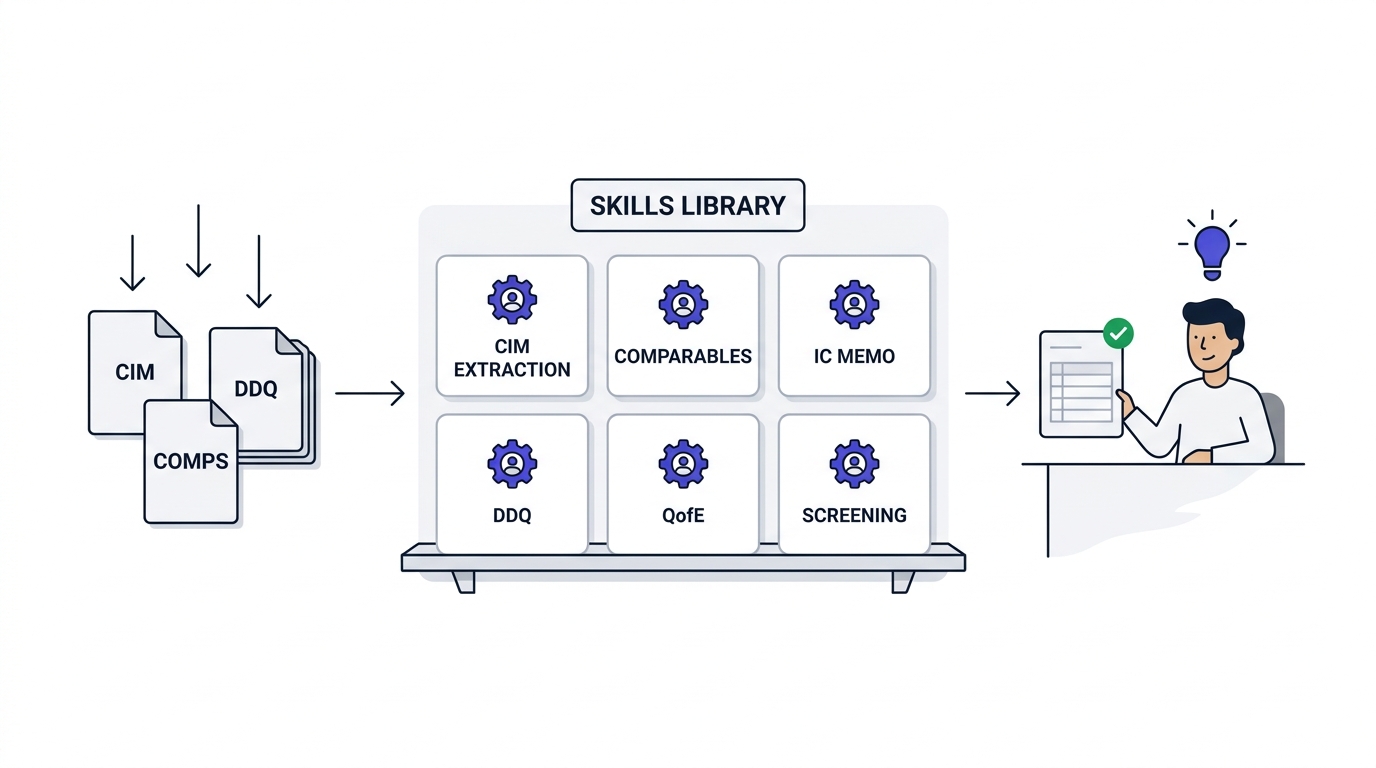
A skills library is a versioned collection of AI agents that perform an analyst's repeatable work — CIM extraction, comp builds, IC memo drafting, DDQ responses — the same way every time. It beats any single analyst on consistency, speed, and institutional memory. That is not a knock on your analysts. It frees them for the judgment, relationships, and creativity that actually drive returns.
What do private equity analysts actually spend their time on?
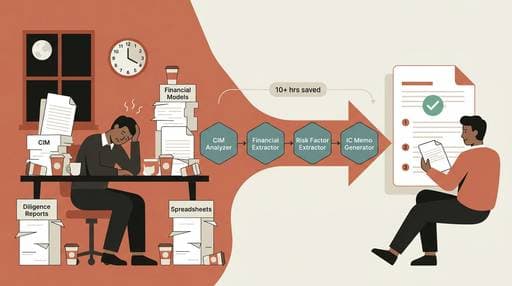
Most of a junior analyst's week is mechanical, not analytical. The headline tasks — CIMs, models, IC memos, diligence questionnaires — are real intellectual work, but the hours underneath them are dominated by extracting numbers, reconciling inconsistencies, and reformatting outputs into house style.
Claim: the analyst job is mostly data plumbing. Context: industry descriptions of the role list "data gathering tasks," document review, and "a lot of PowerPoint" as the core of the day, with modeling and judgment layered on top (Mergers & Inquisitions, 2026). Constraint: the exact mix varies — an analyst at a mega-fund does more modeling, while a flatter middle-market firm pushes analysts toward associate-level judgment sooner.
Agentman's own analysis of analyst workflows puts the split at roughly 80% data extraction and formatting versus 20% judgment. Whether the real number at your firm is 70/30 or 85/15, the shape is the same: your most expensive junior thinking time is being spent on work a machine can do identically.
How does a skills library invert the 80/20 ratio?
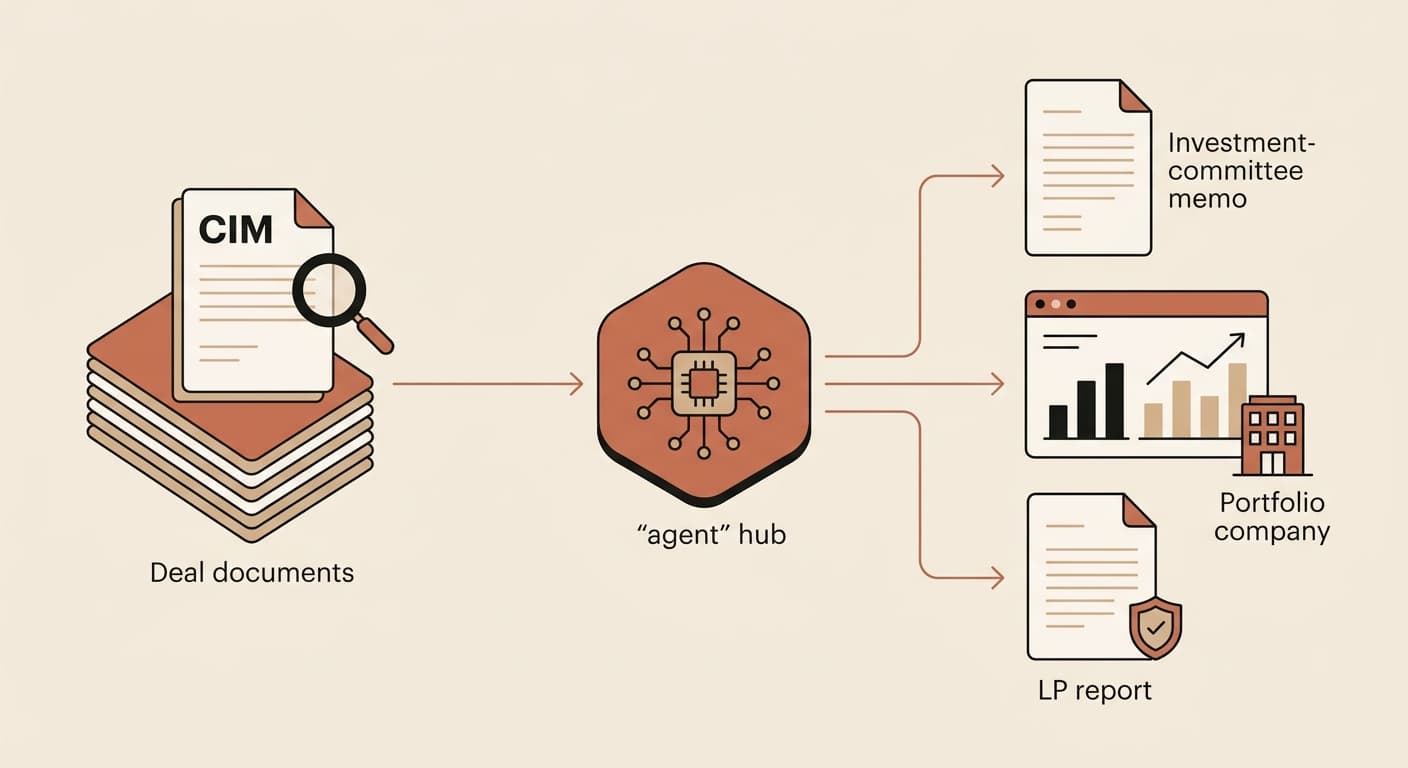
A skills library moves the 80% to agents and gives the 20% back to people. Each "skill" is a defined, reusable agent — one for CIM extraction, one for a quality-of-earnings first pass, one for DDQ drafting — that runs the same procedure on every deal and hands the analyst a structured, sourced output to judge.
This is the practical promise of agentic AI in diligence. These systems "plan, execute, and verify a sequence of actions across many documents, formats, and data sources," collapsing what used to be separate manual steps into a single auditable workflow (V7 Labs, 2026). The analyst stops assembling the inputs and starts interrogating them.
The constraint worth stating plainly: a skill is only as good as its definition. A skills library inverts the ratio only when the firm encodes its actual standards — its underwriting criteria, its memo format, its red-flag list — into the skill. Generic prompting does not do this; a governed, versioned library does.
"The firms that win the next decade won't be the ones with the most analysts. They'll be the ones who turned their analysts' best work into infrastructure — a skills library every new deal runs through, so the firm's judgment compounds instead of walking out the door."
— Prasad Thammineni, Founder & CEO, Agentman (Chain of Agents, Inc.)
Why is a skills library more consistent than any individual analyst?
A skill applies the same criteria on every deal, at any hour, regardless of workload or fatigue. There is no Monday-versus-Friday quality variance, no drift between a rested analyst and one on their third live deal of the month.
Claim: consistency is a structural advantage, not a nice-to-have. Context: agentic systems run analytical workflows "faster and more consistently" than a human performing the same steps, surfacing more inconsistencies and "fewer surprises after close" because every document gets the same treatment rather than the shallow coverage that time pressure forces (V7 Labs, 2026). Constraint: consistency is only valuable if the encoded standard is correct — a uniformly wrong skill is worse than a thoughtful human, which is why the library needs an owner and a review cadence.
For an investment committee, this changes the reliability of the inputs. When every CIM is parsed by the same skill against the same checklist, IC is comparing deals on a common basis instead of on whichever analyst happened to staff each one.
How much faster is a skills library on CIMs, IC memos, and DDQs?
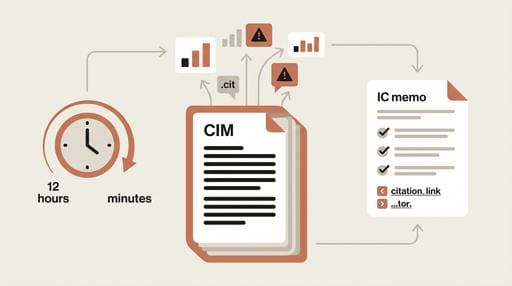
The gain shows up as hours collapsing into minutes on the repeatable artifacts. A skill does the first pass — extraction, structuring, drafting — and the analyst spends their time editing and judging rather than building from a blank page.
The table below is directional; treat the figures as illustrative until replaced with your own pilot benchmarks.
| Workflow | Typical analyst time (traditional) | With a skills library | What changes |
|---|---|---|---|
| CIM data extraction | Several hours per deal | Minutes to a reviewed draft | Skill pulls financials, KPIs, and claims into a structured, sourced template |
| Comparable company set | Half a day | Under an hour | Skill assembles and formats comps; analyst validates selection |
| IC memo first draft | A day or more | A reviewed first draft same day | Skill drafts to house format; analyst sharpens the thesis |
| DDQ / data-request responses | Hours of copy-paste | A populated draft to review | Skill maps questions to source documents and drafts answers |
Claim: speed compounds across the funnel. Context: a focused pilot on a single workflow such as CIM extraction can be live in 2–4 weeks, and the payoff is "higher-quality analysis per analyst, with more evidence checked" rather than simply faster output (V7 Labs, 2026). Constraint: the speed is real only on repeatable, document-heavy tasks — bespoke, novel analysis still belongs with a human, and should.
What happens to institutional memory when your best analyst leaves?
When an analyst leaves, the firm's learning leaves with them — and analysts leave constantly. A skills library is the opposite: it is owned infrastructure that retains every refinement, so the knowledge stays even when the people rotate.
Claim: junior turnover is a structural tax on PE knowledge. Context: by 2025, aggressive buy-side recruiting had compressed junior tenure into cycles as short as 18 months, with firms targeting banking analysts "often before training is complete" (Jensen Partners, 2025). The churn is severe enough that JPMorgan has threatened to dismiss analysts who accept future-dated offers and Goldman Sachs introduced quarterly loyalty attestations — and even Apollo's CEO has warned that rushed recruiting "creates avoidable turnover" (M&A Community, 2025). Constraint: a skills library does not stop people from leaving; it stops their encoded judgment from leaving with them.
Think of it as the difference between knowledge held in heads and knowledge held in versioned infrastructure. Every time an analyst improves how a deal gets screened, that improvement can be written back into the skill — where it outlives the analyst's tenure.
That only works if the library is genuinely shared infrastructure: skills shared across the deal team rather than files on someone's laptop, with version history so a partner can see exactly what changed in the screening criteria, who changed it, and when — and use-only access for the cases where an operating partner or co-investor should be able to run the playbook without walking away with it.
Does a skills library replace analysts — or make them more valuable?
It makes them more valuable. A skills library does not remove the analyst; it removes the data entry, and points the analyst at the work that compounds — judgment, relationships, and creative problem-solving.
Claim: the goal is leverage, not headcount reduction. Context: the explicit aim of agentic diligence is "not to replace analysts, but to free them from manual data entry so they can focus on judgment and strategy," yielding higher-quality analysis per person (V7 Labs, 2026). One analyst plus a skills library can carry the throughput that used to take three. Constraint: this only holds if the firm reinvests the freed hours into higher-value work — a firm that just cuts analysts captures a fraction of the upside and loses its future principals.
The self-improving loop is what makes this durable. Each deal is a chance to refine a skill; each refinement makes the next deal faster and sharper. The library gets smarter on a schedule, while a roster of analysts resets toward zero every two years.
How do you start building your firm's skills library?
Start narrow, prove ROI on one workflow, then expand. The firms that try to automate everything at once tend to fail; the ones that win pick a single high-volume, high-pain workflow and turn it into a skill first.
- Pick one workflow. CIM extraction or DDQ drafting are common first skills — high frequency, clearly defined, easy to measure.
- Encode your standard. Write your actual criteria and house format into the skill so the output reflects how your firm works, not a generic template.
- Run it on live deals. Measure time saved and error rate against your current baseline over a 2–4 week pilot (V7 Labs, 2026).
- Write learnings back. Make refinement part of the deal process so the library compounds.
- Expand to the next workflow. Build the second skill, then the third, into a governed library.
Agentman builds exactly this for private equity: a library of reusable agent skills tuned to deal work, plus Agent Builder to compose them into your firm's diligence and screening workflows. You own the library, you encode your standards into it, and it compounds with every deal you run through it.
Related Entities
This piece sits inside Agentman's platform: Agent Skills (the reusable, versioned skill library), Agent Builder (composing skills into firm-specific workflows), and the Chain of Agents company behind them. For private equity, the skills map directly onto the document-heavy core of the deal cycle — CIM extraction, comparable company analysis, IC memo drafting, DDQ responses, deal sourcing, and due diligence. The throughline is to encode a firm's repeatable judgment into owned infrastructure rather than rent it from a rotating bench of analysts.
Frequently Asked Questions
What is a skills library in private equity?
A skills library is a governed, versioned set of AI agents that perform a PE firm's repeatable analytical work — extracting CIM data, building comps, drafting IC memos, and answering diligence questionnaires — using the firm's own criteria. It is owned infrastructure, so the firm's standards stay consistent across deals and persist even as analysts rotate.
Will an AI skills library replace PE analysts?
No. A skills library automates the data extraction and formatting that consume most of an analyst's hours, freeing analysts for judgment, relationships, and deal strategy. The aim is leverage — one analyst plus a skills library producing the output of several — not headcount reduction. The strategic decisions remain human.
How long does it take to build a PE skills library?
A focused pilot on a single workflow, such as CIM extraction, can be live in roughly 2–4 weeks. Full integration with a mid-sized firm's existing stack — data rooms, CRM, reporting — typically takes 3–6 months. The proven path is to start narrow, prove ROI on one skill, then expand.
Key Takeaways
- Roughly 80% of junior analyst time is data extraction and formatting; a skills library inverts that, returning judgment time to people.
- A library beats individual analysts on consistency (same criteria every deal), speed (hours to minutes on repeatable artifacts), and memory (it does not leave for a competitor).
- It is self-improving: each deal refines the library, so the firm's judgment compounds instead of resetting every two-year analyst cycle.
- This augments analysts rather than replacing them — but only if you reinvest the freed hours into higher-value work.
- Start with one workflow, prove ROI in a short pilot, then expand into a governed library.
Build your firm's skills library. Pick one diligence workflow, pilot it on a live deal in weeks, and see what your analysts do with the hours you give back. Explore the private equity skills library at agentman.ai/agentskills.