

Build a brand from a blank page — the 7-step workflow you can run in Claude
Go from a blank page to a full brand book with seven skills, each feeding the next.
Turn $25–65k, 6–12-week market studies into continuous, affordable insight. Four free Agent Skills build synthetic personas, run interviews, find cohort patterns, and turn findings into roadmap actions. Learn the method and run it in Claude.
Free to try. One click loads the skill into Claude or ChatGPT, with no account and no setup.
Traditional market research is expensive and slow: a proper study runs $25–65k and 6–12 weeks, which means most teams do it rarely, late, or never. Synthetic-persona research replaces the human panel with AI personas built to simulate real customer responses — so you can test a concept, a message, or a price point this afternoon instead of next quarter.
Can you trust it? With honest limits, yes. Personas built on the three-layer architecture hit 76–85% accuracy against human panels — strong enough to narrow options, validate direction, and kill bad ideas cheaply before you commit real research budget. The right framing is supplement, not replace: synthetic research for continuous, fast, cheap iteration; human research to confirm the high-stakes calls.
The skill isn’t magic. It encodes a proven framework anyone can learn. Here’s the method itself, so you understand what it’s doing for you.
A synthetic persona is only as useful as it is realistic, and realism comes from building it in three layers. Layer 1 — identity foundation: demographics (age, income, location, occupation, household). Layer 2 — psychographics: values, motivations, anxieties, decision drivers. Layer 3 — context: the situation and constraints that shape how this person actually behaves. A persona built on all three responds like a real segment; one built on demographics alone is a caricature.
The payoff is measurable: personas built this way respond to surveys and interviews with 76–85% accuracy versus human panels — enough to test concepts, messaging, and pricing before you spend on expensive human studies. They supplement human research, they don’t replace it — but they turn research from an episodic $25–65k, 6–12-week event into a continuous, always-on feedback loop.
Use any one on its own, or chain them. Each hands its output to the next. Every one is free in the public library.
Builds AI personas from a three-layer architecture (identity, psychographics, context) that simulate real customer responses at 76–85% accuracy vs. human panels.
Runs qualitative interviews against those personas — concept, message, and pricing tests — without recruiting a single human.
Finds the statistical patterns across a cohort of personas, so you see segment-level signal, not just anecdotes.
Turns the insight into concrete roadmap and campaign actions — closing the gap between “interesting finding” and “what we do next.”
Any time you need customer signal faster or cheaper than a human study allows — especially early, when you don’t yet have customers to ask. It’s for narrowing options and validating direction before you spend on the expensive stuff.
It lets you do seed-stage market research before you have a market: build persona cohorts, run qualitative interviews against them, find the statistical patterns, and turn the insight into roadmap actions — all without recruiting a single human panel.
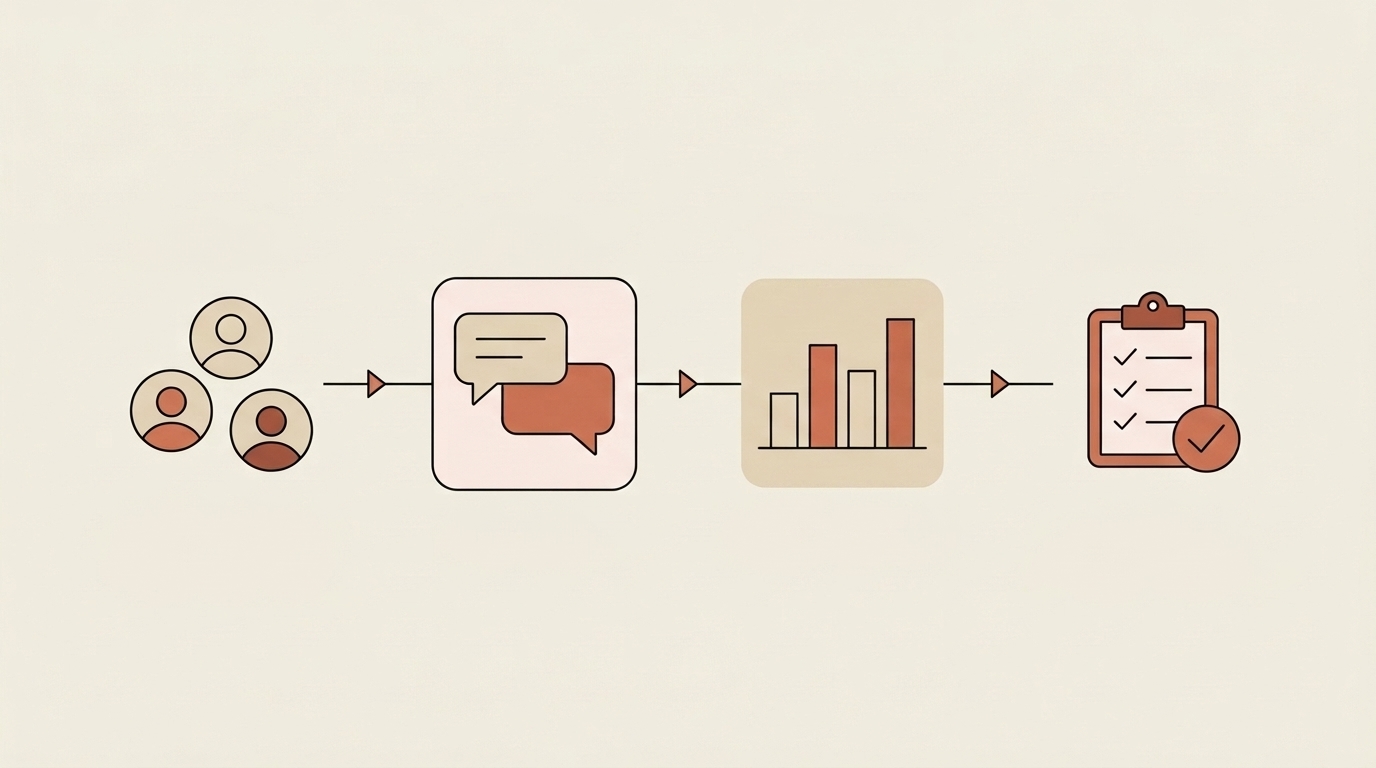
The chain runs creator (build the personas) → interview conductor (ask them) → cohort analyzer (find the patterns) → research-to-action bridge (decide what to do). It’s novel enough to earn attention on its own, and cheap enough to run continuously.
Real prompts, and what the skill hands back.
“Create a cohort of 20 personas representing small-clinic office managers, then interview them on whether they’d pay $99/mo for automated eligibility checks.”
A three-layer persona cohort plus interview responses on price sensitivity and purchase intent — signal you can act on before a human study.
“Here are the interview responses. Find the patterns by segment and tell me what to change on the roadmap.”
A cohort analysis surfacing segment-level patterns, bridged into concrete roadmap and messaging actions.
Identity, psychographics, and context — realism comes from all three, not demographics alone.
Against human panels — enough to narrow options and kill bad ideas cheaply.
Turns a $25–65k, 6–12-week study into an always-on loop you can run any afternoon.
Synthetic research for fast iteration; human research to confirm the high-stakes calls.
The chain doesn’t stop at insight — it bridges to concrete roadmap and campaign decisions.
The suite runs creator → interview conductor → cohort analyzer → research-to-action bridge — from building the personas to deciding what to do with what they tell you. Run the whole loop, or just the piece you need (e.g. the creator to seed personas for a brainstorm).
It pairs naturally with the brand workflow — real audience personas sharpen the synthetic ones, and the research feeds back into positioning.
You can build personas and run a research pass entirely in Claude:
Already connected your library to Claude? Tell it: “Use the synthetic-persona-creator skill (and the others above) from the agentman_skills MCP server.”
Not connected yet? The Try in Claude / ChatGPT button loads the first one from the public library, with no setup. Or connect your library.
Click “Try in Claude / ChatGPT” above, or — if you’ve connected your library — tell Claude: “Use the synthetic-persona-creator skill from the agentman_skills MCP server.” Add the others by slug as you go.
Run synthetic-persona-creator with your target segments. Give it real detail across all three layers — identity, psychographics, context — for realistic personas.
Run synthetic-interview-conductor to test a concept, message, or price against the cohort — the questions you’d ask a human panel.
Feed the responses to persona-cohort-analyzer for segment-level signal instead of one-off anecdotes.
Run research-to-action-bridge to turn the findings into concrete roadmap or campaign actions.
Treat it as a supplement — use synthetic research to narrow and validate, then confirm the high-stakes decisions with real users.
That’s a market-research function you’d normally outsource — now a continuous loop you run yourself.
One click loads the skill into Claude or ChatGPT. No account, no setup.
Built on the three-layer architecture, they respond at 76–85% accuracy versus human panels — strong enough to narrow options, validate direction, and kill bad ideas cheaply. The right use is to supplement human research, not replace it: synthetic for fast iteration, human to confirm high-stakes calls.
No. Run just the creator to seed personas for a brainstorm, or the interview conductor for a quick concept test. Chained, they form a full research loop from persona to roadmap action.
A traditional study runs $25–65k over 6–12 weeks. Synthetic personas run in an afternoon at a fraction of the cost, so you can research continuously instead of once a year — and save the expensive human studies for the decisions that truly need them.
No. Click “Try in Claude / ChatGPT” above and the first skill loads from our public library — no setup. Clone the skills to customize and share them.
Go from a blank page to a full brand book with seven skills, each feeding the next.