Key Facts
- Agentman's eligibility verification agent runs checks at $0.50 each, compared to the CAQH Index benchmark of $7.97 industry benchmark — a 16x more affordable starting point for a first skill (Agentman, 2026).
- The myAgentSkills.ai library contains 87+ production-ready skills across 22 categories that teams can clone and customize on day one (Agentman, 2026).
- Gartner projects that 40% of enterprise applications will include task-specific AI agents by the end of 2026 (Gartner, 2025).
- Deloitte forecasts that 50% of enterprises using generative AI will deploy autonomous AI agents by 2027, doubling from 25% in 2025 (Deloitte, 2025).
- Ten well-chosen skills create up to 45 possible two-skill connections; the value of a skill library grows combinatorially, not linearly (Agentman Skill Compounding model, 2026).
Agent skills compound because every new skill multiplies what existing skills can do together. One skill solves one pain point. Chained skills automate an entire workflow. A library of skills becomes an intelligence network where each addition makes every prior skill more valuable. Agentman's myAgentSkills.ai library gives teams 87+ production-ready skills to start compounding on day one.
Table of Contents
- What is an agent skill?
- How does one skill solve one pain point?
- How do skills chain into multi-step workflows?
- Why does each new skill make existing skills more powerful?
- How does a skill library cut development from weeks to days?
- Related entities
- Frequently asked questions
- Key takeaways
What Is an Agent Skill?
An agent skill is a packaged, reusable unit of expertise — instructions, domain knowledge, and tool access — that an AI agent loads to perform a specific business task reliably. Unlike a one-off prompt, a skill is versioned, testable, and shareable, which is what makes it a building block rather than a conversation.
The distinction matters for compounding. A prompt produces an answer once; a skill produces the same quality of work every time it runs, for anyone on the team. That repeatability is the precondition for chaining skills together, because a workflow is only as reliable as its least reliable step.
The market is converging on this model fast. Gartner projects that 40% of enterprise applications will include task-specific AI agents by the end of 2026 — and task-specific agents are, in practice, agents running well-defined skills (Gartner, 2025).
How Does One Skill Solve One Pain Point?
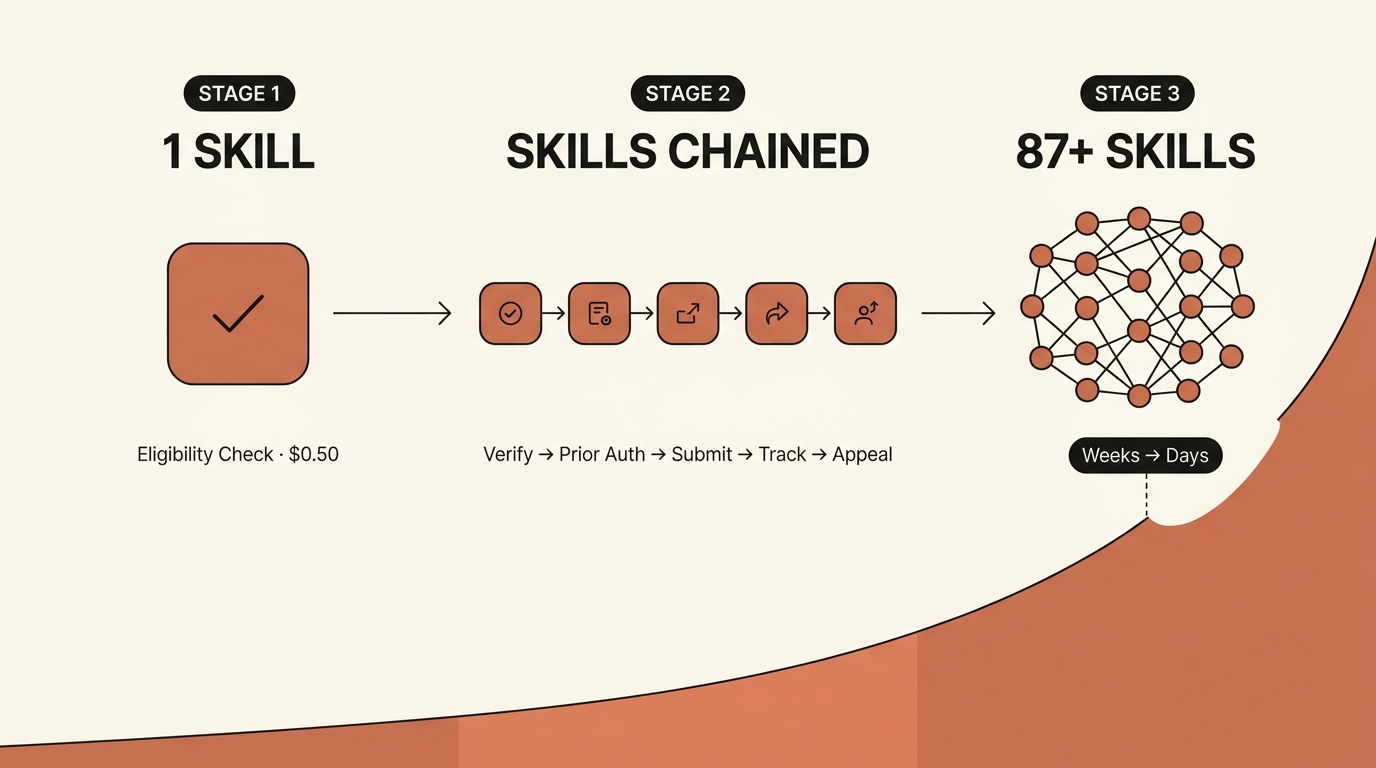
The right way to start is with one skill aimed at one measurable pain point. In healthcare, Agentman's wedge is the eligibility verification agent: it confirms a patient's insurance coverage at $0.50 per check, against the CAQH Index benchmark of $7.97 per-transaction benchmark — a 16x cost difference on a task most independent specialty medical practices run dozens of times a day (Agentman, 2026).
A single skill like this earns trust because its outcome is binary and auditable. The check either returned accurate coverage details or it didn't. Practices like Valley Diabetes & Obesity and Rosen Vein Care started exactly here — one skill, one pain point, one measurable result — before expanding into broader revenue cycle management automation.
The same pattern holds outside healthcare. A private equity analyst's first skill might be a single CIM parser that extracts financials and deal terms from an inbound confidential information memorandum. One document type, one structured output, one hour saved per deal. The constraint to respect: a first skill should be narrow enough that success is unambiguous.
How Do Skills Chain Into Multi-Step Workflows?
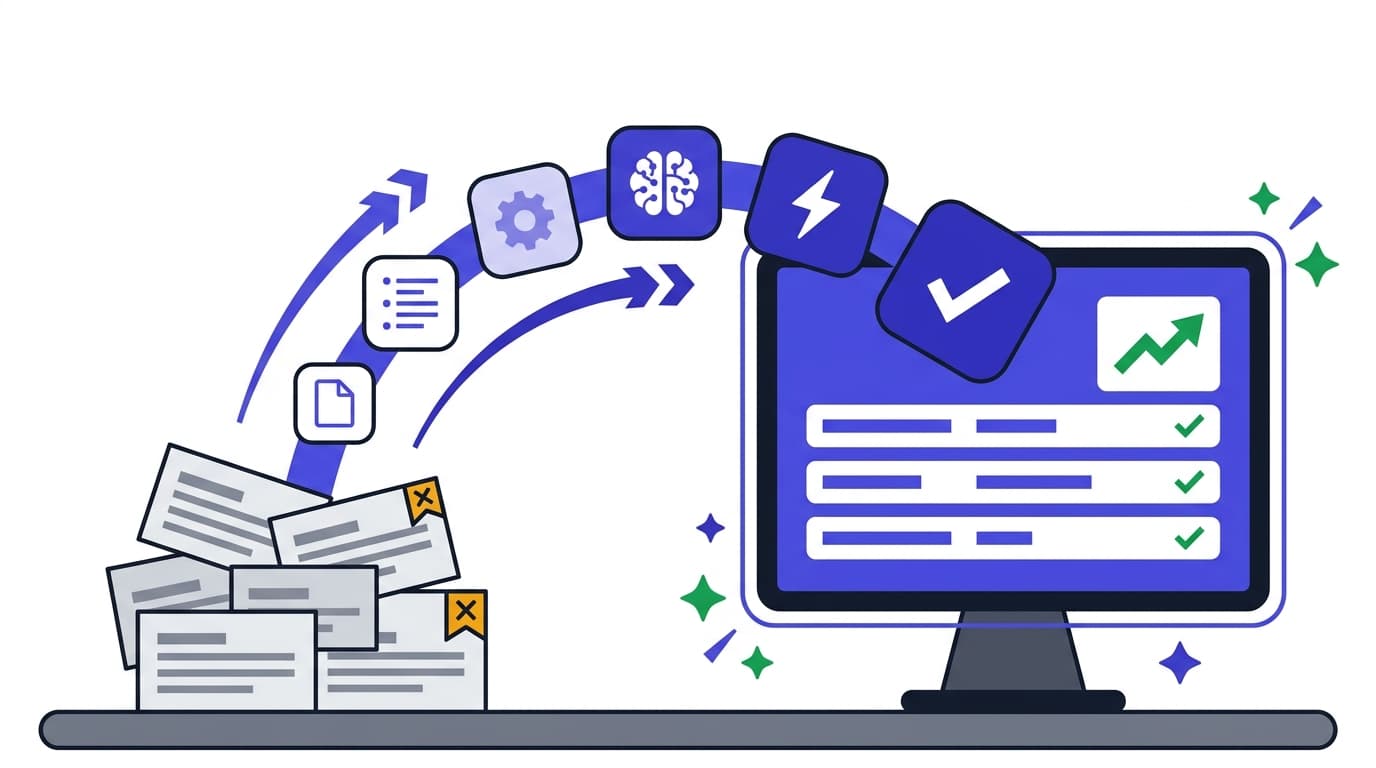
Skills chain when the output of one becomes the input of the next, turning isolated tasks into an end-to-end workflow with no human glue work in between. This is where automation value jumps from minutes saved to entire roles' worth of throughput, because the handoffs between steps — not the steps themselves — are where most back-office time disappears.
In private equity deal screening, a chained workflow looks like this:
- A CIM arrives in the deal inbox
- The parsing skill extracts financials, deal terms, and management bios
- The screening skill scores the deal against the fund's investment criteria
- The drafting skill produces a first-pass IC memo
- The alerting skill notifies the deal team with the memo and score attached
In healthcare revenue cycle management, the equivalent chain runs:
- A claim is prepared for submission
- The eligibility verification agent confirms active coverage
- The prior authorization agent checks whether the payer requires PA and initiates it
- The claim is submitted and the tracking skill monitors payer status
- If denied, the denial management agent assembles and files the appeal
Notice that both chains reuse their first skill. The CIM parser and the eligibility verification agent didn't change — they became the front door of a workflow worth ten times more than the standalone task. Deloitte expects this shift to accelerate: 50% of enterprises using generative AI will deploy autonomous agents by 2027, up from 25% in 2025, and chained workflows are the form that deployment takes (Deloitte, 2025).
Why Does Each New Skill Make Existing Skills More Powerful?
Each new skill adds connections, not just capacity — and connections are where compounding lives. With 2 skills you have 1 possible pairing. With 10 skills you have 45. With 100 skills you have 4,950 potential two-skill combinations, before counting longer chains. Agentman calls this the Skill Compounding model: library value grows with the square of library size, because every skill is a potential upstream or downstream partner for every other.
This is why the 100th skill is more valuable than the 1st, even if it is simpler. A new payer-portal skill instantly upgrades the eligibility verification agent, the prior authorization agent, and the denial management agent — three existing workflows got better without anyone touching them.
"Teams keep asking us which skill to build first, and the honest answer is that it matters less than they think. The compounding starts at skill three or four, when outputs start feeding other skills. At that point your automation stops being a collection of tools and starts behaving like institutional knowledge that executes itself."
— Prasad Thammineni, Founder & CEO at Chain of Agents (Agentman)
The constraint: compounding only happens if skills share standards — consistent data formats, shared tool access, and a common runtime. Sprawl without standards produces 100 islands, not a network. This is the problem skill platforms exist to solve, and it's why 68% of production agent deployments have adopted the Model Context Protocol or an equivalent standardized tool layer (Digital Applied enterprise survey, 2026).
There is a second constraint: compounding only happens if skills are shared. A skill locked in one person's account upgrades nothing. The library model — share a skill with the whole workspace, improve it once, and let published updates flow to every agent that uses it — is what turns individual craft into the network effect the math above describes.
How Does a Skill Library Cut Development From Weeks to Days?
A shared skill library converts custom development into assembly. The myAgentSkills.ai library holds 87+ production-ready skills across 22 categories — spanning healthcare RCM, deal workflows, content operations, and back-office tasks — each one cloneable and customizable on day one (Agentman, 2026).
The economics follow directly from compounding. Building a five-step workflow from scratch means designing, testing, and hardening five components plus four handoffs — typically weeks of work. Assembling the same workflow from library skills means customizing components that already run in production, which collapses the timeline to days. The skill you clone arrives with the connection standards already built in, so it plugs into your existing chains immediately.
The qualifier worth stating: cloned skills still need configuration for your payers, your fund criteria, or your house style. Assembly is faster than development, not instant.
Related Entities
This post sits at the intersection of Agentman's three product lines: Medman, the agentic back-office platform for independent specialty medical practices; Agent Skills, the skill library and marketplace at myAgentSkills.ai; and the underlying Agentman platform. The healthcare examples draw on revenue cycle management workflows — eligibility verification against the CAQH Index benchmark, prior authorization, and denial management — proven with design partners Valley Diabetes & Obesity and Rosen Vein Care.
Frequently Asked Questions
How many agent skills do I need before compounding starts?
Compounding typically becomes visible at three to four skills, the point where one skill's output feeds another. Before that, skills deliver standalone time savings. After that, each addition upgrades existing workflows, and a 10-skill library already supports 45 possible two-skill combinations.
What's the difference between an agent skill and a prompt?
A prompt is a one-time instruction that produces a single answer. An agent skill is a versioned, testable package of instructions, domain knowledge, and tool access that produces consistent results every run. Repeatability is what allows skills to be chained into workflows and shared across a team.
Can I use pre-built skills or do I have to build my own?
You can start with pre-built skills. The myAgentSkills.ai library offers 87+ production-ready skills to clone and customize on day one. Most teams clone a library skill, configure it for their payers, criteria, or style, and have it running in days rather than building from scratch over weeks.
Which skill should a medical practice deploy first?
Start with eligibility verification. It is high-volume, binary in outcome, and easy to measure: Agentman's eligibility verification agent runs at $0.50 per check versus the $7.97 CAQH Index benchmark. Once it's trusted, chain in prior authorization, claim tracking, and denial management.
Key Takeaways
- Start with one skill solving one measurable pain point — eligibility verification in healthcare, CIM parsing in private equity.
- Chain skills so outputs feed inputs; the handoffs, not the tasks, are where back-office time disappears.
- Value compounds combinatorially: 10 skills create 45 possible pairings, 100 skills create 4,950.
- Compounding requires shared standards — a common runtime and data formats, not 100 disconnected tools.
- A library converts development into assembly, collapsing weeks of build time into days.
Ready to start compounding? Browse 87+ production-ready skills at myAgentSkills.ai and clone your first skill today.