

Handle terminations, leaves, and investigations without the panic
Turn the hardest people-decisions into documented, defensible checklists — with four skills.
A “legal front door” routes routine contracts to self-service and risky ones to counsel first. Four free Agent Skills — intake triage, risk scoring, contract analysis, and a negotiation playbook — set it up. Learn the frameworks and run them in Claude.
Free to try. One click loads the skill into Claude or ChatGPT, with no account and no setup.
Legal teams become bottlenecks not because they’re slow, but because everything gets routed to them. An NDA on a standard template and a bespoke $500K master agreement land in the same inbox and wait the same 3–10 days. The business gets frustrated; counsel drowns in low-value review.
A legal front door is the fix borrowed from mature legal-operations teams: one intake, risk-based routing, right-sized review. It’s not about doing less legal work — it’s about pointing legal’s scarce attention at the contracts that actually carry risk, and giving the business a fast, guardrailed path for everything else. The result is faster deals and better coverage of real exposure.
The skill isn’t magic. It encodes proven frameworks anyone can learn. Here’s the method itself, so you understand what it’s doing for you.
The core idea a legal front door borrows from mature legal-ops teams: not every contract deserves the same review. A $5K SaaS subscription on standard terms is not a $500K services deal with a startup touching customer data — but most teams route both into the same queue, so high-risk contracts get under-reviewed (buried) and low-risk ones get over-reviewed (wasted counsel hours).
Triage fixes that by sorting requests by risk before they hit a lawyer: low risk self-serves with guardrails (same day), medium gets a light-touch review (1–2 days), high gets full review (3–5 days), and critical jumps the queue. The lawyer’s time flows to where it actually changes the outcome.
To score a contract objectively (instead of by gut feel), the skill rates it across seven dimensions: value (financial exposure), counterparty (who they are, how stable), data exposure (what data they touch, how sensitive), term (how long you’re locked in), contract type, jurisdiction, and the standard-vs-custom language gap. A high score routes to full legal review; a low score fast-tracks. The point isn’t a magic number — it’s a repeatable, defensible way to decide how much review a contract earns, and portfolio-level visibility into where your risk actually sits.
Use any one on its own, or chain them. Each hands its output to the next. Every one is free in the public library.
Decides what actually needs a lawyer vs. what the business can self-serve — so legal stops being the bottleneck for every request.
Scores each contract across seven risk dimensions before review, so effort matches exposure instead of arrival order.
Reviews, compares, and preps redlines on the contracts that do reach counsel — the detailed clause-level work.
Documents the firm’s positions by clause type so sales and procurement negotiate standard terms without a lawyer in every round.
Any time contract volume outpaces legal capacity — which is most growing companies. If “send it to legal” means a multi-day wait regardless of what the contract is, you have a triage problem a front door solves.
A “legal front door” is a simple operating model: every contract request enters through one clear intake, gets triaged and risk-scored, and is then routed to the right level of attention — self-service for the routine, counsel-first for the risky. Four free skills implement it end to end.
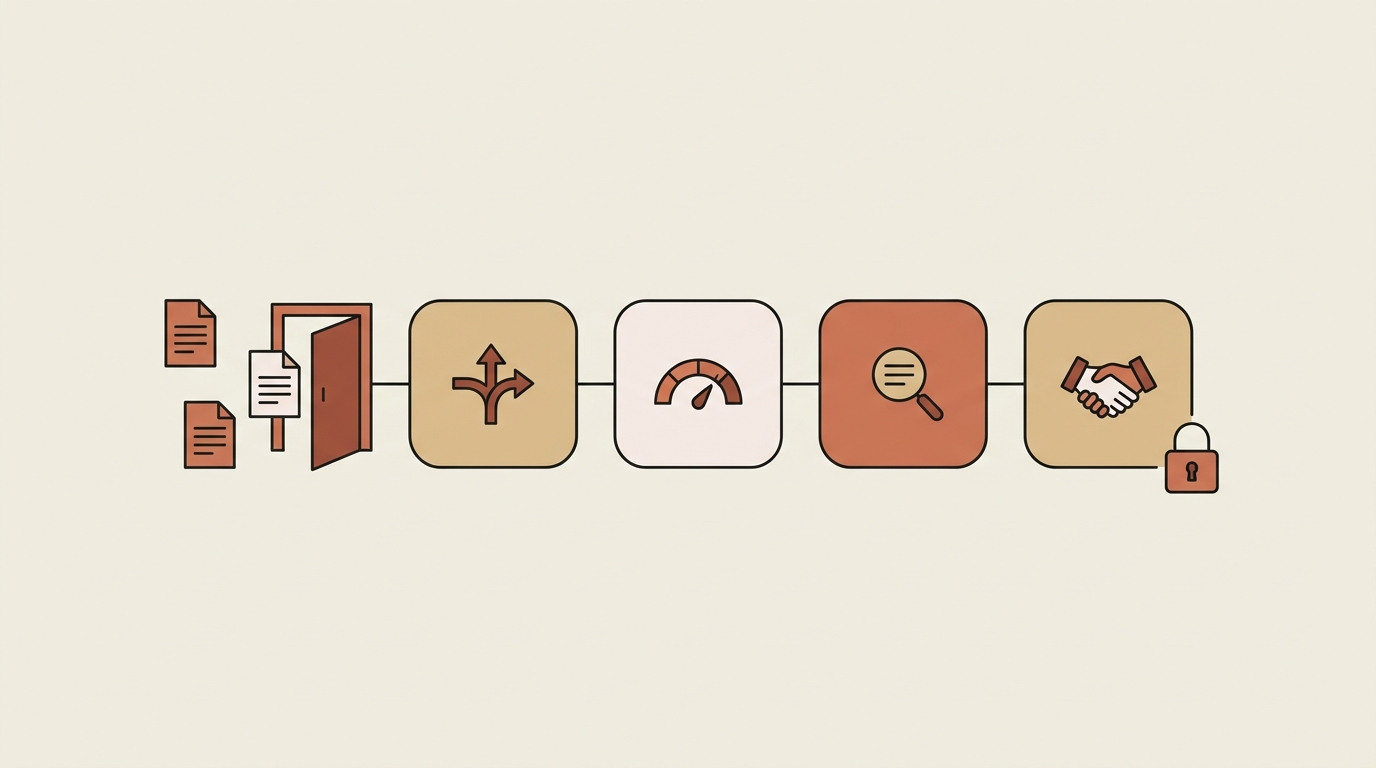
The request arrives → the triager decides if it even needs a lawyer → the risk scorer ranks what does, so the queue orders itself by exposure → the analyzer does the deep clause-level review → and the negotiation playbook lets sales and procurement hold the firm’s positions without pulling counsel into every round.
Real prompts, and what the skill hands back.
“A vendor sent a $200K services agreement — they handle our customer data. Triage it: does it need full legal review, and what’s the risk score?”
A triage decision plus a seven-dimension risk score flagging the data-exposure and value dimensions, with a recommended review depth.
“Sales is negotiating a limitation-of-liability clause. What’s our documented position, fallback, and red line?”
The firm’s clause-level positions from the negotiation playbook — preferred, fallback, and walk-away — so the rep negotiates without waiting on counsel.
Every request enters the same door, so nothing skips triage and nothing gets lost in a Slack thread.
Effort matches exposure — routine self-serves, risky reaches counsel first, not after the mistake.
The seven-dimension score replaces gut feel with a defensible, repeatable number.
The negotiation playbook turns tribal knowledge into shareable, use-only firm positions.
Every skill has fill-in-the-blank thresholds — it becomes *your* front door, not a generic one.
The skills are a pipeline: triager (in or out?) → risk scorer (how much review?) → analyzer (the deep review) → negotiation playbook (hold the line without counsel). Each hands the next a cleaner input, and you can run any one on its own the moment you need just that piece.
The governance kicker: the negotiation playbook is exactly the skill you share use-only — sales runs the firm’s positions without seeing or exporting the internal logic in Agentman. See use-only sharing.
You don’t need a legal-ops consultant to set this up. Run the four skills in Claude and customize each with your company’s thresholds:
Already connected your library to Claude? Tell it: “Use the legal-intake-triager skill (and the others above) from the agentman_skills MCP server.”
Not connected yet? The Try in Claude / ChatGPT button loads the first one from the public library, with no setup. Or connect your library.
Click “Try in Claude / ChatGPT” above, or — if you’ve connected your library — tell Claude: “Use the legal-intake-triager skill from the agentman_skills MCP server.” Add the other three by slug as you go.
Run legal-intake-triager and customize its decision tree with your approved templates and routing thresholds — what self-serves, what gets light-touch, what needs full review.
Run contract-risk-scorer and set the weights on the seven dimensions to match your company’s risk tolerance. Now every incoming contract gets an objective score.
Feed the contracts that clear the threshold to contract-analyzer for clause-level review, comparison, and redline prep.
Fill contract-negotiation-playbook with your positions by clause type, then share it with sales and procurement — ideally use-only, so they run your positions without walking off with the internal logic.
That’s a legal-ops function a firm would bill for — assembled from four free skills you keep and customize.
One click loads the skill into Claude or ChatGPT. No account, no setup.
No. Each works on its own — run the risk scorer to prioritize a backlog, or the negotiation playbook to arm your deal desk. Chained, they form a complete legal front door, but you can adopt them one at a time.
No — it points them at the work that matters. The triager and risk scorer make sure routine contracts self-serve and risky ones reach counsel *first*, before a mistake. Your lawyers do less low-value review and more high-value work.
Share it use-only. The rep’s agent applies your documented positions to the negotiation, but the internal logic is not displayed or exported. See use-only sharing in the help center.
No. Click “Try in Claude / ChatGPT” above and the first skill loads from our public library — no setup. Clone the skills into an Agentman workspace to customize the thresholds and share them with your team.
Turn the hardest people-decisions into documented, defensible checklists — with four skills.