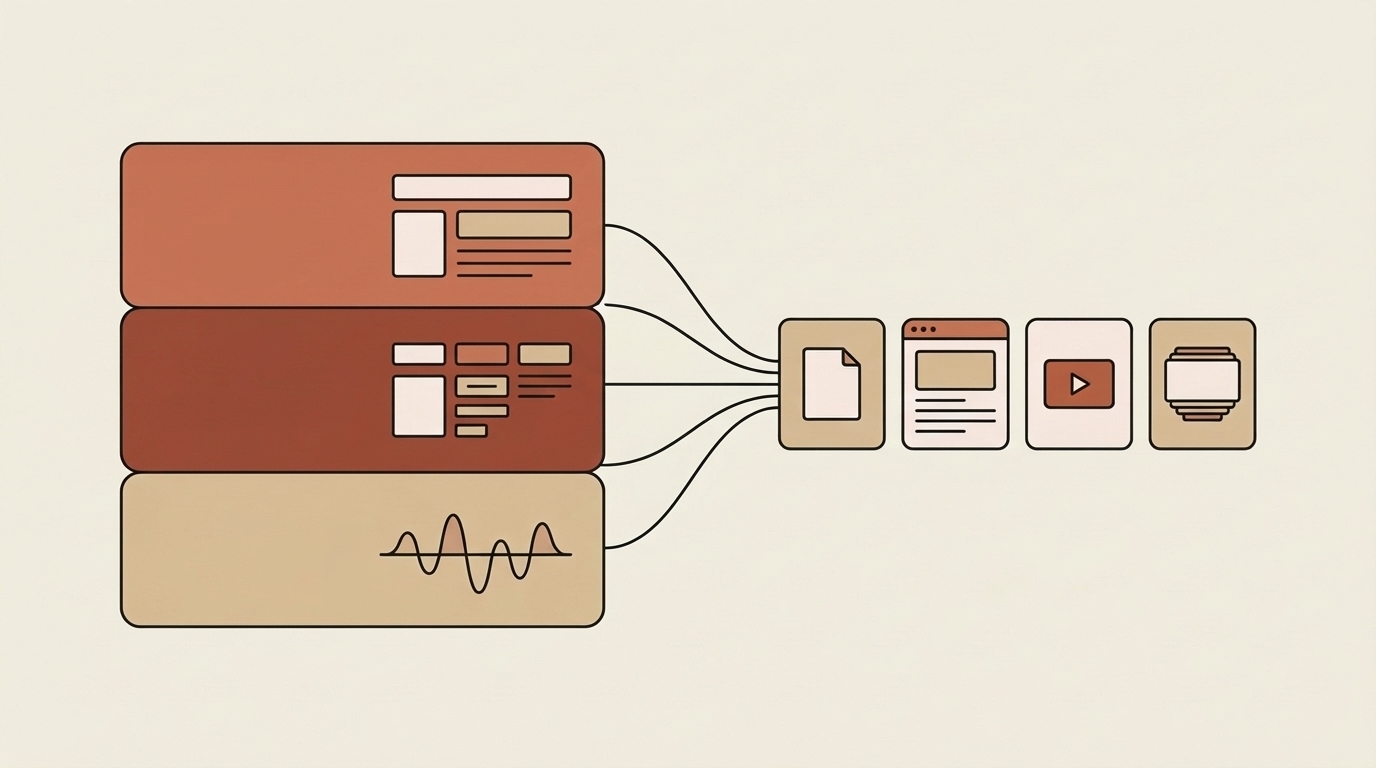

Skill stacking — a voice, content, and format layer stack that produces on-brand blogs, LinkedIn posts, video, and decks from one brand voice profile

Skill Stacking: How One Brand Voice Skill Makes Every Blog, Deck, and LinkedIn Post Sound Like You

Skill stacking is running two or three Agent Skills in the same ask — a voice skill that knows how you sound, a content skill that knows the craft, and a format skill that ships the artifact. One brand voice profile, stacked under different generators, produces on-brand blogs, LinkedIn posts, email sequences, Word docs, and decks.

Debby WangMarketing
12 min read

Key Facts

  • Skill stacking means multiple Agent Skills composing in a single ask: a voice skill supplies the rules, a content skill supplies the craft, a format skill packages the output.
  • The stack is designed into the public library, not improvised: the blog-generator skill's own description states it "requires a brand voice profile as input (from brand-voice-generator skill or user-provided)."
  • The content layer is the most-used part of the marketing catalog: blog-generator, case-study-producer, viral-social-video-creator, and email-sequence-architect are among the top skills by real usage (Agentman usage data, 2026).
  • Agentman runs its own content operation on this pattern — our internal deck-styling and on-brand image skills are two of the most-used skills in the entire library.
  • These are Agent Skills in the same open SKILL.md format you may know as Claude Skills — stacks run in Claude once your library is connected.

Every marketing team has solved half of this problem. Someone wrote brand voice guidelines — they live in a PDF nobody opens mid-draft. Someone got good at prompting for blog posts — their outputs sound nothing like the person prompting for LinkedIn. The two halves never meet, so the brand shows up differently in every channel. Skill stacking is how the halves meet: encode the voice once as a skill, then stack it under whichever content skill the task calls for. The voice never drifts, because it's not a document someone should have read — it's an input the generator actually consumes.

Table of Contents

  1. What is skill stacking?
  2. What are the three layers of a content stack?
  3. The voice layer: encode how you sound
  4. The content layer: seven generators that accept your voice
  5. The format layer: docx, decks, and PDFs that ship
  6. A worked example: one voice, five artifacts
  7. How does a team run this?
  8. How do you get these skills?
  9. Related entities
  10. Frequently asked questions
  11. Key takeaways

What Is Skill Stacking?

Skill stacking is using two or more Agent Skills together in the same ask, where one skill's output or rules become another skill's input. You don't wire anything — skills in your connected library load into the same conversation, and a well-built generator skill declares what it consumes. Ask for "a blog post on switching costs, in our brand voice" and the blog skill does the writing while the voice profile governs how it sounds.

This isn't a trick; it's the design. The blog-generator skill in the public library says it plainly in its own description: it "requires a brand voice profile as input (from brand-voice-generator skill or user-provided)." One skill is built to consume what the other is built to produce. Stacking is just using the library the way it's shaped.

The reason it matters is consistency at scale. A prompt produces one good artifact; a stack produces the same voice across every artifact, every teammate, every channel — because the voice is a versioned asset, not a habit.

What Are the Three Layers of a Content Stack?

LayerWhat it contributesSkills in the public library
VoiceHow you sound: tone, messaging hierarchy, vocabulary rulesbrand-voice-generator (Card or Playbook), or the voice guide from the 7-step brand workflow
ContentThe craft of the artifact: structure, hooks, sequence logicblog-generator, aeo-blog-generator, linkedin-post-generator, email-sequence-architect, case-study-producer, viral-social-video-creator
FormatThe package it ships indocx, pptx, and pdf skills — plus your own style skill for visual branding

Not every ask uses all three. A LinkedIn post is voice + content. A branded client-facing one-pager is voice + content + format. The layers are there when the task needs them.

There's also a planning bench that feeds the stack: seo-content-strategist (keyword clustering, content gap analysis, content briefs), competitive-intelligence-analyst (positioning analysis, battle cards), and product-launch-orchestrator (launch tiers, channel coordination, deliverables checklists). They decide what to make; the stack makes it.

The Voice Layer: Encode How You Sound

The fastest path is the Brand Voice Generator: feed it brand examples, website content, or a description, and it produces a voice profile at one of two depths — a 1–2 page Brand Voice Card for quick alignment, or a 20–40 page Brand Voice Playbook that works as a full content-creation handbook. It classifies your brand against 12 archetypes automatically and confirms the approach with you before generating.

If you've run the 7-step brand workflow, you already have something stronger: a voice guide grounded in your research, personas, and strategy. Either way, the move that makes it a layer rather than a document is the same — save the profile into a skill in your workspace (clone a generator and bake it in, or keep it as its own voice skill the way Agentman does internally), so every future ask can load it by name instead of by paste.

Already have brand guidelines from an agency? They work too — blog-generator accepts a user-provided profile. Encoding them as a skill just means nobody has to find the PDF.

The Content Layer: Seven Generators That Accept Your Voice

blog-generator — the anchor of the stack and one of the most-used marketing skills in the library. It transforms topic briefs into structured, on-brand blog content with thought-leadership positioning — and it's the skill whose description names the stack explicitly: brand voice profile in, polished post out.

aeo-blog-generator — the same job, optimized for a different reader: AI answer engines. It structures posts for extraction and citation by ChatGPT, Google AI Overviews, and Perplexity. Stack it with your voice profile when the goal is being quoted by the machines, not just ranked.

linkedin-post-generator — high-conversion LinkedIn posts built on proven thought-leadership frameworks, aimed at founders and GTM leaders. Worth knowing: the library version is wired to Agentman's own brand voice — which makes it the perfect demonstration of the pattern. Clone it, swap our voice profile for yours, and you have a LinkedIn generator that sounds like your founder instead of ours.

email-sequence-architect — multi-touch campaign design: welcome sequences, nurture flows, re-engagement, sales follow-ups, with branching logic, subject-line formulas, and A/B strategies. Stacked with your voice, every touch in a five-email sequence sounds like the same company sent it.

case-study-producer — interview frameworks, story structures, metric extraction, and multi-format output templates for customer stories. It's built for repurposing across channels — which is exactly where an unstacked workflow leaks voice. Stack it and the web version, the sales PDF, and the social cut all match.

viral-social-video-creator — short-form video scripts for TikTok, Instagram Reels, YouTube Shorts, and LinkedIn, guided by a structured multi-phase process from discovery through selection to planning. Voice matters more in video scripts than anywhere: it's your founder's mouth the words come out of.

Each of these is a system skill — already in your library, individually useful, and better stacked.

The Format Layer: Docx, Decks, and PDFs That Ship

Content doesn't always ship as a chat reply. The library's docx skill creates and edits Word documents with tracked changes and comments; the pptx skill builds presentations with layouts and speaker notes; the pdf skill generates and processes PDFs at scale. Stack them on top of a voice + content pair and "write the case study" becomes "write the case study as the client-ready Word doc" in a single ask.

The format layer is also where visual brand joins verbal brand — and here we'll show our own homework. Agentman's content operation runs on exactly this pattern: an internal deck-styling skill sits under every branded PowerPoint we produce, and an on-brand image skill sits under every diagram and cover. They're two of the most-used skills in the entire library — not because they're clever, but because they're load-bearing: every deck, every image, every doc goes through the stack. The pattern we're describing is the one we run.

It extends past documents into media. The hero images across this blog are generated by stacking our on-brand image skill on an in-house Nano Banana connector — the style skill supplies the palette, illustration rules, and composition guidance; the image model does the rendering; no designer in the loop for a routine cover. The same shape works for video: stack your style skill with a video model like Veo and the motion graphics inherit the brand the way the covers do. Any generator — text, image, or video — becomes on-brand the moment a style skill sits underneath it.

Build your own version once: a small style skill holding your colors, type, and layout rules per format. It's the visual twin of the voice card.

A Worked Example: One Voice, Five Artifacts

Say you run the Brand Voice Generator on Monday and save the Card into your workspace. The rest of the week looks like this — same voice input every time, different stack on top:

  1. Tuesday, blog: voice card + blog-generator → a thought-leadership post that sounds like your founder wrote it on a good day.
  2. Wednesday, distribution: voice card + linkedin-post-generator → three LinkedIn angles on the post; voice card + viral-social-video-creator → a short-form script for the same idea.
  3. Thursday, nurture: voice card + email-sequence-architect → a five-touch sequence for the leads the post brings in.
  4. Friday, sales enablement: voice card + case-study-producer + docx → the customer story as a client-ready Word doc; add pptx → the same story as four slides for the sales deck.

Five channels, one voice, zero "wait, is this how we say it?" Slack threads. And when the brand evolves next quarter, you update the voice card once — every stack downstream inherits the change.

How Does a Team Run This?

The stack only pays off if everyone's asks load the same voice. That's a sharing problem, not a prompting problem — and it's what the team layer is for.

Share the voice skill with your workspace so every marketer, founder, and agency contractor stacks the identical profile. Give edit access to whoever owns the brand and read or use access to everyone else. When the voice changes, version history records what changed and when — and if a freelancer or outside agency should produce on-brand content without being able to copy your messaging playbook out the door, share the voice skill use-only: they run it; they never read it.

How Do You Get These Skills?

Everything above is a system skill in the public Agent Skills library — free to run in any workspace.

  1. Find them. Register at studio.agentman.ai/register and search the library for "brand voice", "blog", or "email".
  2. Build your voice layer. Run brand-voice-generator, then save the profile into a skill in your workspace so it's loadable by name.
  3. Clone what needs customizing. Clone linkedin-post-generator and swap in your voice; clone any generator you want to bake house rules into.
  4. Connect to Claude. Connect your library and stacks trigger on natural asks — "write the launch post in our voice, as a Word doc" loads all three layers.

Skill stacking lives in Agentman's Agent Skills platform: the system skills library at agentman.ai/agentskills/library, the open SKILL.md format popularized as Claude Skills, and the team layer — workspace sharing, use-only access, cloning, and version history. The marketing context connects to brand voice, content operations, SEO and AEO content, email nurture sequences, case studies, short-form video scripts, and document formats (DOCX, PPTX, PDF). Upstream sits the 7-step brand workflow that produces the voice guide; the conceptual view is in AI Skills for Marketing.

Frequently Asked Questions

What is skill stacking?

Skill stacking is running two or more Agent Skills together in one ask so they compose: a voice skill supplies how you sound, a content skill supplies the craft of the artifact, and optionally a format skill packages it as a document, deck, or PDF. The skills load into the same conversation from your connected library — no wiring or integration work.

Do the skills automatically work together?

Well-built generators declare what they consume — blog-generator explicitly takes a brand voice profile as input — and Claude loads the relevant skills from your library based on what you ask for. The practical habit: name the layers in your ask ("in our brand voice, as a deck") until you trust the triggering, then relax.

Do I need to run the full 7-step brand workflow first?

No. The Brand Voice Generator produces a usable voice card in one sitting, and blog-generator also accepts a user-provided profile — existing agency guidelines work. The full workflow produces a deeper, strategy-grounded voice guide; graduate to it when the card starts feeling thin.

Is this the same as Claude Skills?

Yes — Agent Skills use the same open SKILL.md format popularized as Claude Skills. The stacking pattern works anywhere your library is connected; the team layer (shared voice skill, use-only access for agencies, version history) is what Agentman adds on top.

Key Takeaways

  • Skill stacking = voice skill × content skill × format skill in one ask. The layers compose because the library was designed that way — blog-generator literally requires a voice profile as input.
  • Encode your voice once (Brand Voice Card in a sitting, or the 7-step workflow's voice guide for depth), save it as a skill, and every generator downstream inherits it.
  • The content layer covers the week: blogs, AEO posts, LinkedIn, email sequences, case studies, and video scripts — all accepting the same voice input.
  • The format layer ships real artifacts: Word docs with tracked changes, decks, PDFs. Agentman's own most-used internal skills are exactly this pattern in production.
  • Share the voice skill with your workspace — or use-only with outside agencies — and on-brand stops depending on who wrote the draft.

Build your stack this week. Register at studio.agentman.ai/register, run the Brand Voice Generator, and stack the card under blog-generator for your next post. (Connect your library to Claude first — the stack triggers where you already write.)

Ready to automate your back office?

See how production-grade AI agents handle your toughest workflows.