Key Facts
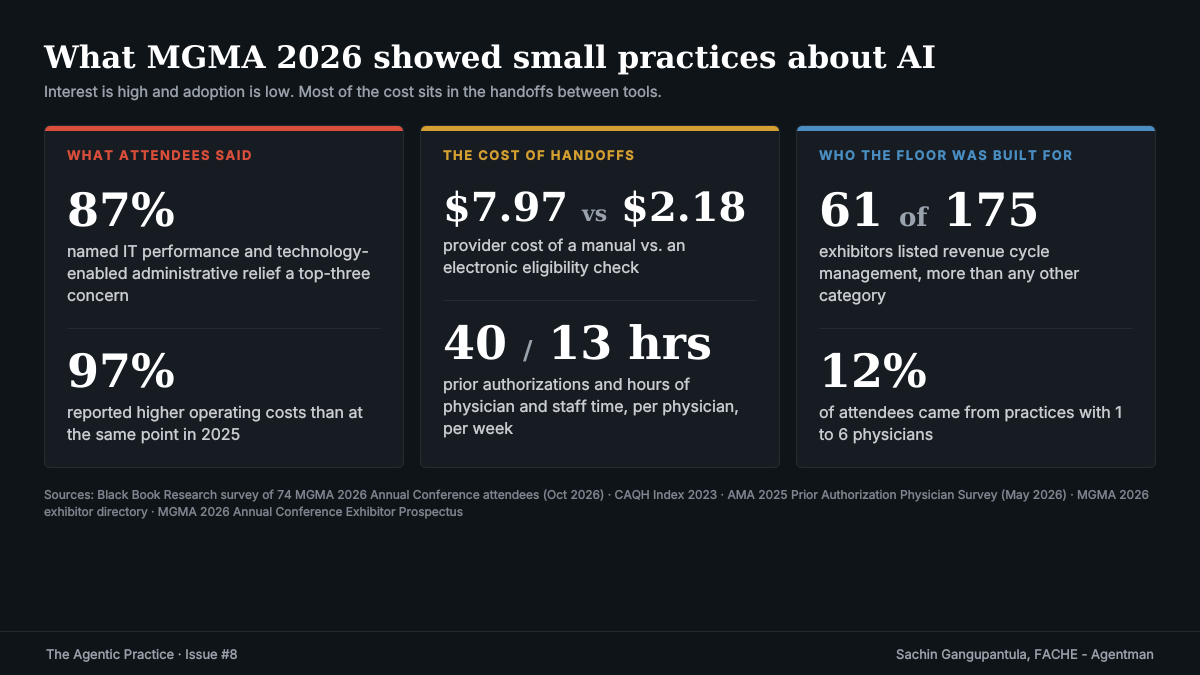
- 87% of 74 MGMA 2026 attendees surveyed put IT performance and technology-enabled administrative relief among their top three concerns, and 97% said operating costs were higher than at the same point in 2025 (Black Book Research, September 2026).
- A manual eligibility check costs a provider $7.97; an electronic one costs $2.18 (2023 CAQH Index). At 50 checks a day, the gap is about $72,000 a year.
- Physicians complete about 40 prior authorizations a week, costing 13 hours of physician and staff time (AMA, 2026).
- 142 of 171 classifiable healthcare back-office vendor websites required a demo or sales call before showing the product (Agentman research, 2026).
- Medman prices by consumption: $0.50 per eligibility check and $10 per hour of call time, with no minimums and no annual contract.
Small practices aren't buying AI because most of what's on offer moves work instead of removing it. At MGMA's 100th Annual Conference, only about 1 in 10 practice leaders we talked to had AI running in production. The tools that will win are the ones that pass work to each other, finish the whole job, and price predictably.
I was at MGMA's 100th Annual Conference in San Antonio at the end of September, along with more than 1,200 practice leaders from more than 45 states. The most useful hours were the small-practice networking sessions, where administrators from practices our size talked openly about what we were seeing in the floor demos and in the sessions.
Table of Contents
- Why are small practices hesitating to buy AI?
- Why does the front desk become the integration layer?
- Where should a practice start with AI, and what is it worth?
- What five questions should you ask any AI vendor before the demo?
- Where are the agents running today?
- What governance questions should practices ask about AI agents?
- Frequently Asked Questions
Why are small practices hesitating to buy AI?
Small practices hesitate because the AI on offer was built and priced for large health systems. Minimums run to five figures, sales cycles are long, and the success stories on stage come from groups with an IT team. Interest is high and almost nobody is buying, and that caution makes sense when the last tool you bought added work.
In one networking session, a participant described calling an AI voice vendor. The first question back was whether the practice could afford it. The quoted minimum was $70,000 a year. Others in the room described long sales cycles, with a fresh round of pricing negotiation just to extend scheduling to every provider in the practice.
The packed sessions followed the same format. A vendor brought up a client who had implemented its AI successfully. Those clients were large health systems or big group practices, with a different ROI and different operational problems than ours.
Almost every conversation ended with the same question. Would the tool take work off their staff, or move it to a different screen?
When our team compared notes afterward, only about 1 in 10 of the people we talked to had AI running in production. Most had sat through the promising demos. Very few had signed anything. Black Book's survey of 74 attendees found 87% put technology-enabled administrative relief among their top three concerns, and 97% said operating costs were higher than a year earlier.
Why does the front desk become the integration layer?
When eligibility comes from one vendor and prior auth from another, a person carries the result between them. Each vendor can show you the task its tool took over. None of them counts the minutes your staff now spends moving that result to the next system.
Most booths pitched a platform. Up close, the demos I saw walked through one workflow at a time, and none showed how it would connect to the eligibility tool or phone system a practice already runs.
I've run eligibility from one vendor and prior auth from another. The front desk ends up as the integration layer between them. You get two contracts, two support lines, and a coordinator copying a member ID from one screen into the other.
The EHR vendors on the floor offered their own add-ons. That helps when every workflow lives inside the EHR. At our practice, payer portals, faxes and IPA plans sit outside it.
Demos also leave out the payer. For us, the same continuous glucose monitor goes by fax for one payer, through a third-party portal for another, and through the payer's own portal for a third. Checking eligibility for a test patient is easy. Checking it for a Medicaid managed care member whose PCP assignment changed last week is the real job, and that's where most tools break.
"Each vendor can show you the task its tool took over. None of them counts the minutes your staff now spends carrying the result to the next system."
— Sachin Gangupantula, FACHE, MBA, CDH-E, VP of Practice Operations at Valley Diabetes & Obesity
The administrators I talked to wanted tools that pass work to each other and finish the whole job. Several said it almost word for word.
Where should a practice start with AI, and what is it worth?
Start with revenue cycle. Eligibility errors and denials cost a small practice the most money for the least clinical reason, and the savings are measurable in dollars per transaction. But the savings only show up if the result flows to the next step without a person re-keying it.
MGMA's senior vice president of IT, Julia Rosen, told Medical Economics at the conference that she would "always advise starting with revenue cycle." On the floor, 61 of the 175 exhibitors listed revenue cycle management as a category, more than any other.
| Workflow | The number | What it means for a small practice |
|---|---|---|
| Eligibility check | $7.97 manual vs. $2.18 electronic (2023 CAQH Index) | At 50 checks a day, about $290 a day, or roughly $72,000 a year across 250 working days |
| Prior authorization | 40 requests and 13 hours per physician per week (AMA, 2026) | For a 3-physician practice, about 120 requests and 39 hours a week, close to one full-time employee |
| Vendor evaluation | 142 of 171 vendor sites required a demo or sales call (Agentman, 2026) | You often can't see how a tool handles the handoff until you're already in a sales cycle |
| Who's in the room | 12% of MGMA attendees came from practices with 1 to 6 physicians | About one attendee in eight runs a practice your size |
The eligibility savings only show up if the electronic check feeds the schedule. If a person still has to re-key the result, the savings disappear.
Prior auth is the workflow with the most handoffs: the order, the eligibility check, the payer's rules, the submission, the follow-up. Every handoff between two tools can put a person back in the loop.
What five questions should you ask any AI vendor before the demo?
Ask what work disappears, who handles the misses, what gets handed to the next step, what it costs each month, and who answers when it goes wrong. These five questions separate tools that remove work from tools that move it.
Here's the filter I use at our own practice, written down so you can use it too.
- Which task does my staff stop doing on day one? Ask them to name it in words your front desk would use.
- Who works the exceptions, and where do they show up? Every tool misses something. You want to know whether the misses land in a queue someone owns or in a pile nobody watches.
- What does your tool hand to the next step, and in what form? This is the integration question. If the answer is "your staff exports it," the work has moved.
- What does it cost per month? Small and mid-sized practices need a predictable expense so we can model the ROI before we sign. A five-figure annual minimum fails that test for most of us, and it means paying for capacity we may never use. At Agentman we price by consumption: $0.50 per eligibility check and $10 per hour of call time, with no minimums and no annual contract. That stays predictable because the volume is predictable. You know how many patients are on next week's schedule and roughly how many calls come in after hours.
- Who picks up the phone when it gets something wrong? Ask how fast, and ask to talk to a practice your size that has called.
Where are the agents running today?
At Valley Diabetes & Obesity, the inbox triage and eligibility verification agents now hand work to each other, the after-hours voice agent is deploying, and the prior authorization agent is being built to take the last step. The week after MGMA, the eligibility verification agent went live at two more practices on different EHRs.
I've run operations at an independent primary care and diabetes practice in Modesto for ten years. The eligibility and inbox agent deployment results are in Issue #2 and Issue #6. What's new is how the agents hand work to each other.
When a prior auth request arrives by fax, the inbox triage agent flags it and tags the payer and drug. The eligibility verification agent has already confirmed which company handles the authorization for that plan. Our human prior auth coordinator works across roughly thirty payers and six different submission channels, and she still opens six browser tabs to finish each request. The prior authorization agent is being built to take that last step, so the handoff never lands back on her desk.
The after-hours voice agent is deploying now. It answers calls between 6 p.m. and 9 a.m. that used to sit in voicemail until morning. It will forward the critical calls to the on-call physician. I'll share numbers once we have them.
The week after MGMA, we went live at two more practices: a psychiatry group on DrChrono and a vascular surgery practice on Tebra. Neither looks like Valley Diabetes & Obesity, and neither runs our EHR.
The psychiatry practice sees 120 to 150 patients a day. Before each visit, the eligibility verification agent:
- Flags whether the patient's plan carves out behavioral health to a separate company
- Pulls the copay for that day's type of visit
- Gives the front desk the deductible and coinsurance to collect
Staff no longer work through portals and payer phone calls while a patient waits at check-in. That prevents denials later and gives the practice an accurate picture of the cash it should collect. Their front desk now starts each day confident that every patient on the schedule can be seen, and the effort to get there has dropped by 60%. What they told us mattered most was that it's easy to use and that the numbers are right.
What governance questions should practices ask about AI agents?
Four questions came up in nearly every serious conversation at MGMA, and practices should add them to the five above. Who is liable when an agent makes a call? What does the vendor's business associate agreement cover? Where does patient data go during inference? How do you defend an agent's decision when a payer or auditor asks?
Governance gets its own issue next. HHS does not recognize any HIPAA compliance certification, and an AI vendor whose agent touches patient data is a business associate with direct legal liability. Until then, our guide to HIPAA-compliant AI agents, BAAs, and audit trails covers the basics.
Related Entities
This issue sits inside Agentman's work on agentic front and back office automation for independent specialty medical practices, delivered under the product name Medman. The eligibility verification agent ($0.50 per check against the $7.97 CAQH Index benchmark for a manual verification) hands work to the inbox triage agent and the prior authorization agent, and the after-hours voice agent extends the same chain to the phone. The work spans revenue cycle management across specialties including diabetes and obesity, psychiatry, and vascular surgery, with Valley Diabetes & Obesity as the founding design partner.
Frequently Asked Questions
Why aren't small medical practices adopting AI?
Most AI tools are priced and designed for large health systems, with five-figure annual minimums, long sales cycles, and integration work that assumes an IT team. Small practices also worry that a new tool will move work to a different screen instead of removing it. At MGMA 2026, only about 1 in 10 practice leaders we talked to had AI in production.
How much does a manual eligibility check cost a practice?
The 2023 CAQH Index puts the provider cost of a manual eligibility and benefit verification at $7.97, compared with $2.18 for a fully electronic one. For a practice running 50 checks a day, that gap is about $290 a day, or roughly $72,000 a year across 250 working days, if the electronic result feeds the schedule without re-keying.
Where should a medical practice start with AI?
Start with revenue cycle. MGMA's senior vice president of IT advised practices at the 2026 Annual Conference to begin there, because eligibility errors and denials cost small practices the most money for the least clinical reason, and the savings are measurable per transaction.
What should a practice ask an AI vendor before a demo?
Ask which task staff stop doing on day one, who works the exceptions, what the tool hands to the next step, what it costs per month, and who answers when it gets something wrong. Add four governance questions: liability, BAA coverage, where patient data goes during inference, and how an agent's decision is defended in an audit.
Why do AI tools add work for front desk staff?
When eligibility, prior authorization, and phone tools come from different vendors, staff carry each result from one system to the next. Each tool removes its own task but adds a handoff, such as re-keying a member ID. The savings only appear when one tool's output feeds the next step directly.
What to do next
- Bring the five questions to your next demo. If the answer to "what do you hand to the next step" is "your staff exports it," the work has moved.
- Count your handoffs. Mark every place a person carries a result from one tool to another. That's where the savings are leaking.
- Add the four governance questions before you sign anything that touches patient data.
If you were at MGMA, I'd like a number from you. How many AI tools did you see running in production at a practice your size?
If you run an independent specialty practice and want to see how the Medman agents hand work to each other, talk to us.
Sources
- Black Book Research. "MGMA Attendees Signal Intensifying Financial, Coverage and Technology Pressures for Medical Practices Entering 2027," September 2026. https://www.newswire.com/news/mgma-attendees-signal-intensifying-financial-coverage-and-technology-pressures
- Medical Economics. "Start with revenue cycle: MGMA's IT chief on where practices should begin with AI," October 2026. https://www.medicaleconomics.com/view/start-with-revenue-cycle-mgma-s-it-chief-on-where-practices-should-begin-with-ai
- CAQH. 2023 CAQH Index, average provider cost per eligibility and benefit verification by mode.
- American Medical Association. "AMA survey: Prior authorization reform pledge falls short with physicians," 2026. https://www.ama-assn.org/press-center/ama-press-releases/ama-survey-prior-authorization-reform-pledge-falls-short-physicians
- Agentman. "We Checked 338 Healthcare Vendors. Most Won't Let You Try It," 2026. https://agentman.ai/blog/healthcare-software-demo-gate-research
Sachin Gangupantula, FACHE, MBA, CDH-E — VP of Practice Operations, Valley Diabetes & Obesity; VP, Agentic Healthcare, Agentman
The Agentic Practice publishes when the practice lets me write it.