

Run customer interviews before you have customers
Build persona cohorts, run interviews, find patterns, turn insight into roadmap actions.
Interviews and surveys are only worth the insights you pull from them. A free Agent Skill turns scattered user feedback into structured, prioritized, evidence-backed insights — affinity mapping, pattern statements, and recommendations. Learn the method and run it in Claude.
Free to try. One click loads the skill into Claude or ChatGPT, with no account and no setup.
Teams invest real effort collecting research — interviews, surveys, usability sessions — and then it dies in a doc. The reason is almost always synthesis: pulling signal from a pile of qualitative data is hard, slow, and easy to do badly, so it gets skipped or done from memory. The result is “insights” that are really just the loudest anecdote, and product decisions made on vibes.
Good synthesis is a method, not a talent: extract observations, group them into themes by frequency, find the root-cause patterns, and turn those into prioritized, evidence-backed insights. Done this way, research stops being a cost center and becomes the thing that de-risks your roadmap — because you can point to exactly which users said what, how often, and why it matters.
The skill isn’t magic. It encodes a proven framework anyone can learn. Here’s the method itself, so you understand what it’s doing for you.
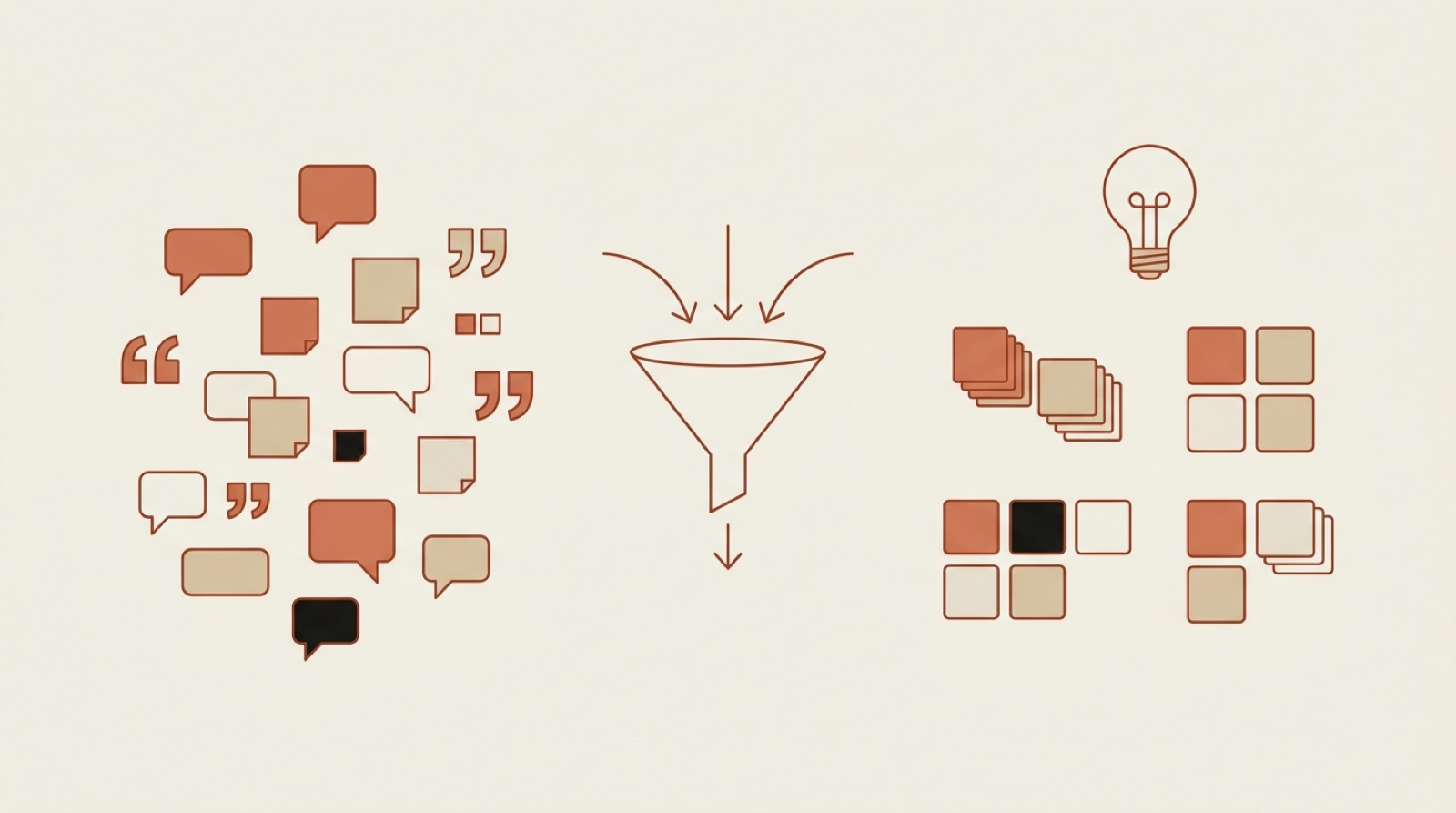
The gap between doing research and using it is synthesis — and most teams do it ad hoc, so insights are inconsistent and hard to defend. This skill encodes a repeatable pipeline: raw data → observations → patterns → insights → recommendations. You start by extracting verbatim observations (quotes, behaviors, pain points), then affinity-map them into themes with frequency counts, so you can see what’s signal (5 of 10 users) versus a one-off.
From themes it builds pattern statements in a fixed shape — “[WHO] experiences [WHAT problem] when [CONTEXT] because [ROOT CAUSE]” — which forces you past symptoms to causes. Those become insights carrying their own evidence: an actionable finding, the supporting data points, a confidence level, and the impact if solved. The result is research that survives scrutiny in a product review, because every insight traces back to the quotes underneath it.
Any time you have research to make sense of — after a round of interviews, a survey, or a pile of feedback you’ve been meaning to “get to.” Especially when you need to defend a product decision with evidence rather than opinion.
It transforms scattered user feedback — interview notes, survey responses, support tickets — into structured insights that actually drive product decisions. Instead of a folder of transcripts nobody re-reads, you get themes with frequencies, root-cause pattern statements, and prioritized insights that each carry their evidence and confidence.
It’s the single most-used skill in the public library (76 uses and counting) — because turning research into decisions is a job every product team has and few do systematically.
Real prompts, and what the skill hands back.
“Here are 10 user interview transcripts. Synthesize them: affinity-map the themes, find the patterns, and give me prioritized insights with evidence.”
Themes with frequency counts, root-cause pattern statements, and a prioritized set of insights — each with supporting quotes, a confidence level, and the impact if solved.
“We keep hearing complaints about reporting. Pull the pattern and tell me the root cause and how confident we should be.”
A pattern statement (who / what / when / why) with the supporting evidence and a confidence rating grounded in how consistently it showed up across sources.
It starts from real quotes and behaviors tagged by source, not summaries — so insights trace back to evidence.
Observations group into themes with frequency counts, separating signal from the one-off anecdote.
Fixed-shape pattern statements (who / what / when / why) force past symptoms to causes.
Each insight carries its data points, a confidence level, and the impact if solved.
Every finding traces to the quotes underneath it, so it survives scrutiny.
It’s the synthesis engine at the center of a research practice. Pair it with synthetic-persona research to synthesize simulated interviews before you have users, or run it straight on real interview data to turn a discovery round into roadmap decisions.
The insights it produces feed directly into personas, PRDs, and positioning — it’s the step that turns listening into deciding.
Feed it your raw research and let it run the synthesis pipeline:
Already connected your library to Claude? Tell it: “Use the user-research-synthesizer skill from the agentman_skills MCP server.”
Not connected yet? The Try in Claude / ChatGPT button loads it from the public library, with no setup. Or connect your library.
Click “Try in Claude / ChatGPT” above, or — if you’ve connected your library — tell Claude: “Use the user-research-synthesizer skill from the agentman_skills MCP server.”
Paste your interview notes, transcripts, survey responses, or feedback. It extracts verbatim observations — quotes, behaviors, pain points — tagged by source.
It groups the observations into themes with frequency counts, so you see what’s a real pattern (5 of 10 users) versus a one-off.
It writes pattern statements — who experiences what when context because root cause — pushing past symptoms to causes you can design against.
Each insight comes with its evidence, a confidence level, and the impact if solved — so you can rank what to act on and defend it in a review.
That’s a research analyst’s synthesis pass — from a free skill you run on every round.
One click loads the skill into Claude or ChatGPT. No account, no setup.
It’s the method of turning raw research into decisions: extract verbatim observations, affinity-map them into themes by frequency, write root-cause pattern statements, and produce prioritized insights that each carry their evidence and confidence. It’s the step between collecting research and acting on it.
Interview notes or transcripts, survey responses, support tickets, sales-call notes — any qualitative feedback. The more verbatim the input, the stronger the synthesis, because insights trace back to real quotes.
A summary flattens everything to the same weight. Synthesis separates signal from anecdote with frequency counts, finds root causes with pattern statements, and attaches confidence and impact to each insight — so you can prioritize and defend decisions, not just recap what people said.
No. Click “Try in Claude / ChatGPT” above and the skill loads from our public library — no setup. Clone it into an Agentman workspace to customize and share it.
Build persona cohorts, run interviews, find patterns, turn insight into roadmap actions.
Go from a blank page to a full brand book with seven skills, each feeding the next.